Abstract
This report details the use of various strain gauges for different applications. Firstly, a single
strain gauge is used to measure strain on a cantilever beam at five different loads. Deflection at
these load
...
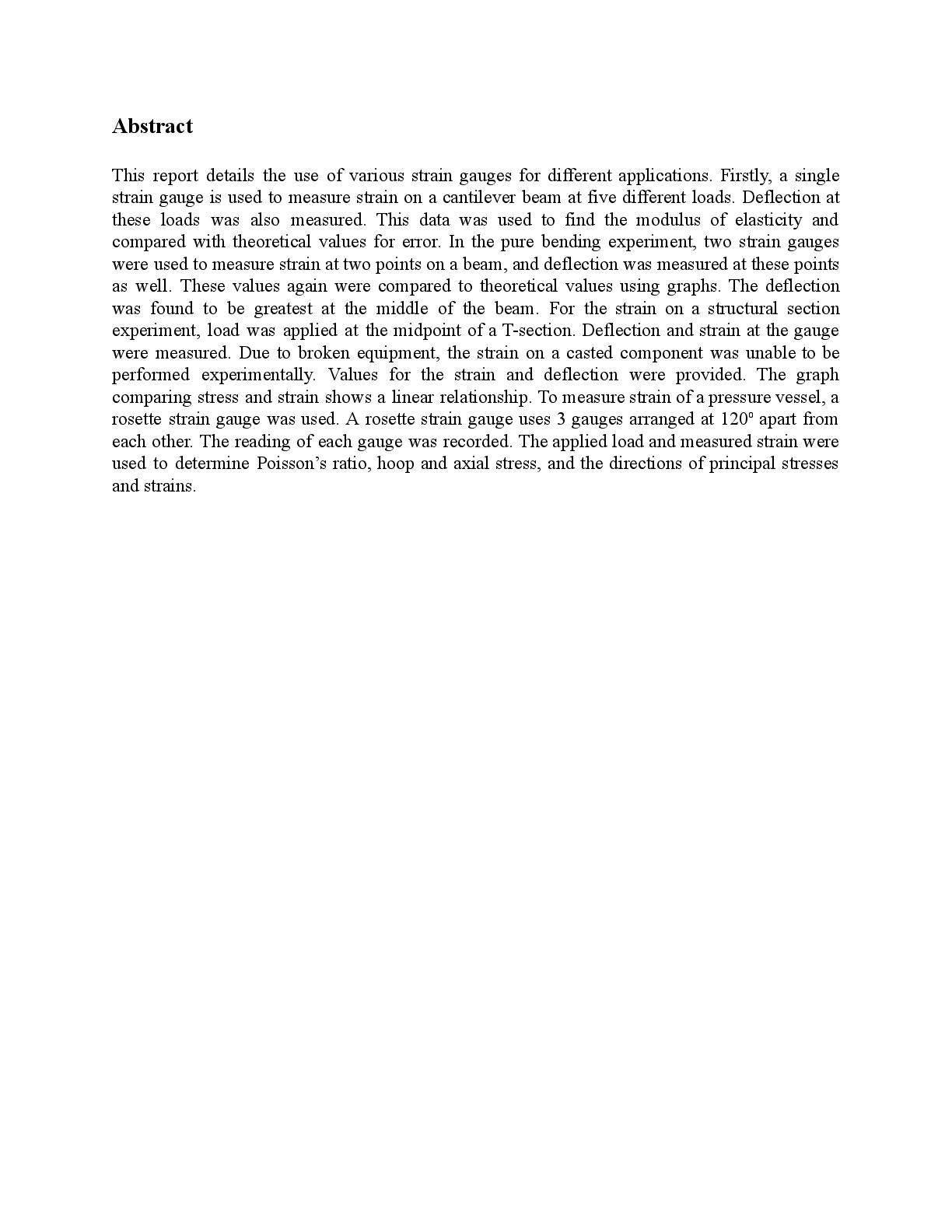
Abstract
This report details the use of various strain gauges for different applications. Firstly, a single
strain gauge is used to measure strain on a cantilever beam at five different loads. Deflection at
these loads was also measured. This data was used to find the modulus of elasticity and
compared with theoretical values for error. In the pure bending experiment, two strain gauges
were used to measure strain at two points on a beam, and deflection was measured at these points
as well. These values again were compared to theoretical values using graphs. The deflection
was found to be greatest at the middle of the beam. For the strain on a structural section
experiment, load was applied at the midpoint of a T-section. Deflection and strain at the gauge
were measured. Due to broken equipment, the strain on a casted component was unable to be
performed experimentally. Values for the strain and deflection were provided. The graph
comparing stress and strain shows a linear relationship. To measure strain of a pressure vessel, a
rosette strain gauge was used. A rosette strain gauge uses 3 gauges arranged at 120o apart from
each other. The reading of each gauge was recorded. The applied load and measured strain were
used to determine Poisson’s ratio, hoop and axial stress, and the directions of principal stresses
and strains.Table of Contents
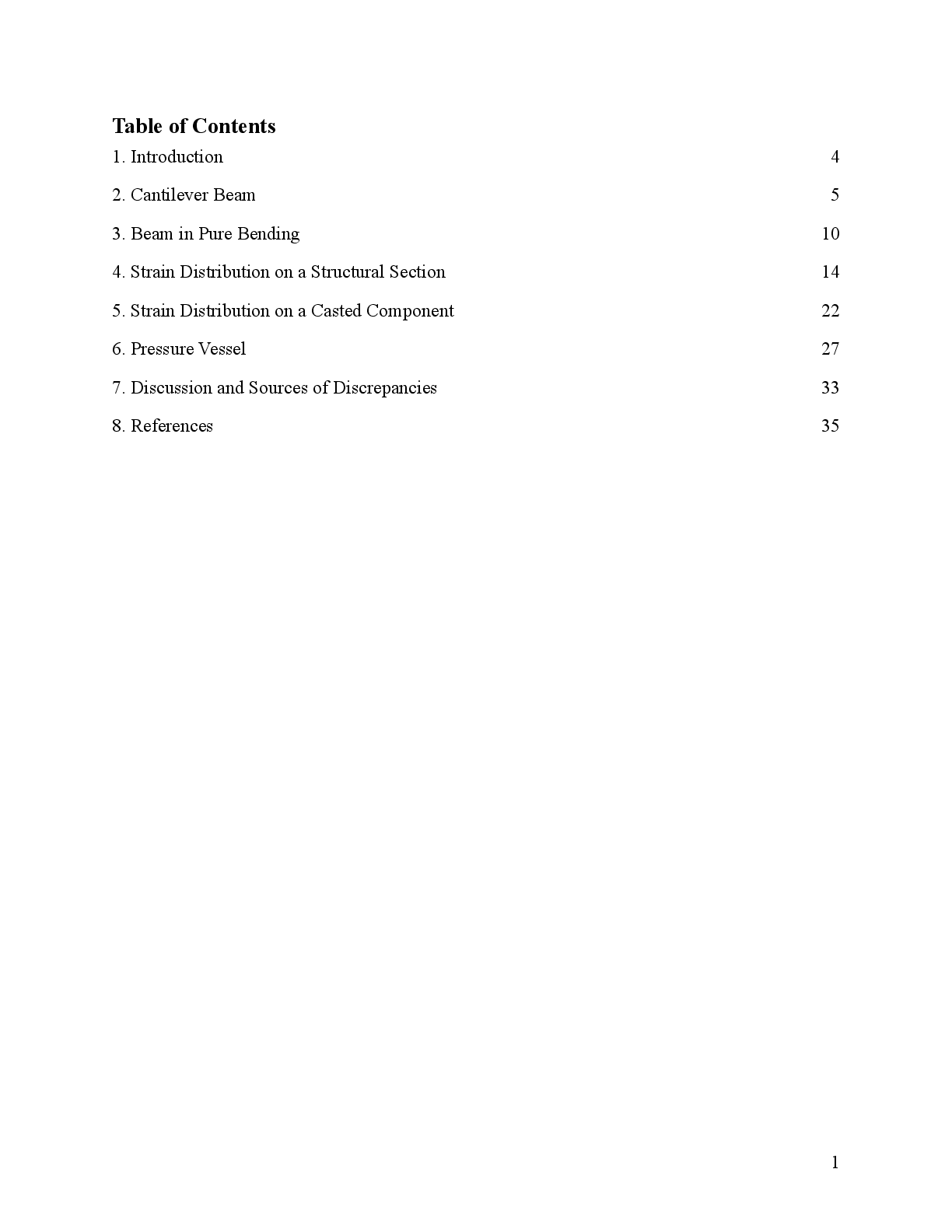
1. Introduction 4
2. Cantilever Beam 5
3. Beam in Pure Bending 10
4. Strain Distribution on a Structural Section 14
5. Strain Distribution on a Casted Component 22
6. Pressure Vessel 27
7. Discussion and Sources of Discrepancies 33
8. References 35
1List of Tables
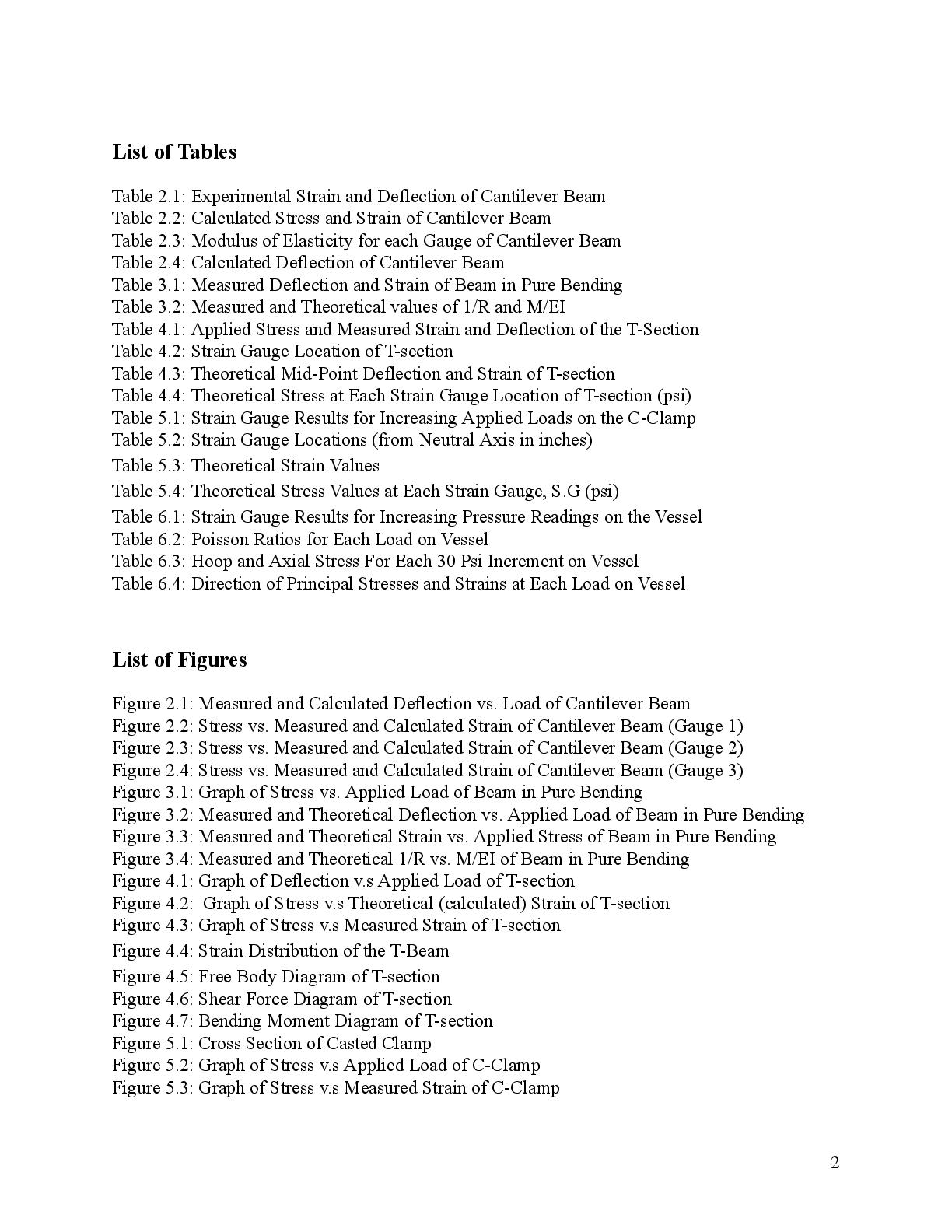
Table 2.1: Experimental Strain and Deflection of Cantilever Beam
Table 2.2: Calculated Stress and Strain of Cantilever Beam
Table 2.3: Modulus of Elasticity for each Gauge of Cantilever Beam
Table 2.4: Calculated Deflection of Cantilever Beam
Table 3.1: Measured Deflection and Strain of Beam in Pure Bending
Table 3.2: Measured and Theoretical values of 1/R and M/EI
Table 4.1: Applied Stress and Measured Strain and Deflection of the T-Section
Table 4.2: Strain Gauge Location of T-section
Table 4.3: Theoretical Mid-Point Deflection and Strain of T-section
Table 4.4: Theoretical Stress at Each Strain Gauge Location of T-section (psi)
Table 5.1: Strain Gauge Results for Increasing Applied Loads on the C-Clamp
Table 5.2: Strain Gauge Locations (from Neutral Axis in inches)
Table 5.3: Theoretical Strain Values
Table 5.4: Theoretical Stress Values at Each Strain Gauge, S.G (psi)
Table 6.1: Strain Gauge Results for Increasing Pressure Readings on the Vessel
Table 6.2: Poisson Ratios for Each Load on Vessel
Table 6.3: Hoop and Axial Stress For Each 30 Psi Increment on Vessel
Table 6.4: Direction of Principal Stresses and Strains at Each Load on Vessel
List of Figures
Figure 2.1: Measured and Calculated Deflection vs. Load of Cantilever Beam
Figure 2.2: Stress vs. Measured and Calculated Strain of Cantilever Beam (Gauge 1)
Figure 2.3: Stress vs. Measured and Calculated Strain of Cantilever Beam (Gauge 2)
Figure 2.4: Stress vs. Measured and Calculated Strain of Cantilever Beam (Gauge 3)
Figure 3.1: Graph of Stress vs. Applied Load of Beam in Pure Bending
Figure 3.2: Measured and Theoretical Deflection vs. Applied Load of Beam in Pure Bending
Figure 3.3: Measured and Theoretical Strain vs. Applied Stress of Beam in Pure Bending
Figure 3.4: Measured and Theoretical 1/R vs. M/EI of Beam in Pure Bending
Figure 4.1: Graph of Deflection v.s Applied Load of T-section
Figure 4.2: Graph of Stress v.s Theoretical (calculated) Strain of T-section
Figure 4.3: Graph of Stress v.s Measured Strain of T-section
Figure 4.4: Strain Distribution of the T-Beam
Figure 4.5: Free Body Diagram of T-section
Figure 4.6: Shear Force Diagram of T-section
Figure 4.7: Bending Moment Diagram of T-section
Figure 5.1: Cross Section of Casted Clamp
Figure 5.2: Graph of Stress v.s Applied Load of C-Clamp
Figure 5.3: Graph of Stress v.s Measured Strain of C-Clamp
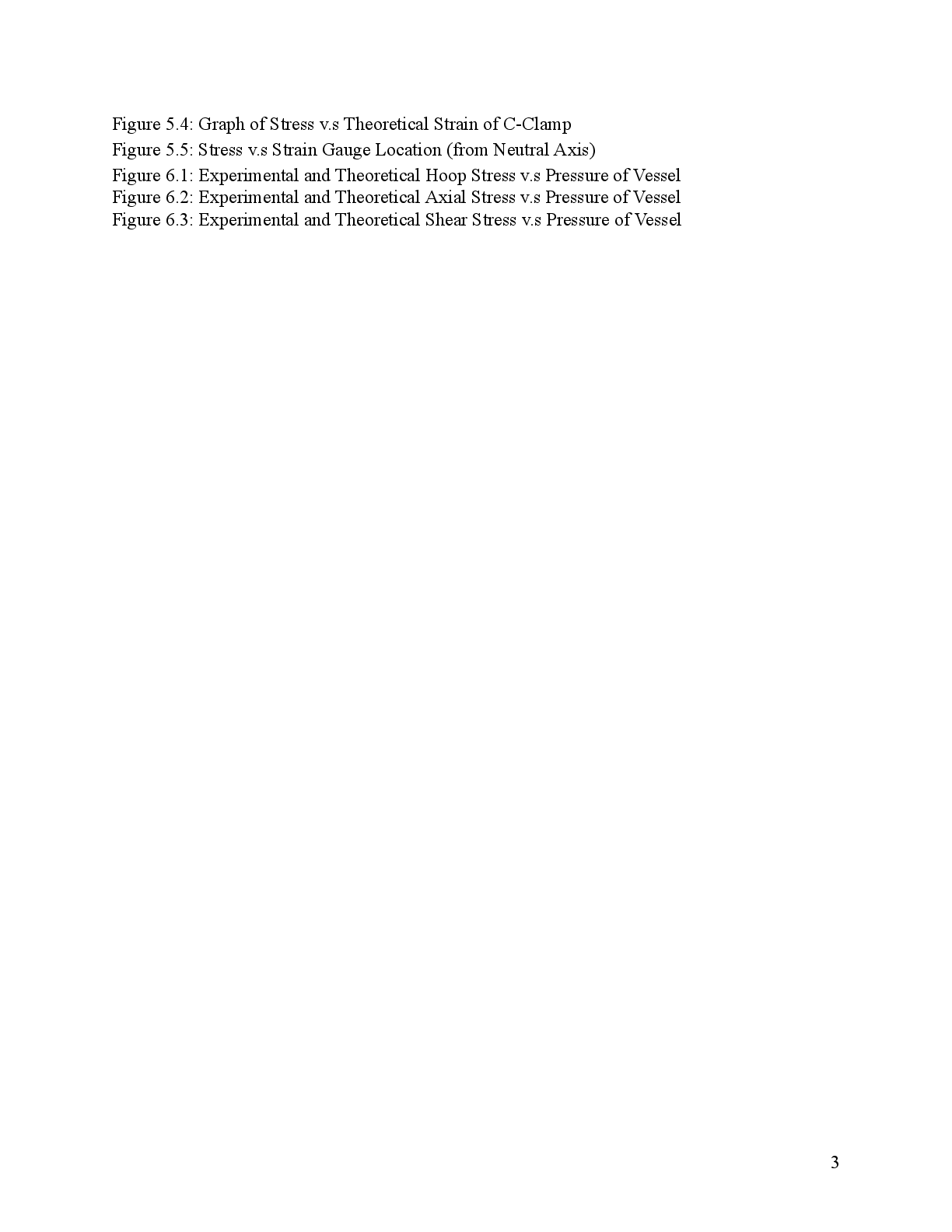
2Figure 5.4: Graph of Stress v.s Theoretical Strain of C-Clamp
Figure 5.5: Stress v.s Strain Gauge Location (from Neutral Axis)
Figure 6.1: Experimental and Theoretical Hoop Stress v.s Pressure of Vessel
Figure 6.2: Experimental and Theoretical Axial Stress v.s Pressure of Vessel
Figure 6.3: Experimental and Theoretical Shear Stress v.s Pressure of Vessel
[Show More]