HPE7-A02
Exam Practice Questions
This HPE7-A02 exam PDF provides detailed practice questions, answers, and
explanations. These HP HPE7-A02 exam practice questions are designed for IT
professionals, system administrat
...
HPE7-A02
Exam Practice Questions
This HPE7-A02 exam PDF provides detailed practice questions, answers, and
explanations. These HP HPE7-A02 exam practice questions are designed for IT
professionals, system administrators, and students preparing for ACP - Network
Security certification.
Key Features
Exam-Oriented Questions: Realistic practice questions that mirror the format
and difficulty of actual certification exams.
Wide Coverage: Includes cloud computing, networking, security, AI, and
enterprise IT management exams.
Study-Friendly Format: Organized sections by exam type, enabling focused
preparation.
Important Note:
This material is for personal study purposes only. Please do not
redistribute or use for commercial purposes without permission.
Share some HPE7-A02 exam online questions below.
1.Enhanced Security: By using certificates for authentication, the solution provides a higher level of
security compared to traditional username/password methods.
Reference: ClearPass Onboard documentation highlights the use of the platform for provisioning
certificates on unmanaged devices to facilitate secure network access via 802.1X.
2.Preserving Bindings: Saving IP-to-MAC bindings to external storage ensures that these critical
security tables are not lost during a reboot, maintaining network integrity.
3.You are establishing a cluster of HPE Aruba Networking ClearPass servers. (Assume that they are
running version 6.9.).
For which type of certificate it is recommended to install a CA-signed certificate on the Subscriber
before it joins the cluster?
A. Database
B. HTTPS
C. RADIUS/EAP
D. RadSec
Answer: B
Explanation:
When establishing a cluster of HPE Aruba Networking ClearPass servers, it is recommended to install
a CA-signed certificate for HTTPS on the Subscriber before it joins the cluster. This ensures secure
communication between the servers in the cluster and provides a trusted certificate for client
connections.
4.Assume that an AOS-CX switch is already implementing DHCP snooping and ARP inspection
successfully on several VLANs.
What should you do to help minimize disruption time if the switch reboots?
A. Configure the switch to act as an ARP proxy.
B. Create static IP-to-MAC bindings for the DHCP and DNS servers.
C. Save the IP-to-MAC bindings to external storage.
D. Configure the IP helper address on this switch, rather than a core routing switch.
Answer: C
Explanation:
To minimize disruption time if an AOS-CX switch reboots while implementing DHCP snooping and
ARP inspection, you should save the IP-to-MAC bindings to external storage. This ensures that the
DHCP snooping and ARP inspection tables, which are crucial for preventing spoofing attacks, are
preserved across reboots. When the switch restarts, it can reload these bindings from the external
storage, thereby maintaining network security and reducing the downtime associated with rebuilding
these tables.
5.Insight Enablement: Enabling Insight on the CPPM server allows it to leverage the data and
capabilities of CPDI, integrating device profiling information into policy decisions.
6. Traffic Matching Rules: When traffic matches a rule in the active ruleset, it is flagged as suspicious
or malicious.
7.1X Authentication Workflow: Requires the root CA certificate of the issuing authority for the
supplicants’ certificates. This ensures that the server can validate the client certificate during the EAPTLS handshake.
Trusted CA Usage: In ClearPass, certificates with "Trusted CA" usage are used for validating client
and server identities during secure authentication exchanges.
Option A: Incorrect. The "ClearPass Server certificate" is used for server-side identity verification and
is not used to validate client certificates.
Option B: Incorrect. Database usage is unrelated to RADIUS/EAP or certificate validation.
Option C: Incorrect. While LDAP/AD integration supports certificate validation, this is not the primary
purpose of Trusted CAs for 802.1X.
Option D: Correct. Trusted CAs for EAP are required to validate client certificates during the
authentication process.
By uploading the root CA as a "Trusted CA with EAP usage," the CPPM can properly authenticate the
certificates presented by the supplicants during EAP-TLS negotiations.
8.What is one use case that companies can fulfill using HPE Aruba Networking ClearPass Policy
Manager's (CPPM's) Device Profiler?
A. Identifying device security vulnerabilities by CVE ID and receiving remediation recommendations
B. Leveraging artificial intelligence to more accurately identify Internet of Things (loT) devices
C. Quarantining devices that do not have the required antivirus software installed on them
D. Assigning different AOS firewall roles to users on computers and the same users on smartphones
Answer: B
Explanation:
One use case that companies can fulfill using HPE Aruba Networking ClearPass Policy Manager's
(CPPM's) Device Profiler is leveraging artificial intelligence to more accurately identify Internet of
Things (IoT) devices. ClearPass Device Profiler uses AI and machine learning to analyze network
traffic and device behavior, providing detailed and accurate identification of IoT devices on the
network. This helps in managing and securing diverse and numerous IoT devices by ensuring they
are correctly profiled and assigned appropriate access policies.
Reference: Aruba ClearPass documentation highlights the use of AI and machine learning in device
profiling to enhance the identification and management of IoT devices.
9.Network Visibility: Regular scanning helps maintain up-to-date visibility of all devices on the
network, improving security and management.
Reference: ClearPass documentation on device profiling and network visibility outlines the use of
DHCP fingerprints for identifying and categorizing devices, emphasizing the importance of periodic
subnet scans for maintaining accurate profiles.
10.You have created a Web-based Health Check Service that references a posture policy. You want
the service to trigger a RADIUS change of authorization (CoA) when a client receives a Healthy or
Quarantine posture.
Where do you configure those rules?
A. In a RADIUS enforcement policy
B. In the Agents and Software Updates > OnGuard Settings
C. In the posture policy
D. In a WEBAUTH enforcement policy
Answer: A
Explanation:
RADIUS Change of Authorization (CoA):
CoA is triggered when ClearPass determines that a client’s posture status has changed (e.g.,
Healthy, Quarantine).
The RADIUS enforcement policy is where you configure actions and enforcement profiles that
respond to these posture changes.
Option Analysis:
Option A: Correct. RADIUS enforcement policies are used to configure actions, including triggering
CoA.
Option B: Incorrect. OnGuard settings configure posture agent behavior, not enforcement rules.
Option C: Incorrect. The posture policy evaluates compliance but does not trigger CoA.
Option D: Incorrect. WEBAUTH enforcement policies are for web-based authentication, not posturerelated CoA.
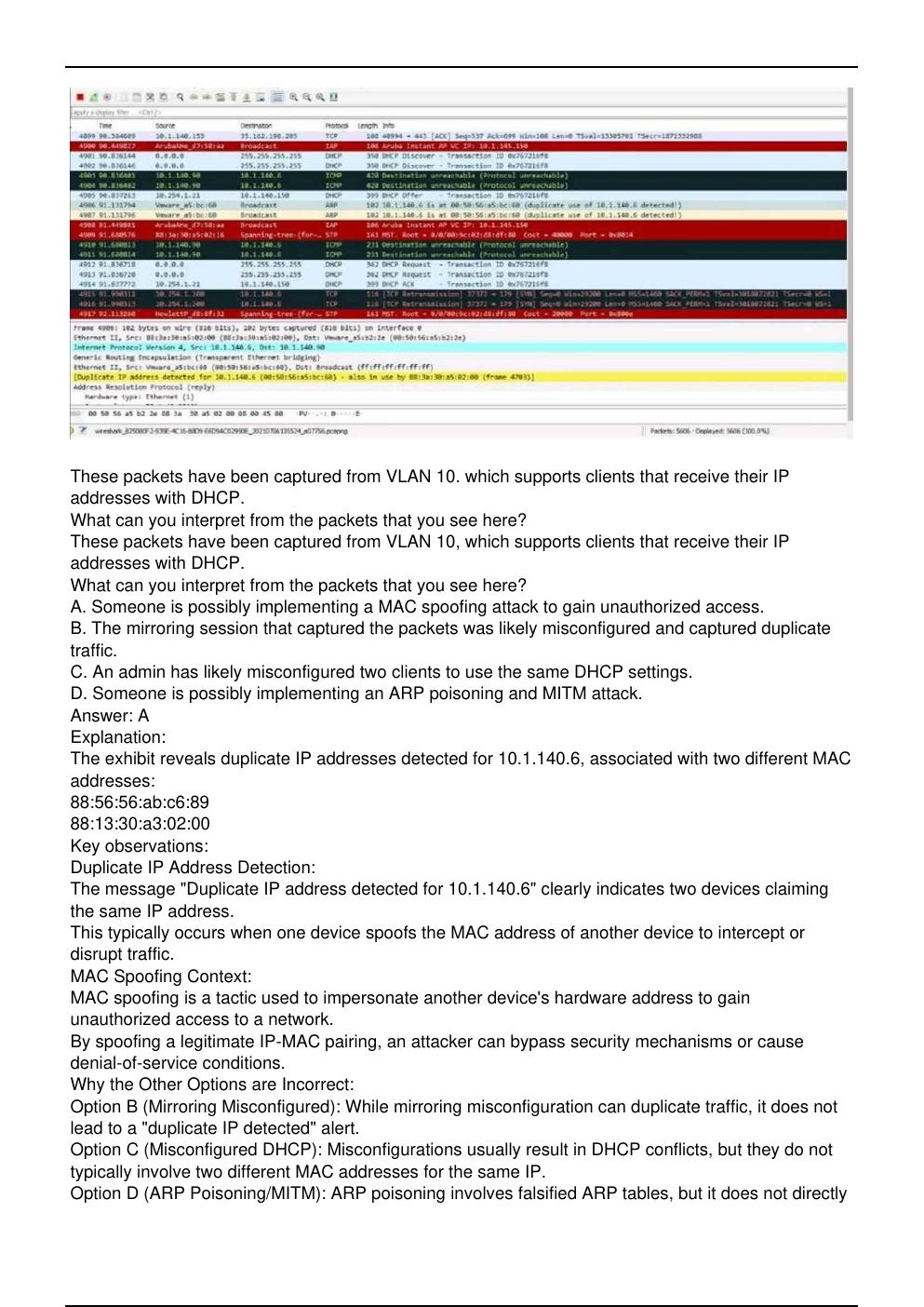
11.Refer to the Exhibit:
[Show More]






.png)