Chemistry > Lab Report > CHEM 272-Lab 10 Report-GRADED A (All)
CHEM 272-Lab 10 Report-GRADED A
Document Content and Description Below
Last updated: 3 years ago
Preview 1 out of 4 pages
Instant download
.png)
Buy this Document to get the Full Access Instantly
Provided by Students Who Aced it
We Verify Document Content to Gurantee Accuracy
Reviews( 0 )
Document information
Connected school, study & course
About the document
Uploaded On
May 04, 2021
Number of pages
4
Written in
All

Additional information
This document has been written for:
Uploaded
May 04, 2021
Downloads
0
Views
221
Topic Tags
Related Subjects & Courses
Explore similar study resources and related concepts.
Recommended For You
Get more on Lab Report »

.png)
CH101 CHEMISTRY 101 Lab 10 PreLab Acid-Base Studies. Current S...
 (1)CDWDCW.png)
CH101 CHEMISTRY 101 Lab 10 PostLab - Acid-Base Studies. Curren...
.png)
CH101 CHEMISTRY 101 Lab 10 InLab - Acid-Base Studies. Current...

CHEM 120 Unit 6 Lab: OL Lab 10: Nuclear Chemistry (GRADED A)


College of Staten Island, CUNYGEO 101Lab 10 - Mass Wasting
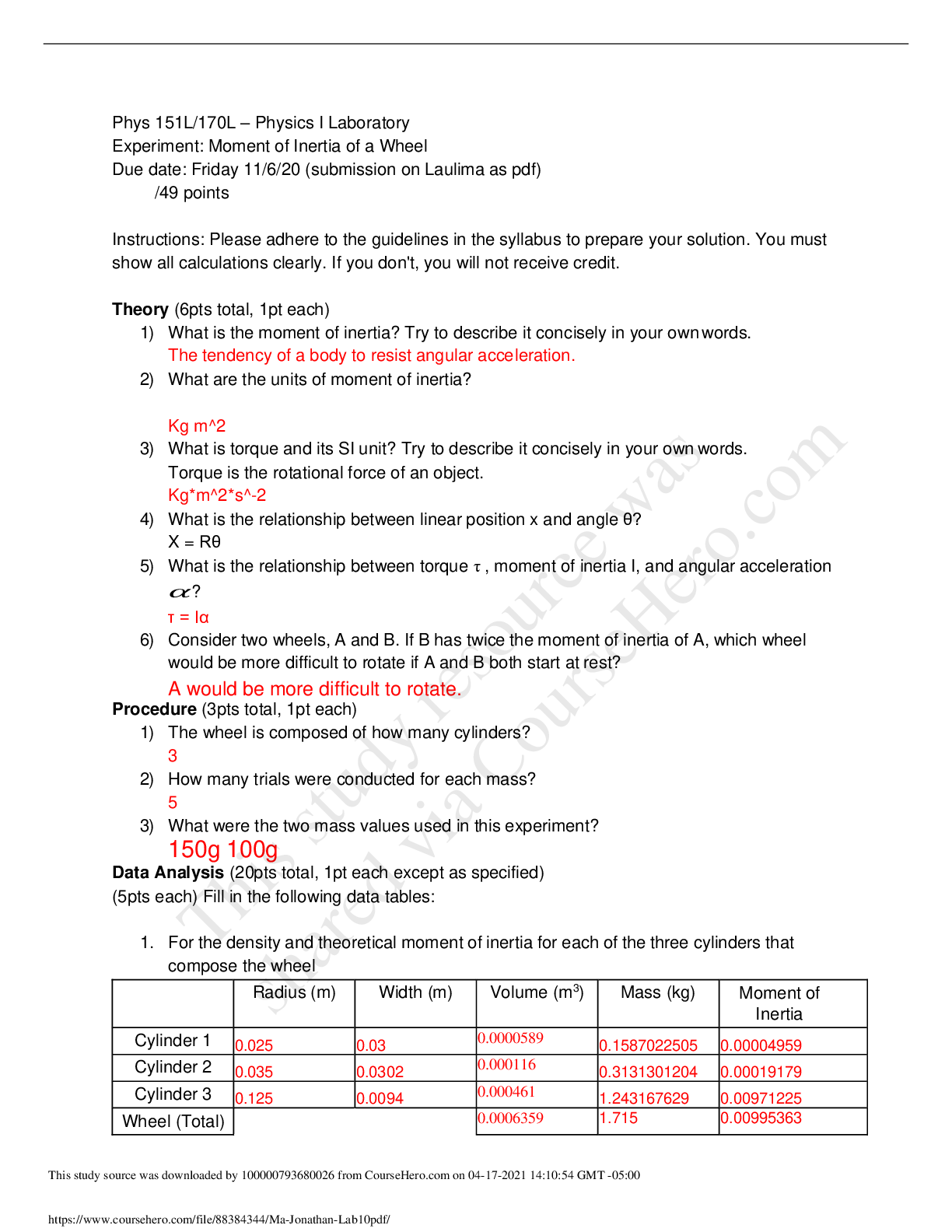
Moment of Inertia of a Wheel University of Hawaii, Manoa - PHY...

Tensile Testing of Polymers The City College of New York, CUNY...


Mass wasting lab report>College of Staten Island, CUNY - GEO 1...

PHY 2048L Prelab10: SCIENCE LAB.Lab 10: Properties of Waves. P...
The City College of New York, CUNY<<<<ME 461ME 461 lab 10...re...

Brooklyn Technical High SchoolMEME 461Lab 10 ME 461 - Lab Expe...

William Paterson University PHYS 260 Lab 10 Torque-VERIFIED BY...

 (1).png)
.png)