FTV 6A
FINAL EXAM REVIEW
1) What defines a “major” studio from a “minor” studio? Name the “Big 5”
and “Little 3.” Compare and contrast their structure, types of production,
and position in the industry.
- Big 5 – Wh
...
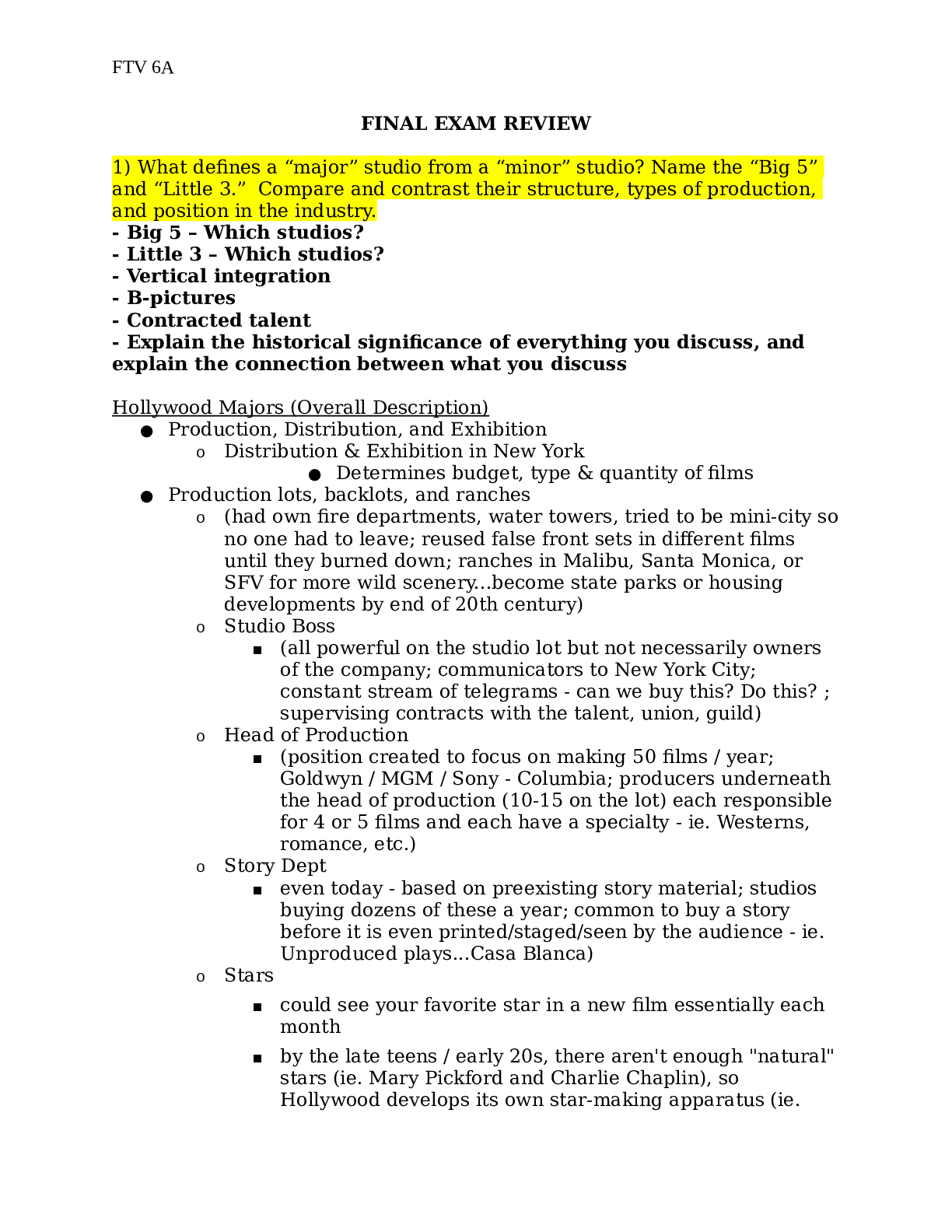
FTV 6A
FINAL EXAM REVIEW
1) What defines a “major” studio from a “minor” studio? Name the “Big 5”
and “Little 3.” Compare and contrast their structure, types of production,
and position in the industry.
- Big 5 – Which studios?
- Little 3 – Which studios?
- Vertical integration
- B-pictures
- Contracted talent
- Explain the historical significance of everything you discuss, and
explain the connection between what you discuss
Hollywood Majors (Overall Description)
● Production, Distribution, and Exhibition
o Distribution & Exhibition in New York
● Determines budget, type & quantity of films
● Production lots, backlots, and ranches
o (had own fire departments, water towers, tried to be mini-city so
no one had to leave; reused false front sets in different films
until they burned down; ranches in Malibu, Santa Monica, or
SFV for more wild scenery...become state parks or housing
developments by end of 20th century)
o Studio Boss
▪ (all powerful on the studio lot but not necessarily owners
of the company; communicators to New York City;
constant stream of telegrams - can we buy this? Do this? ;
supervising contracts with the talent, union, guild)
o Head of Production
▪ (position created to focus on making 50 films / year;
Goldwyn / MGM / Sony - Columbia; producers underneath
the head of production (10-15 on the lot) each responsible
for 4 or 5 films and each have a specialty - ie. Westerns,
romance, etc.)
o Story Dept
▪ even today - based on preexisting story material; studios
buying dozens of these a year; common to buy a story
before it is even printed/staged/seen by the audience - ie.
Unproduced plays...Casa Blanca)
o Stars
▪ could see your favorite star in a new film essentially each
month
▪ by the late teens / early 20s, there aren't enough "natural"
stars (ie. Mary Pickford and Charlie Chaplin), so
Hollywood develops its own star-making apparatus (ie.
FTV 6A
Cosmetic surgery or training -> puts them in a bunch of
films in their 1st year -> check fanmail, ask exhibitors
about buzz, look at reviews, etc. tried to see if there were
any roles they fit in and if the studio made a lot of stuff
with those roles; those picked up got a bigger salary and
bigger parts and you'd be stereotyped in "your role")... a
big part of this is…
o Long Term Option Contract (7 years)
▪ Long Term Option Contract (7 years)
● not just the stars but directors, writers, producers,
etc. signed to these; bound you to the studio usually
exclusively for up to 7 years
● large volumes, 30-50 pages in length
● billing (what the person's name will look like in
relation to the others on the credits and ads)
● salary level (stars paid very well!...but had to work
hard for their money)
● no creative control; work 40 weeks a year (M-F and
even Saturday half days)
● no percentage of the profits (very well paid; but not
dependent on the success of the film; no "net
profits")
● limited to 7 years or else it'd be indentured
servitude
o Publicity Dept
▪ Hollywood news is not news... it's hype! About the studios,
stars, etc.
▪ also includes huge quantity of glamour photos
▪ "off-casting": let the bad girl play the good girl every once
and a while just so it's not too predictable to the public
▪ James Cagney (Warner Bros. 7 year contract; 1st year
makes 4 films with small supporting roles and then picked
up; gangster films but off-cast every once in a
while...always wanted to do musicals and comedies - got
to do Footlight Parade with Warner Bros. - so, didn't sign
again and instead went to a B film company and made
films just the way he wanted; total flops...small budgets,
made distribution, etc. -> signs another Warner Bros.
contract as a result)
▪ stars avoided roles they hated by "staying home" - missing
work resulted in a suspension
FTV 6A
▪ Joan Crawford and MGM "I don't want to ice skate!" Tried
to stay home but was unsuccessful
● Control first run theatres (15 % of theaters but 75%
● Share films to fill screens
● Theaters require 100/yr while studios made 50
● Cooperate to reach national audience
● Cheap tickets for high quality films
● Supreme Court calls oligopoly in late 1940s (collaborative more than
competitive -> Anti-Trust Act)
● The Big Five (in order of prestige/position)
Paramount
● Adolph Zukor
● 1912 Famous Players
● 1914 Hodkinson and Paramount
● 1916 Famous Players and Paramount merge; Producer Jesse Lasky
● -Director Cecil B. DeMille; Pickford, Fairbanks, Valentino dominate in
roaring 20’s
● 1933 Receivership (suffers greatly during Great Depression
(bankruptcy) because its so big; gets out of bankruptcy by 1936... Mae
West helps)
● 1936-1964 Pres. Barney Balaban
● Studio Boss Y. Frank Freeman
● 1966 Gulf and Western
● 1000+ theaters, controlled Chicago, the South, New England and
Canada.
● Famous theaters the Brooklyn Paramount and the Oakland
Paramount.
● Classy films for classy audiences; sophisticated comedies
● Films from Class
o Trouble in Paradise (Lubitsch, 1933)
o Sullivan’s Travels (Sturges, 1941)
o Sunset Blvd. (Wilder, 1950)
o Rear Window (Hitchcock, 1954)
o The Godfather (Coppola, 1972)
● Paramount Directors
o Ernst Lubitsch 1892-1947
▪ Trouble in Paradise!
▪ shows Paramount's "classiness"
o Cecil B. DeMille 1881-1959
FTV 6A
▪ big self-producer; big hits
▪ 1914 The Squaw Man
o Joseph von Sternberg 1894-1969
▪ pre-code sex dramas usually starring Marlene Dietrich
o Preston Sturges 1898-1957
▪ one of Paramount's greatest writer; screwball comedies; becomes a
director / writer in 1940 (Paramount makes him a director); galaxy of
great actors
▪ 1941 Sullivan's Travels
o Billy Wilder 1906-2002
▪ great writer of romantic comedies who becomes a director in 1944
▪ serious movies, film noire, etc.
▪ 1950 Sunset Boulevard
o big budget Alfred Hitchcock films
▪ 1958 Vertigo
▪ Psycho and others
● Loved to bring in folks who already had a following from other forms
of mass media (ie. Broadway) but also have own home-grown
Hollywood stars (like MacMurry or Ladd) (LeBron James in
Trainwreck! L.O.L.)
● Bob Hope and Bing Crosby
o we think of Crosby as a radio star or crooner but he's also a
movie star! A few romantic comedies and serious pictures
o Bob Hope was a Broadway and radio comedian but became a
big movie star at Paramount!
o Paramount pairs the two up every year or two (the "road"
films"... ie. "Road to Rio")
o huge money making comedies
● The Paramount Program
o Fleischer Cartoons (Betty Boop, Popeye, Superman)
o Paramount News
o Live Action Shorts (often big band musical)
● Post-Studio Fate
● 1966 Gulf & Western
● Leads the way in the Reagan Era (Indiana Jones)
● Today: Viacom, CBS
● Major post-studio franchises
[Show More]












.png)


.png)

