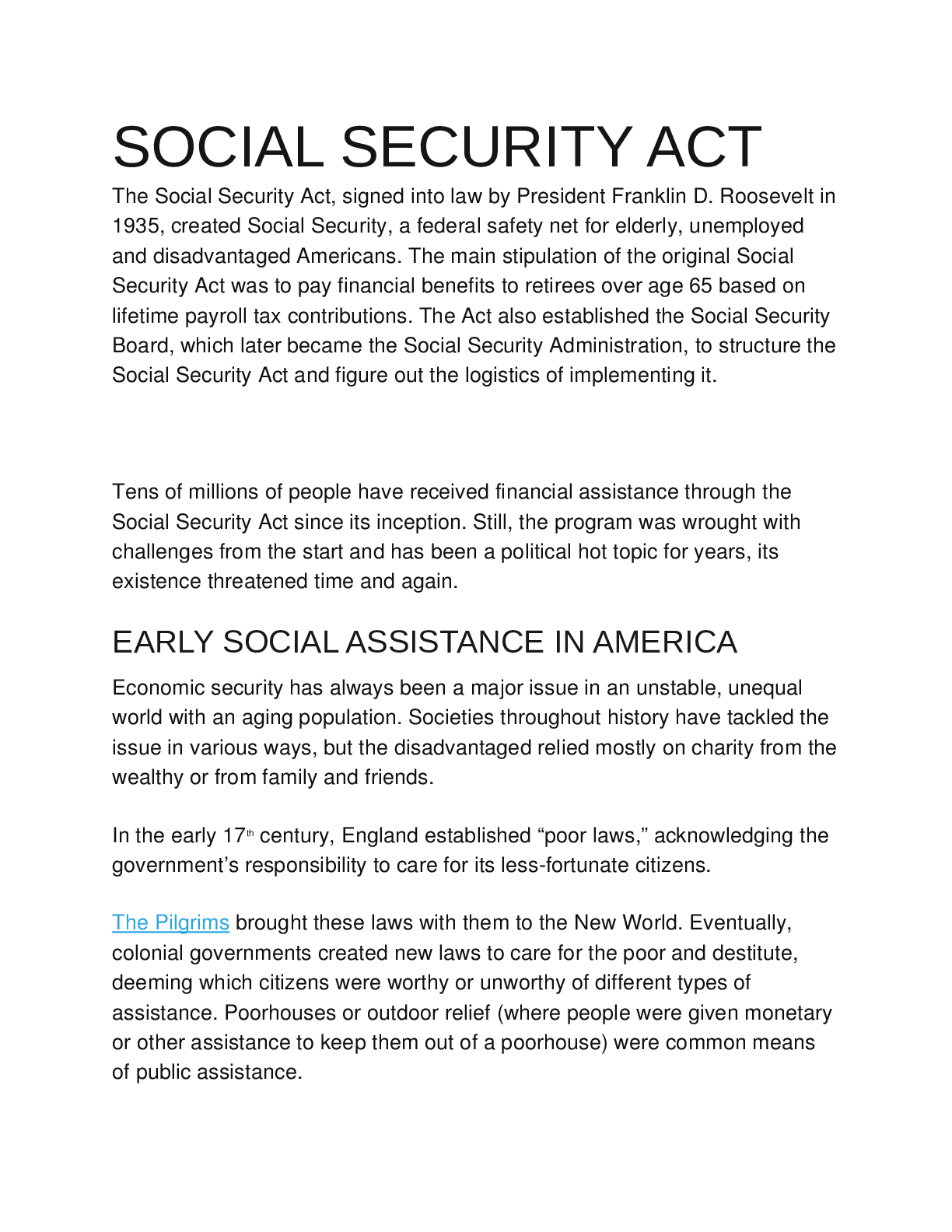
SOCIAL SECURITY ACT
The Social Security Act, signed into law by President Franklin D. Roosevelt in
1935, created Social Security, a federal safety net for elderly, unemployed
and disadvantaged Americans. The main sti
...
SOCIAL SECURITY ACT
The Social Security Act, signed into law by President Franklin D. Roosevelt in
1935, created Social Security, a federal safety net for elderly, unemployed
and disadvantaged Americans. The main stipulation of the original Social
Security Act was to pay financial benefits to retirees over age 65 based on
lifetime payroll tax contributions. The Act also established the Social Security
Board, which later became the Social Security Administration, to structure the
Social Security Act and figure out the logistics of implementing it.
Tens of millions of people have received financial assistance through the
Social Security Act since its inception. Still, the program was wrought with
challenges from the start and has been a political hot topic for years, its
existence threatened time and again.
EARLY SOCIAL ASSISTANCE IN AMERICA
Economic security has always been a major issue in an unstable, unequal
world with an aging population. Societies throughout history have tackled the
issue in various ways, but the disadvantaged relied mostly on charity from the
wealthy or from family and friends.
In the early 17th century, England established “poor laws,” acknowledging the
government’s responsibility to care for its lessfortunate citizens.
The Pilgrims brought these laws with them to the New World. Eventually,
colonial governments created new laws to care for the poor and destitute,
deeming which citizens were worthy or unworthy of different types of
assistance. Poorhouses or outdoor relief (where people were given monetary
or other assistance to keep them out of a poorhouse) were common means
of public assistance.
By the mid19th century, conditions in poorhouses were often deplorable. Yet
thanks to deteriorating economic conditions they were also packed to the
rafters, and local governments struggled to keep up with the overwhelming
need.
EARLY FORMS OF SOCIAL SECURITY
A large segment of American citizens received an early form of social security
decades before President Franklin D. Roosevelt signed the Social Security
Act.
Starting in 1862, hundreds of thousands of veterans disabled in the Civil
Warand their widows and orphans could apply for a government pension. In
1890, the law was amended to include any disabled Civil War veteran,
regardless of how the disability occurred. In 1906, the law was amended
again to include old age as a criterion.
Company pension plans came on the scene in 1882 when the Alfred Dolge
Company created a pension fund for its employees. A handful of companies
followed suit, but few employees received even a nickel. Most of the
companies went out of business before the pensions could be distributed, or
the pensions were never dispersed.
INDUSTRIAL REVOLUTION IN AMERICA
According to the Social Security Administration, four changes beginning in
the late 19th century helped abolish the economic security policies of the time:
the Industrial Revolution, America’s urbanization, the vanishing extended
family and a longer life expectancy.
Prior to the Industrial Revolution, many people were farmers and managed to
support themselves during hard times, and extended family often lived
together on family farms and cared for one another as they aged or struggled.
The Industrial Revolution, however, enticed people to flock to cities for jobs
that were often threatened by layoffs and recession, leaving many without a
way to support themselves if they lost their job. The urbanization of American
also found many people leaving their extended family behind to fend for
themselves.
As sanitary and general conditions in America improved, the life expectancy
of its citizens did, too. When more and more people grew older, many were
unable to work or became sick yet still required care.
IMPACT OF THE GREAT DEPRESSION
The Great Depression left millions of people unemployed and struggling to
put food on the table. It struck the elderly especially hard and many states
passed legislation to protect their elder citizens.
But most elderassistance programs of the time were a dismal failure. They
were underfunded, poorly run and, in some cases, flat out ignored by officials.
Those seniors who received assistance only got about 65 cents a day.
As the depression raged on, government officials and frustrated private
citizens alike moved to find ways to help struggling Americans and introduced
plans to increase economic security. Most ideas were basically federal or
state financed pension plans. Some included all citizens while others included
only the elderly.
None of the plans became law; however, many had huge followings and
initiated spirited dialogue about how to care for the disadvantaged and the
elderly.
ROOSEVELT’S RADICAL IDEA
Until Franklin D. Roosevelt became president, most social assistance plans in
America were dependent on the government, charities and private citizens
doling out money to people in need.
Roosevelt, however, borrowed a page from Europe’s economic security
rulebook and took a different approach. He proposed a program in which
people contributed to their own future economic security by contributing a
portion of their work income through payroll tax deductions.
Basically, the current working generation would pay into the program and
finance the retired generation’s monthly allowance.
SOCIAL SECURITY BENEFITS
In June 1934, President Roosevelt created the Committee on Economic
Security (CES) and tasked them with creating an economic security bill. Led
by the first woman to hold a U.S. cabinet post, Secretary of Labor Frances
Perkins, the CES drafted the Social Security Act aimed at giving people
economic security throughout their lives.
The bill included:
an oldage pension program
unemployment insurance funded by employers
health insurance for people in financial distress
financial assistance for widows with children
financial assistance for disabled individuals
After much debate, Congress passed the Social Security Act to provide
benefits to retirees based on their earnings history and on August 14, 1935,
Roosevelt signed it into law. This firmly placed the burden of economic
security for American citizens on the federal government’s shoulders.
SOCIAL SECURITY CARDS
After signing the Social Security Act, President Roosevelt established a
threeperson board to administer the program with the goal of starting payroll
tax deductions for enrollees by January 1, 1937. It was a daunting task, but
by November 1936 registration for the program began.
Not everyone could participate, though. Selfemployed professionals, field
hands and domestic workers were excluded.
To become eligible, workers completed an application at their local post office
and received a national identity card with a unique, ninedigit identification
number. Within eight days of rolling out the program, over one million workers
had Social Security numbers.
Four months later, almost 26 million had enrolled despite most projected
payouts being below poverty level. The Social Security card was—and still is
—used to track workers earnings and benefits.
SOCIAL SECURITY ACT AMENDMENTS
Many amendments have been passed to the original Social Security Act. For
instance, originally, monthly payouts of oldage benefits were slated to start
on January 1, 1942. Eligible people who turned 65 prior to that date received
a lump sum payment.
On August 10, 1939, an amendment passed to move up the start date to
receive monthly benefits to January 1, 1940. Another amendment extended
eligibility to dependents and survivors of retired workers.
In the 1950s, amendments were made which extended Social Security
eligibility to domestic and farm workers, nonfarm selfemployed
professionals and some federal employees. It also offered voluntary coverage
to some state and federal employees, hundreds of thousands of nonprofit
employees and workers in the Virgin Islands and Puerto Rico.
In addition, benefits were increased for millions of beneficiaries and a new
contribution schedule established.
MEDICARE
In 1960, President Dwight D. Eisenhower approved legislation to allow Social
Security benefits for disabled workers and their dependents.
In 1965, the Social Security Act was amended to provide medical insurance
to Social Security beneficiaries age 65 and older. This new “Medicare”
program also offered people 65 and older the chance to purchase
supplemental medical insurance.
In 1972, President Richard M. Nixon signed legislation to provide an
automatic cost of living allowance each year to offset the cost of inflation.
Prior to the new law, annual increases required Congressional approval.
EFFORTS TO KEEP SOCIAL SECURITY
SOLVENT
By 1977, it was clear Social Security was in financial peril. An amendment
was passed changing the benefit qualification formula for people born after
1917. Other amendments were also passed including increasing the payroll
tax and slightly decreasing benefits to help cut costs, leaving some
beneficiaries with less money during difficult economic times.
These efforts didn’t prevent the program from facing a serious financial crisis
in the 1980s, however, and President Ronald Reagan created a commission
to examine how to keep Social Security in the black. In 1983, he signed
[Show More]





.png)
.png)
.png)
.png)
.png)
.png)


, 5e Robert Strayer, Eric Nelson.png)
, 5e Robert Strayer, Eric Nelson.png)
, 4e Nancy Hewitt, Steven Lawson.png)

.png)


