Liberty University BUSI 240 quiz 6
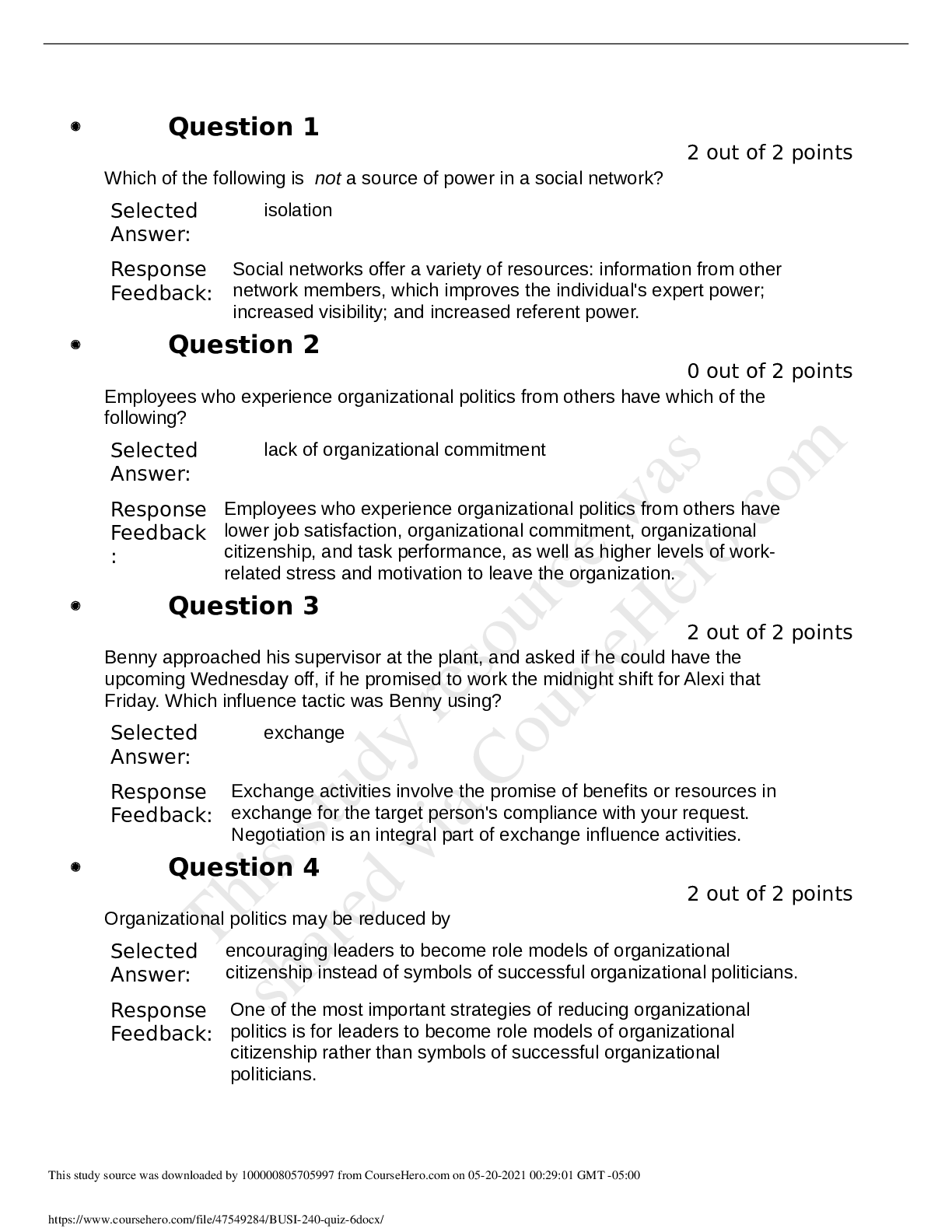
Question 1
Which of the following is not a source of power in a social network?
Question 2
0 out of 2 points
Emplo
...
Liberty University BUSI 240 quiz 6
Question 1
Which of the following is not a source of power in a social network?
Question 2
0 out of 2 points
Employees who experience organizational politics from others have which of the following?
Question 3
2 out of 2 points
Benny approached his supervisor at the plant, and asked if he could have the upcoming Wednesday off, if he promised to work the midnight shift for Alexi that Friday. Which influence tactic was Benny using?
Question 4
Organizational politics may be reduced by
Question 5
Scenario A
2 out of 2 points
Your team is allocated a project involving a major client, the Beswick Company. Although the organization has many clients, this client, and project, is the largest source of revenue and affects the work of several other teams in the organization. The project requires continuous involvement with the client, so any problems with the client are immediately felt by others in the organization.
According to the model of power, your team has
Question 6
Which of the following is a "hard" influence tactic?
Question 7
Social networks generate power through
Question 8
In organizational settings, power is defined as
Question 9
2 out of 2 points
If people in certain roles can request certain behaviors of others, then there is
Question 10
Which of the following statements about power is true?
Question 11
0 out of 2 points
refers to how much one is located between others in a network
Question 12
is the freedom to exercise judgment in an organization.
Question 13
Scenario B
2 out of 2 points
As a manager for XYZ Company, you are assigned to resolve a conflict between two departments of your organization, Department A and Department B. Both parties have equal power. Both the parties are under time pressure to resolve the conflict.
You also realize that the parties lack trust/openness for problem solving.
If instead of equal power, Department A had considerably more power than Department B, what would Department B's best conflict resolution style be?
Question 14
Which of the following behaviors might start the conflict process?
Question 15
2 out of 2 points
Initial offer points, target points, and resistance points represent three elements in the
Question 16
is the cornerstone of effective value creation.
Question 17
2 out of 2 points
Samir knows he is correct and needs a quick resolution to the conflict. He needs to
Question 18
2 out of 2 points
The effectiveness of negotiating depends to some extent on the environment in which the negotiations occur. Three key situational factors are
Question 19
2 out of 2 points
Which of the following immediately follows conflict perceptions and emotions in the conflict process?
Question 20
2 out of 2 points
José and Ron were disagreeing over who should take the holiday shift. Although José didn't really want to work that holiday, because Ron was very adamant that he have that holiday off, José agreed to take the shift. Because the issue was less important to José compared to Ron's feelings about the issue, the conflict was
resolved by José
Question 21
The problem-solving interpersonal style of conflict has
Question 22
2 out of 2 points
Some research suggests that people from high collectivism cultures—where group goals are valued more than individual goals—are motivated to maintain harmonious relations and, consequently, are more likely than those from low collectivism cultures to manage disagreements through or problem solving.
Question 23
2 out of 2 points
Which of the following is a major advantage of having moderate levels of organizational conflicts?
Question 24
2 out of 2 points
behaviors may give the other side unrealistically high expectations, thereby motivating them to seek more from you in the future.
Question 25
2 out of 2 points
Which of the following sources of conflict is typically associated with mergers and acquisitions, where everyone wants the company to succeed, but they fight over the "right way" to do things because of their unique experiences in the separate companies?
[Show More]