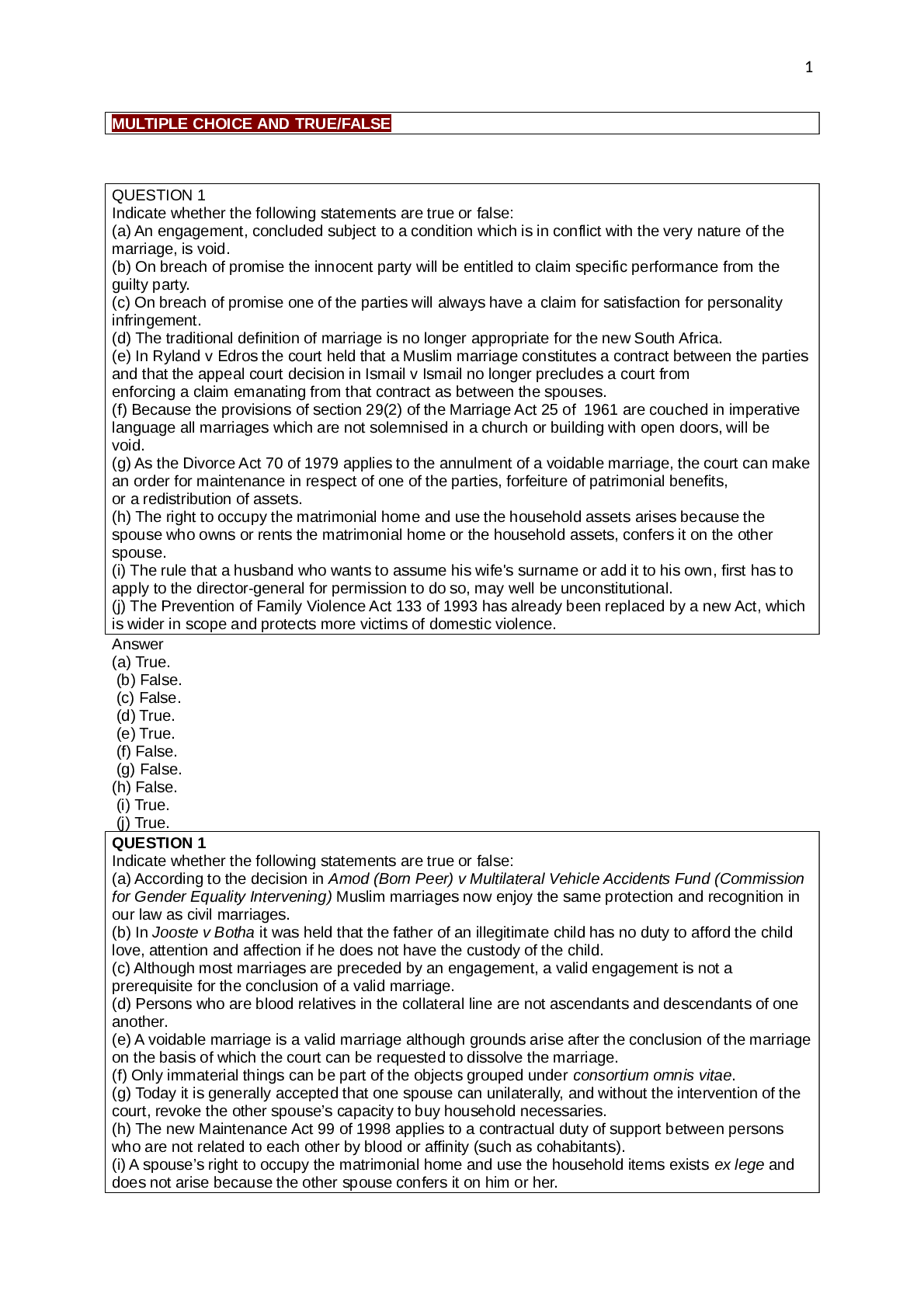
QUESTION 1
Indicate whether the following statements are true or false:
(a) An engagement, concluded subject to a condition which is in conflict with the very nature of the
marriage, is void.
(b) On breach of promise
...
QUESTION 1
Indicate whether the following statements are true or false:
(a) An engagement, concluded subject to a condition which is in conflict with the very nature of the
marriage, is void.
(b) On breach of promise the innocent party will be entitled to claim specific performance from the
guilty party.
(c) On breach of promise one of the parties will always have a claim for satisfaction for personality
infringement.
(d) The traditional definition of marriage is no longer appropriate for the new South Africa.
(e) In Ryland v Edros the court held that a Muslim marriage constitutes a contract between the parties
and that the appeal court decision in Ismail v Ismail no longer precludes a court from
enforcing a claim emanating from that contract as between the spouses.
(f) Because the provisions of section 29(2) of the Marriage Act 25 of 1961 are couched in imperative
language all marriages which are not solemnised in a church or building with open doors, will be
void.
(g) As the Divorce Act 70 of 1979 applies to the annulment of a voidable marriage, the court can make
an order for maintenance in respect of one of the parties, forfeiture of patrimonial benefits,
or a redistribution of assets.
(h) The right to occupy the matrimonial home and use the household assets arises because the
spouse who owns or rents the matrimonial home or the household assets, confers it on the other
spouse.
(i) The rule that a husband who wants to assume his wife's surname or add it to his own, first has to
apply to the director-general for permission to do so, may well be unconstitutional.
(j) The Prevention of Family Violence Act 133 of 1993 has already been replaced by a new Act, which
is wider in scope and protects more victims of domestic violence.
Answer
(a) True.
(b) False.
(c) False.
(d) True.
(e) True.
(f) False.
(g) False.
(h) False.
(i) True.
(j) True.
QUESTION 1
Indicate whether the following statements are true or false:
(a) According to the decision in Amod (Born Peer) v Multilateral Vehicle Accidents Fund (Commission
for Gender Equality Intervening) Muslim marriages now enjoy the same protection and recognition in
our law as civil marriages.
(b) In Jooste v Botha it was held that the father of an illegitimate child has no duty to afford the child
love, attention and affection if he does not have the custody of the child.
(c) Although most marriages are preceded by an engagement, a valid engagement is not a
prerequisite for the conclusion of a valid marriage.
(d) Persons who are blood relatives in the collateral line are not ascendants and descendants of one
another.
(e) A voidable marriage is a valid marriage although grounds arise after the conclusion of the marriage
on the basis of which the court can be requested to dissolve the marriage.
(f) Only immaterial things can be part of the objects grouped under consortium omnis vitae.
(g) Today it is generally accepted that one spouse can unilaterally, and without the intervention of the
court, revoke the other spouse’s capacity to buy household necessaries.
(h) The new Maintenance Act 99 of 1998 applies to a contractual duty of support between persons
who are not related to each other by blood or affinity (such as cohabitants).
(i) A spouse’s right to occupy the matrimonial home and use the household items exists ex lege and
does not arise because the other spouse confers it on him or her.
[Show More]