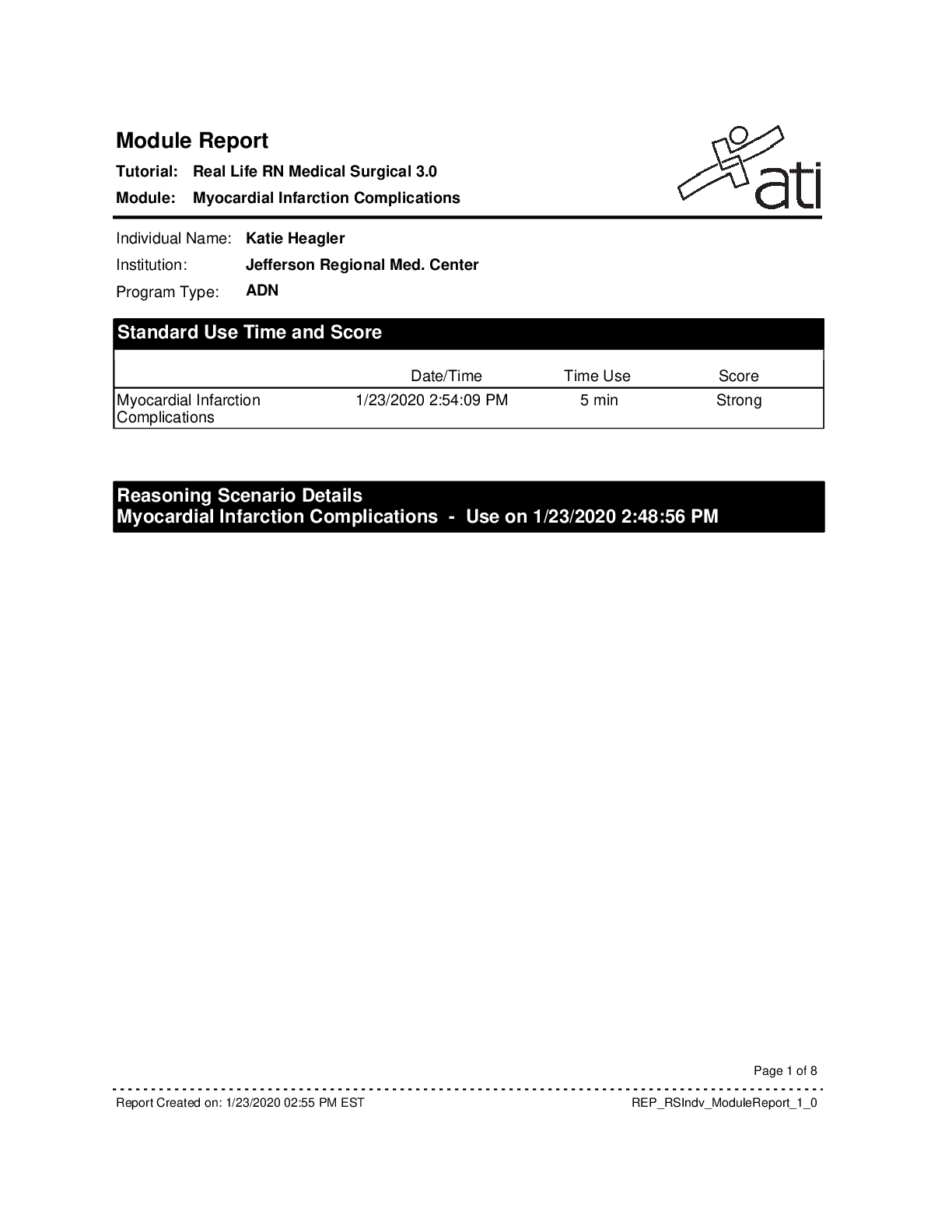
Module Report
Real Life RN Medical Surgical 3.0
Myocardial Infarction Complications
Tutorial:
Module:
Reasoning Scenario Details
Myocardial Infarction Complications - Use on 1/23/2020 2:48:56 PM
Report Created on:
...
Module Report
Real Life RN Medical Surgical 3.0
Myocardial Infarction Complications
Tutorial:
Module:
Reasoning Scenario Details
Myocardial Infarction Complications - Use on 1/23/2020 2:48:56 PM
Report Created on: 1/23/2020 02:55 PM EST REP_RSIndv_ModuleReport_1_0
Page 1 of 8Reasoning Scenario Performance Related to Outcomes:
*See Score Explanation and Interpretation below for additional details.
Body Function Strong Satisfactory Improvement Needs
Cardiac Output and Tissue Perfusion 100%
Cognition and Sensation 100%
Integument 100%
Oxygenation 100%
Regulation and Metabolism 100%
NCLEX RN Strong Satisfactory Improvement Needs
RN Management of Care 100%
RN Pharmacological and Parenteral Therapies 100%
RN Reduction of Risk Potential 100%
RN Physiological Adaptation 100%
QSEN Strong Satisfactory Improvement Needs
Safety 100%
Patient-Centered Care 100%
Evidence Based Practice 100%
Decision Log:
Optimal Decision
Scenario Mr. Davis has taken an initial dose of nitroglycerin.
Question Mr. Davis has taken the first dose of nitroglycerin. Which of the following actions
should be taken next?
Selected Option Mrs. Davis should call 911 if her husband¶s chest pain is not relieved within 5
minutes.
Rationale Unresolved chest pain with the administration of nitroglycerin can indicate the
client is having a myocardial infarction, so Mrs. Davis should call 911 if the pain
continues. Mr. Davis should also take another dose of nitroglycerin. For
unresolved chest pain, a total of three doses of nitroglycerin should be
administered 5 minutes apart. Mr. Davis should also take a 325 mg dose of
aspirin to inhibit platelet aggregation, which can reduce cardiac damage from
the formation of a thrombus.
Report Created on: 1/23/2020 02:55 PM EST REP_RSIndv_ModuleReport_1_0
Page 2 of 8Optimal Decision
Scenario Nurse Christine reviews Mr. Davis¶s a 12-lead ECG.
Question Nurse Christine is reviewing Mr. Davis¶�ECG strip, which was completed at
1725. Which pattern on the ECG strip is the priority finding? (You will find hot
spots to select in the artwork below. Select only the hot spot that corresponds to
your answer.)
Selected Option 137,36,147,36,137,49,147,48
Rationale The priority finding is the ST-segment elevation possibly indicating an acute
coronary event, which is the greatest risk to Mr. Davis.
Optimal Decision
Scenario Nurse Christine prepares to initiate prescriptions.
Question Nurse Christine is preparing to initiate the prescriptions for Mr. Davis. Which of
the following prescriptions should she expect to initiate? (Select all that apply.)
Selected Ordering Chest x-rayTroponin levelMorphinePotassium and creatinine levels
Rationale Nurse Christine should expect to initiate a bedside chest x-ray to rule out chest
pain resulting from a dissecting aorta. A CAT-scan is ordered if the chest x-ray
indicates the client has a dissecting aorta. Troponin is a cardiac enzyme, and
when elevated, is an early indicator of myocardial cell damage. Morphine is
administered to relieve pain, reduce myocardial oxygen consumption, and
facilitate vasodilation. Potassium and creatinine are drawn for a baseline prior to
the cardiac catheterization. A client having an ST-segment elevation myocardial
infarction (STEMI) will not have an MRI before having a heart catheterization
because this would delay the initiation of the cardiac catheterization and thus
prohibit the provider meeting the 60-minute time-frame from the arrival to the
facility to intervention
[Show More]