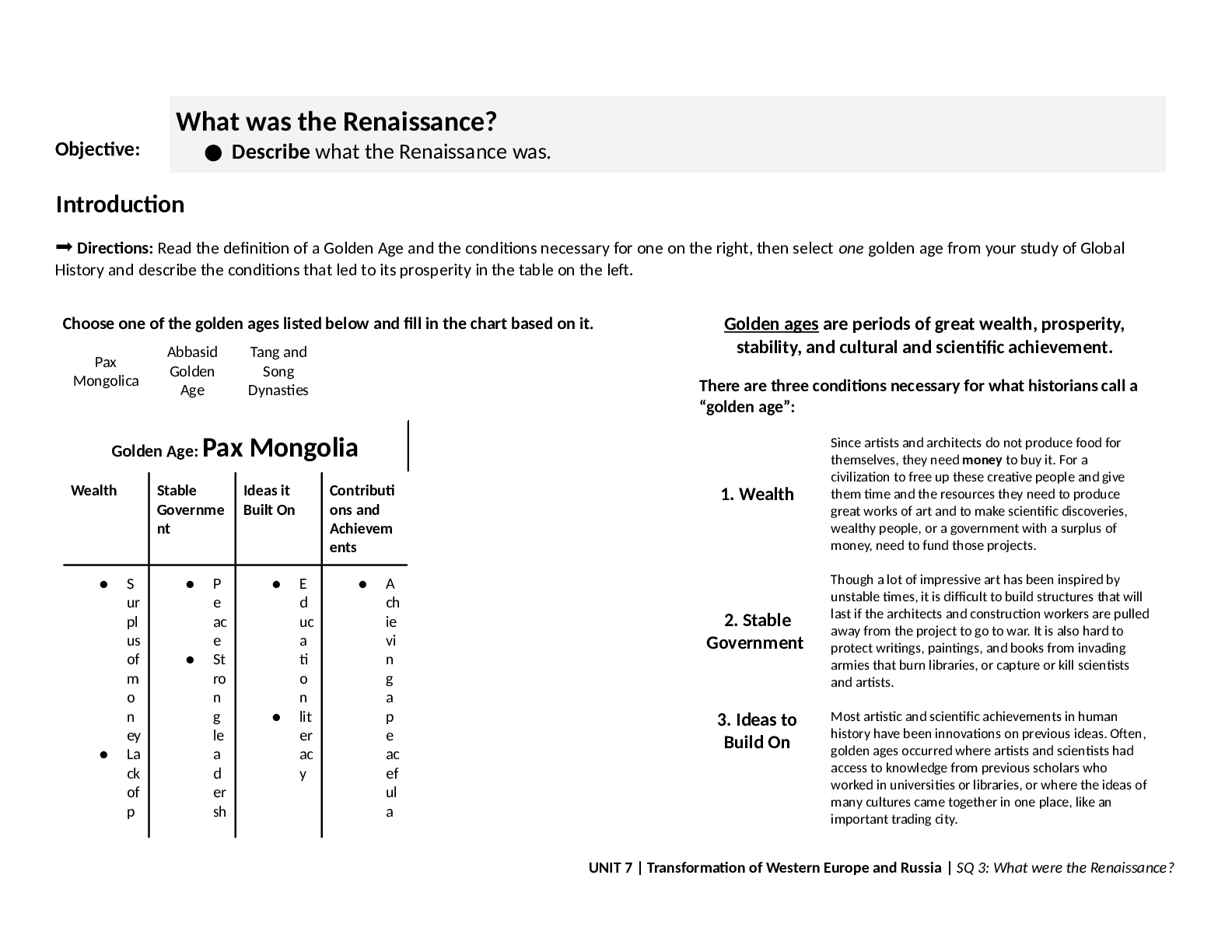
Directions: Read the definition of a Golden Age and the conditions necessary for one on the right, then select one golden age from your study of Global
History and describe the conditions that led to its prosperity in t
...
Directions: Read the definition of a Golden Age and the conditions necessary for one on the right, then select one golden age from your study of Global
History and describe the conditions that led to its prosperity in the table on the left.
Choose one of the golden ages listed below and fill in the chart based on it.
Pax
Mongolica
Abbasid
Golden
Age
Tang and
Song
Dynasties
Golden Age: Pax Mongolia
Wealth Stable
Governme
nt
Ideas it
Built On
Contributi
ons and
Achievem
ents
Golden ages are periods of great wealth, prosperity,
stability, and cultural and scientific achievement.
There are three conditions necessary for what historians call a
“golden age”:
1. Wealth
Since artists and architects do not produce food for
themselves, they need money to buy it. For a
civilization to free up these creative people and give
them time and the resources they need to produce
great works of art and to make scientific discoveries,
wealthy people, or a government with a surplus of
money, need to fund those projects.
2. Stable
Government
Though a lot of impressive art has been inspired by
unstable times, it is difficult to build structures that will
last if the architects and construction workers are pulled
away from the project to go to war. It is also hard to
protect writings, paintings, and books from invading
armies that burn libraries, or capture or kill scientists
and artists.
3. Ideas to
Build On
Most artistic and scientific achievements in human
history have been innovations on previous ideas. Often,
golden ages occurred where artists and scientists had
access to knowledge from previous scholars who
worked in universities or libraries, or where the ideas of
many cultures came together in one place, like an
important trading city
[Show More]