[FAP Interim Assessment]
Instructions: You must enter your answers to each assessment question in the sections
noted below, and must not change any information contained within the black brackets [].
[Question 1]
noi
...
[FAP Interim Assessment]
Instructions: You must enter your answers to each assessment question in the sections
noted below, and must not change any information contained within the black brackets [].
[Question 1]
noitseuq
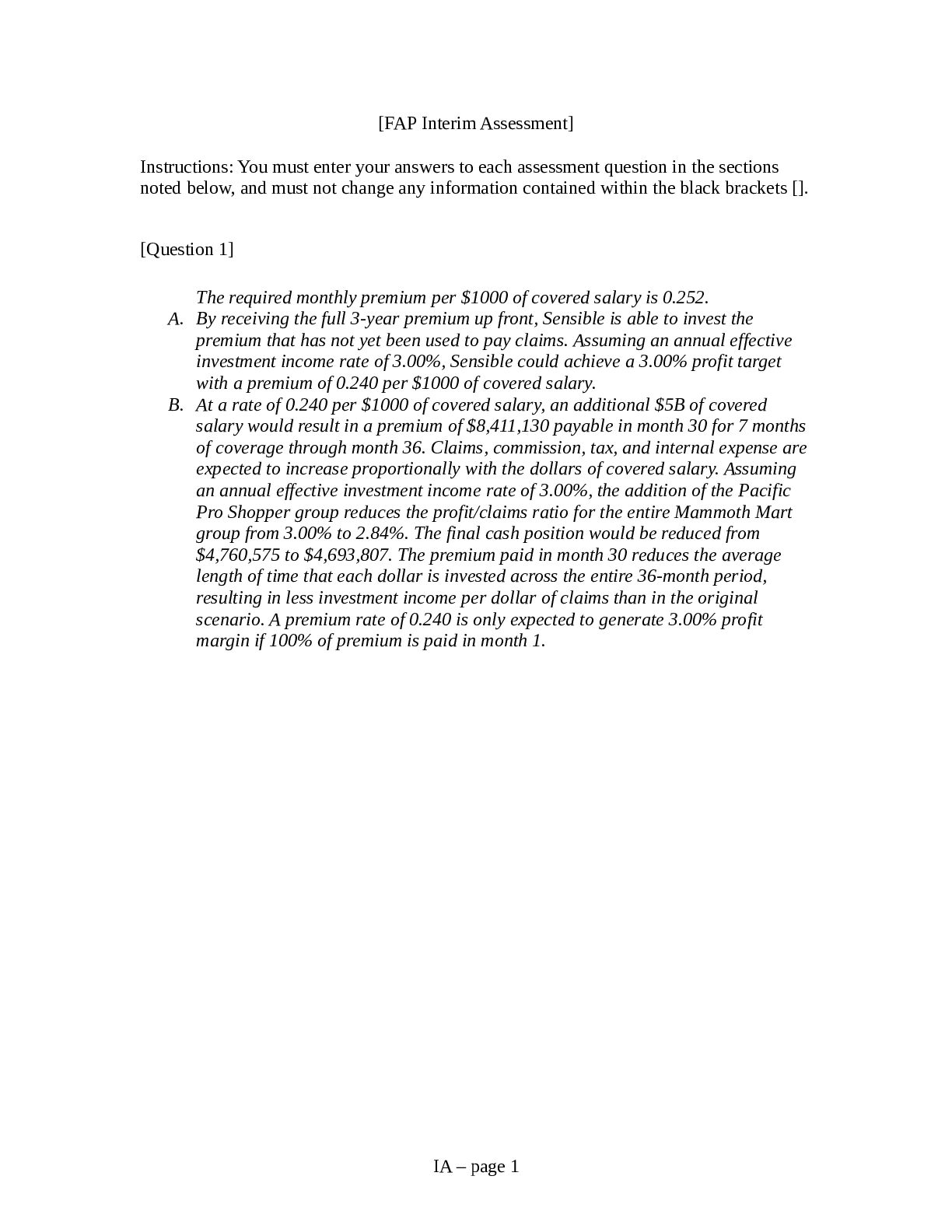
The required monthly premium per $1000 of covered salary is 0.252.
A. By receiving the full 3-year premium up front, Sensible is able to invest the
premium that has not yet been used to pay claims. Assuming an annual effective
investment income rate of 3.00%, Sensible could achieve a 3.00% profit target
with a premium of 0.240 per $1000 of covered salary.
B. At a rate of 0.240 per $1000 of covered salary, an additional $5B of covered
salary would result in a premium of $8,411,130 payable in month 30 for 7 months
of coverage through month 36. Claims, commission, tax, and internal expense are
expected to increase proportionally with the dollars of covered salary. Assuming
an annual effective investment income rate of 3.00%, the addition of the Pacific
Pro Shopper group reduces the profit/claims ratio for the entire Mammoth Mart
group from 3.00% to 2.84%. The final cash position would be reduced from
$4,760,575 to $4,693,807. The premium paid in month 30 reduces the average
length of time that each dollar is invested across the entire 36-month period,
resulting in less investment income per dollar of claims than in the original
scenario. A premium rate of 0.240 is only expected to generate 3.00% profit
margin if 100% of premium is paid in month 1.
IA – page 1[Question 2]
noitseuq
Key external factors
1. Cultural/Social - Sensible is primarily concentrated on the east coast of the
US, while Mammoth Mart is distributed nationwide with the potential for expansion into
Canada soon. Cultural values and attitudes differ between the average Sensible client’s
employees and Mammoth’s, and between Sensible’s account managers and Mammoth
Mart’s key decision makers. Understanding those differences could make or break the
relationship between the two organizations.
2. Demographics - The demographic mix of Mammoth Mart could change over
the course of the contract. Age/gender band mix could shift due to an ageing population,
turnover, or mergers and acquisitions. The underwriting assumptions used to quote the
group at the beginning of the 36-month period are essentially locked in for the duration
of the contract, so changes to demographic mix could cause claim frequencies to differ
from what was assumed in the underwriting models and net profit to come in above or
below target. Additionally, Mammoth Mart’s experience could differ from the Sensible
rate manual, and this would not be known until the contract is in effect due to lack of
historical data.
3. Physical Environment - Natural or human disaster could result in catastrophic
losses, reducing profitability. Mammoth would be such a large portion of Sensible’s total
block of business that solvency could be an issue if there was a high mortality rate in a
short period of time.
4. Investment returns affect the profitability of a contract to extent that realized
returns differ from the rate of return that was assumed for underwriting purposes. This is
a key driver of profitability, and investment returns are highly uncertain over a short
period of time such as a three-year contract with Mammoth Mart.
5. As we saw with Pacific Pro Shopper, acquisitions or divestitures during the
contract term affect overall profitability. Premium true-ups payable after the initiation of
the contract are invested for a shorter period and result in less investment income
(assuming a constant, positive return on investment). As mentioned above, M&A activity
also affects the demographics of the group
6. Regulations governing group term life policies at the state and national level.
Given Sensible’s concentration on the east coast, an appropriate response to a restrictive
new state-level regulation in California may be for Sensible to pull out of that market and
decline to renew contracts for clients with employees in California. This would not be
feasible with Mammoth Mart as a client, as it would affect over half of Sensible’s total
covered lives. At the national level, Mammoth Mart’s expansion into Canada would force
Sensible to ensure compliance with Canadian regulations. Any additional work done by
Sensible employees to react to changing regulations or to comply with regulations in new
markets could increase internal costs.
7. Competitive landscape – in a competitive market, conservative pricing
assumptions may lead to a key client leaving for a competitor. On the other hand,
aggressive pricing may lead to losses that cannot be recouped at the following renewa
[Show More]