Angela Clayton, a 7-year-old girl, was diagnosed with sickle cell disease at
birth. She was outside playing in the snow when she developed severe
abdominal pain. Her parents immediately took her to the emergency room
...
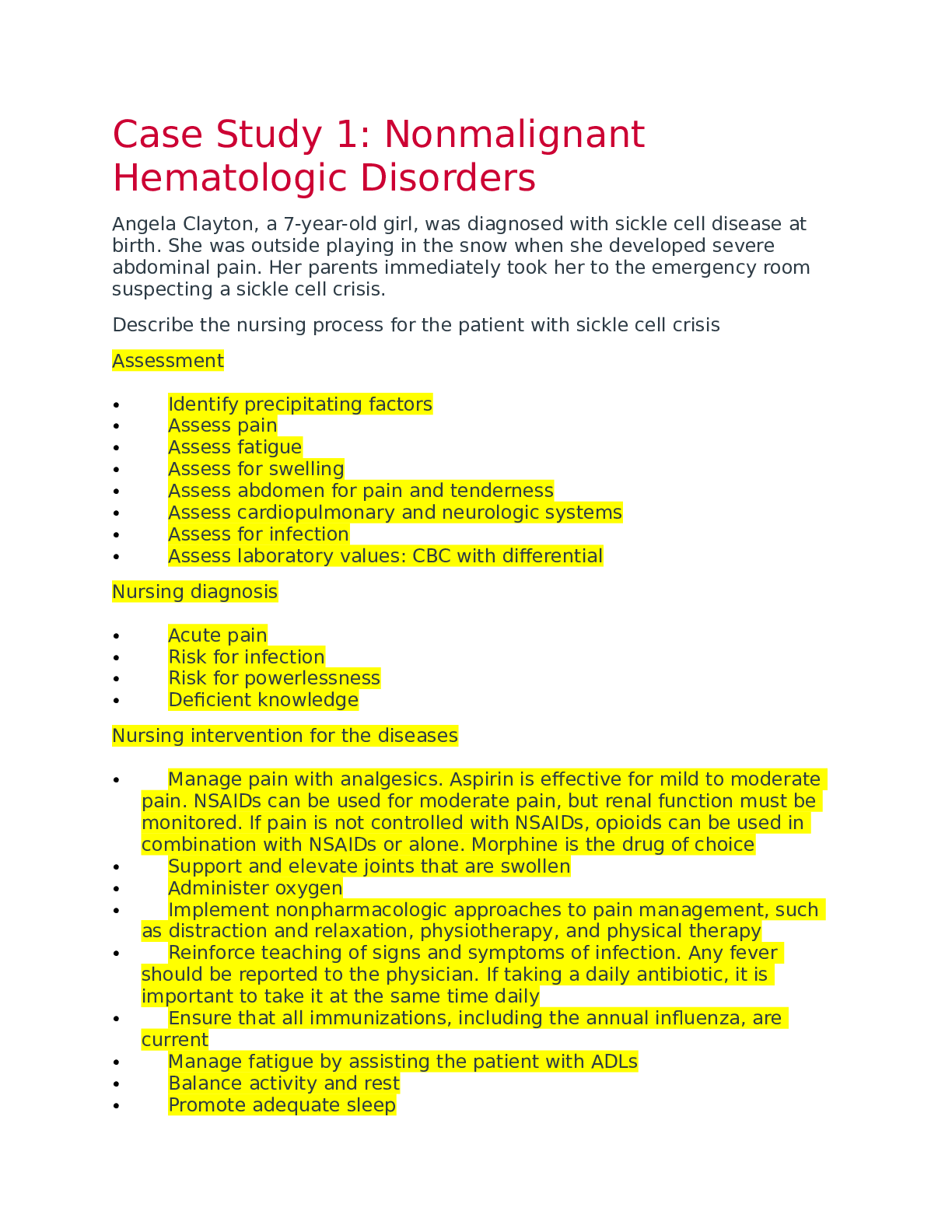
Angela Clayton, a 7-year-old girl, was diagnosed with sickle cell disease at
birth. She was outside playing in the snow when she developed severe
abdominal pain. Her parents immediately took her to the emergency room
suspecting a sickle cell crisis.
Describe the nursing process for the patient with sickle cell crisis
Assessment
Identify precipitating factors
Assess pain
Assess fatigue
Assess for swelling
Assess abdomen for pain and tenderness
Assess cardiopulmonary and neurologic systems
Assess for infection
Assess laboratory values: CBC with differential
Nursing diagnosis
Acute pain
Risk for infection
Risk for powerlessness
Deficient knowledge
Nursing intervention for the diseases
Manage pain with analgesics. Aspirin is effective for mild to moderate
pain. NSAIDs can be used for moderate pain, but renal function must be
monitored. If pain is not controlled with NSAIDs, opioids can be used in
combination with NSAIDs or alone. Morphine is the drug of choice
Support and elevate joints that are swollen
Administer oxygen
Implement nonpharmacologic approaches to pain management, such
as distraction and relaxation, physiotherapy, and physical therapy
Reinforce teaching of signs and symptoms of infection. Any fever
should be reported to the physician. If taking a daily antibiotic, it is
important to take it at the same time daily
Ensure that all immunizations, including the annual influenza, are
current
Manage fatigue by assisting the patient with ADLs
Balance activity and rest
Promote adequate sleep
Maintain hydration and nutrition. Adequate hydration helps to reduce
sickling. If unable to take oral fluids, IV fluids will be required
Provide emotional support to the patient and family
Educate patient and family on medication and medical management of
disease
Refer the parents to a support group
Evaluation
Control of pain and fatigue
Absence of infection
Increased knowledge
Absence of complication
Expresses improved sense of control
Mary Saeger, a 56-year-old woman, is receiving outpatient chemotherapy for
bladder cancer. A round of chemotherapy consists of gemcitabine on day 1
and day 8. Cisplantin is administered on day 2. A CBC with differential is
ordered prior to the chemotherapy on day 1, day 8, and 1 week after the
chemotherapy. The absolute neutrophil count (ANC) is 489/mm³ at 1 week
after the chemotherapy. The patient’s temperature is 97.6°F.
What is the significance of the absolute neutrophil count?
Neutrophils prevent and limit bacterial infections. The absolute neutrophil
count (ANC) of 489/mm³ suggests that the patient is at high risk for an
infection.
Based on the reason for the neutropenia, what medical management would
you anticipate?
Since the patient is afebrile and demonstrates no signs of infection, the
physician will not admit the patient to the hospital. Admitting the patient to
the hospital would increase the patient’s risk of acquiring infection. Since the
chemotherapy is considered to be curative, the physician will not want to
stop or reduce the dose of the treatment. The physician will order growth
factors, such as granulocyte colony-stimulating factor (G-CSF) or
granulocyte-macrophage colony-stimulating factor (GM-CSF), to increase the
neutrophil production. If the growth factor is not effective in stimulating
neutrophil production, the chemotherapy will be stopped until the neutrophil
level improves.
What patient teaching will the nurse provide to the patient?
The nurse would teach the patient the following:
Signs and symptoms of infection. The patient should be instructed to
report any signs of infection, including fever to the physician.
Avoid crowds and contact with those who have infections
Maintain good handwashing and hygiene, including oral hygiene
Use hand sanitizer when handwashing is not possible
Maintain a high-calorie, high-protein diet with a fluid intake of 3,000
mL/day, unless contraindicated
Avoid activities that pose a risk for environmental infections such as
gardening, and cleaning up after pets
Instruct that growth factors may cause muscle and bone discomfort,
especially in the sternum.
Acetaminophen is effective in relieving the discomfort
Case Study 2: Immune Deficiency
Disorders
The nurse educator for an oncology unit is preparing an in-service presentation for new nurses
about the care of patients with immunodeficiencies. Patients with cancer who are receiving
chemotherapy, as well as those with bone marrow transplants, are immunocompromised and
require special attention to assess for signs of infection. The nurse educator focuses on special
care needs of this patient population.
What is the rationale for assessing the pulse and respiratory rates for 1 full minute in a patient
with immunodeficiency?
Immunodeficiency results in a compromised immune system and a high risk of infection, careful
assessment of the patient’s immune status is essential. Pulse rate and respiratory rate should be
counted for a full minute because even subtle changes can signal deterioration in the patient’s
clinical status. Changes in respiratory status can indicate a pending infection.
What special precautions about dietary restrictions and food preparation should be included in
the teaching for a patient with immunodeficiency?
Patients with immunodeficiencies should cook all foods thoroughly to prevent infection.
Perishable foods always should be refrigerated to prevent contamination. A healthy and wellbalanced diet and adequate caloric intake help to decrease risks of infection.
What nursing actions should be implemented to decrease the risk of infection in the patient with
immunodeficiency?
Closely monitor for subtle changes in vital signs that indicate infection
Monitor white blood cell count with differential, culture, and sensitivity results
Teach the patient to avoid use of alcohol and tobacco
Use strict aseptic technique when performing invasive procedures
Josh Parsons, a 36-year-old patient diagnosed with leukemia, is immunocompromised. The
patient’s absolute neutrophil count is 750. The patient has a moderate risk for infection. The
nurse provides patient and family education on ways to decrease the risk for infection.
What should the nurse include in the teaching session with the patient and family?
Instruct the patient on the proper way to perform handwashing, and have the patient
demonstrate. Instruct the patient to wash hands before eating, after going to the bathroom,
and before and after carrying out a health care-related procedure
Instruct the patient to use lotion or cream to keep skin supple, moist, and intact. Instruct
the patient not to use lotion or cream between the toes
Instruct the patient to keep nails trimmed and free of rough edges
Instruct the patient to avoid crowds and anyone with known sickness
Instruct the family to screen visitors to make sure that visitors are free of possible
infection
Instruct the patient and family on signs and symptoms of an infection to report promptly
to the health care provider. Report fever of 100°F or higher; chills; cough; shortness of
breath; white patches in the mouth; sore throat; swollen glands; burning upon urination or
foul-smelling urine; persistent diarrhea; any sores or lesions that have redness, swelling, and
drainage; and extreme fatigue. Instruct the patient to monitor the temperature daily
because fever may be the only presenting symptom
Instruct the patient to avoid fresh flowers, fruits, and vegetables
Instruct the patient and family to cook food properly to kill bacteria and to refrigerate
leftovers immediately. Date the leftovers and dispose of them properly. (Provide a handout
on proper handling of food, such as the “USDA Food Safety for People with Cancer”
available at the Web site included in the references)
Instruct the family to keep the bathroom and kitchen clean and disinfected on a daily
basis to decrease bacteria. Instruct the patient and family to clean and disinfect all eating
utensils and dishes properly
Instruct the patient to avoid pet feces, especially the litter box
Instruct the patient to avoid activities that could result in cuts or scratches on the skin,
such as using a razor blade or gardening without gloves
Instruct the patient to avoid persons who have received a live vaccine within the past 3
weeks
Instruct the patient on proper oral hygiene to avoid bleeding gums that could lead to an
infection. Instruct the patient to use a soft toothbrush and avoid alcohol mouthwash. Use a
warm saline solution as a rinsing agent
Reference
US Department of Agriculture (2012). Food safety for people with cancer. Available
at: http://www.fda.gov/Food/FoodborneIllnessContaminants/PeopleAtRisk/ucm312565.htm (Lin
ks to an external site.)Links to an external site.
The nurse is planning to provide education on HIV infection transmission and prevention
strategies at a local senior center.
What should the nurse include in the session considering the needs of the older population?
Share the statistics from the Centers for Disease Control (CDC) that approximately one
quarter of people living with HIV are over the age of 50
Instruct the group on what HIV is and the basic ways it is transmitted. Provide a largeprint brochure on the topic
Instruct on ways HIV is transmitted in the older adult population:
o Through unprotected sex because older adults view condoms as unnecessary
birth control. The transmission of HIV is through body fluids, including vaginal secretions
and semen or blood
o Blood transfusions or organ transplants prior to 1985
o Through the use of IV drugs and sharing needles. The needles may have been
contaminated with HIV
o In older gay adult males who lost their lifelong female partner and are
establishing a relationship with a new younger male partner. The male may have HIV
and expose others to the virus
Instruct the group on the normal aging process of the immune system, which makes the
older adult more susceptible to HIV, cancer, and other infections
Provide preventive education to decrease the spread of HIV:
o Instruct the group that latex condoms are the only safe and effective barrier for
decreasing exposure to HIV during sexual intercourse. Instruct on the proper way to use
condoms, and provide a large-print brochure
o Instruct the group that the female condom is also an acceptable measure to
decrease exposure to HIV, and provide a brochure on its proper usage
o Explain to the group that with oral contact with the vagina or rectum, the dental
dam should be used as a barrier
o Explain to the group that with oral contact with the penis, a condom should be
used as a barrier
o Explain to the group that currently no chemical products decrease HIV
transmission
o Instruct the group to avoid sexual practices that lead to cutting or tearing the
lining of the vagina, rectum, or penis
o Instruct the group of places to receive confidential HIV testing. Have information
for the group on locations where a person may go for confidential testing
o Instruct the group on needle exchange programs available in the area. Have
information for the group on the locations of the programs
Sallie Jefferies, 28-year-old patient, is at the obstetric clinic for a pregnancy visit. The physician
informs the patient that her HIV screen test is positive. The patient has no evidence of AIDS. The
[Show More]

![Preview of eBook [PDF] Barash, Cullen, and Stoelting's Clinical Anesthesia 9th Edition By Bruce F. Cu](https://browseimages.nyc3.digitaloceanspaces.com/paper-images/2024/Aug/29/8DF2QRTq2024-08-29-10-3966d0259b7c4b5.png)
![Preview of eBook [PDF] Burns' Pediatric Primary Care 7th Edition BY Dawn Lee Garzon Maaks,, Nancy Bar](https://browseimages.nyc3.digitaloceanspaces.com/paper-images/2024/Aug/26/WR2rowXX2024-08-26-02-0966cc625bea839.png)


![Preview of eBook [PDF] AACN Essentials of Progressive Care Nursing 5th Edition By Sarah A. Delgado](https://browseimages.nyc3.digitaloceanspaces.com/paper-images/2024/Aug/29/ipbdJSTN2024-08-29-11-1466d02df30fc96.png)




![Preview of [eTextbook] [PDF] Labor Economics 9th Edition By George Borjas](https://browseimages.nyc3.digitaloceanspaces.com/paper-images/2025/Jan/13/JcsHZtUb2025-01-13-07-42678542822cb77.png)






.png)
.png)

