Biol 235 Unit 3 Sample Questions
Question type: Multiple Choice
1) What are the three main parts of a eukaryotic cell?
a) plasma membrane, organelles, cytoplasm
b) plasma membrane, organelles, nucleus
c) pla
...
Biol 235 Unit 3 Sample Questions
Question type: Multiple Choice
1) What are the three main parts of a eukaryotic cell?
a) plasma membrane, organelles, cytoplasm
b) plasma membrane, organelles, nucleus
c) plasma membrane, cytoplasm, organelles
d) plasma membrane, cytoplasm, nucleus
e) plasma membrane, cytosol, organelles Answer: d
Difficulty: Medium
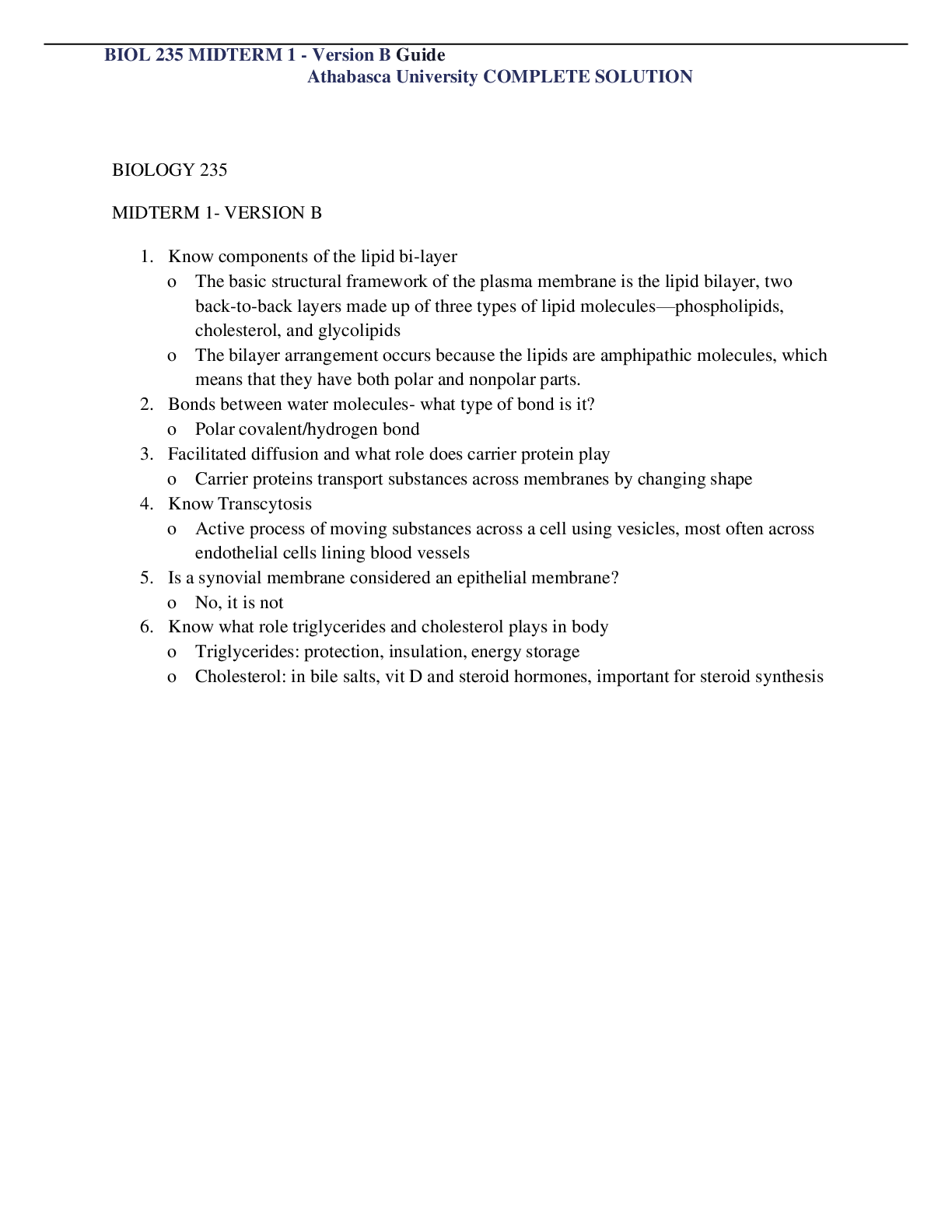
Study Objective 1: SO 3.1 Name and describe the three main parts of a cell. Section Reference 1: Sec 3.1 Parts of a Cell
Question type: Essay
2) Briefly describe the fluid mosaic model.
Answer:
Difficulty: Medium
Study Objective 1: SO 3.2 Describe the structure and functions of the plasma membrane. Section Reference 1: Sec 3.2 The Plasma Membrane
Solution: The fluid mosaic model states that the molecular arrangement of the plasma membrane resembles an ever-moving sea of fluid lipids containing a mosaic of many different proteins.
Question type: Multiple Choice
3) The three main components of the lipid bilayer portion of a plasma membrane are
a) phospholipids, glycoproteins, and water.
b) proteins, cholesterol, and fatty acids.
c) cholesterol, triglycerides, and glycolipids.
d) phospholipids, cholesterol, and glycolipids.
e) phospholipids, cholesterol, and proteins.
Answer: d Difficulty: Medium
Study Objective 1: SO 3.2 Describe the structure and functions of the plasma membrane. Study Objective 2: SO 3.2.2 Explain the concept of selective permeability.
Section Reference 1: Sec 3.2 The Plasma Membrane
4) What are the nonpolar parts of phospholipids?
a) phosphate-containing head groups
b) fatty acid tail groups
c) Both the head and tail groups are nonpolar.
d) Neither the head nor tail groups are nonpolar.
Answer: b Difficulty: Medium
Study Objective 1: SO 3.2 Describe the structure and functions of the plasma membrane. Study Objective 2: SO 3.2.2 Explain the concept of selective permeability.
Section Reference 1: Sec 3.2 The Plasma Membrane
5) The polar portion of a cholesterol molecule, which forms hydrogen bonds with the polar heads of neighboring phospholipids and glycolipids, consists of a
a) –OH group.
b) –CH3 group.
c) –CH4 group
d) –COOH group
e) None of these choices is correct.
Answer: a Difficulty: Hard
Study Objective 1: SO 3.2 Describe the structure and functions of the plasma membrane. Study Objective 2: SO 3.2.2 Explain the concept of selective permeability.
Section Reference 1: Sec 3.2 The Plasma Membrane
6) This type of membrane protein extends across the entire lipid bilayer of the plasma membrane touching both intracellular fluid and the extracellular fluid.
a) complement protein
b) transmembrane protein
c) peripheral protein
d) lipoprotein
e) All of these choices are correct.
Answer: b Difficulty: Medium
Study Objective 1: SO 3.2 Describe the structure and functions of the plasma membrane. Study Objective 2: SO 3.2.2 Explain the concept of selective permeability.
Section Reference 1: Sec 3.2 The Plasma Membrane Question type: Essay
7) Describe five different functions of integral membrane proteins.
Answer:
Difficulty: Hard
Study Objective 1: SO 3.2 Describe the structure and functions of the plasma membrane. Study Objective 2: SO 3.2.2 Explain the concept of selective permeability.
Section Reference 1: Sec 3.2 The Plasma Membrane
Solution: Some membrane proteins act as ion channels or carriers that transport substances across the membrane. Other membrane proteins act as receptors that allow the cell to respond to various types of ligands. Other membrane proteins are enzymes that catalyze specific chemical reactions. Still other membrane proteins act as linker proteins that anchor cells to neighboring structures including other cells. Lastly, some membrane proteins serve as cell identity molecules.
Question type: Multiple Choice
8) This type of membrane protein enables cells to catalyze specific chemical reactions at the inner or outer surface of their plasma membrane.
a) receptors
b) phospholipids
c) cholesterol
d) enzymes
e) ligands Answer: d
Difficulty: Medium
Study Objective 1: SO 3.2 Describe the structure and functions of the plasma membrane. Study Objective 2: SO 3.2.2 Explain the concept of selective permeability.
Section Reference 1: Sec 3.2 The Plasma Membrane
9) Which of the following types of membrane proteins function by recognizing and binding to hormones and neurotransmitters?
a) transporters
b) receptors
c) enzymes
d) linkers
e) cell identification markers Answer: b
Difficulty: Medium
Study Objective 1: SO 3.2 Describe the structure and functions of the plasma membrane. Study Objective 2: SO 3.2.2 Explain the concept of selective permeability.
Section Reference 1: Sec 3.2 The Plasma Membrane
10) This type of membrane protein anchors cells to neighboring cells and to protein filaments found outside or inside the cell.
a) transporters
b) receptors
c) ligands
d) ion channels
e) linkers Answer: e
Difficulty: Easy
Study Objective 1: SO 3.2 Describe the structure and functions of the plasma membrane. Study Objective 2: SO 3.2.2 Explain the concept of selective permeability.
Section Reference 1: Sec 3.2 The Plasma Membrane
11) Plasma membranes are , which means that some chemicals move easily through plasma membrane while other chemicals do not.
a) selectively permeable
b) concentration graded
c) electrically graded
d) selectively soluble
e) electrical insulators Answer: a
Difficulty: Medium
Study Objective 1: SO 3.2 Describe the plasma membrane structural and functional properties. Study Objective 2: SO 3.2.2 Explain the concept of selective permeability.
Section Reference 1: Sec 3.3 Transport across the Plasma Membrane
12) Which of the following does NOT influence the rate of diffusion of a chemical across a plasma membrane?
a) concentration gradient of the chemical across the membrane
b) mass of the diffusing chemical
c) distance that the chemical has to diffuse
d) amount of ATP available
e) temperature
[Show More]


.png)

.png)




.png)


.png)



.png)





.png)