Lab 6 The Skeletal System BIO201L
Student Name: Click here to enter text.
Access Code (located on the lid of your lab kit): Click here to enter text.
Pre-Lab Questions:
”1. List the functions of the skeletal system.”
...
Lab 6 The Skeletal System BIO201L
Student Name: Click here to enter text.
Access Code (located on the lid of your lab kit): Click here to enter text.
Pre-Lab Questions:
”1. List the functions of the skeletal system.”
The skeletal system provides the body with:
support
protection
movement
storage of nutrients
Blood production through RBC in the bones.”
2. What material contributes the greatest to the compressive strength of bone? ”
Calcium phosphate an calcium carbonate ”
3. Briefly describe the process of bone remodeling. ”
The remodeling of bones begines with a recess stage when osteoclasts are
recruited and activated for the beginning of the resorption of bones. Next comes
the activation of osteoblasts to start the removal of osteoclasts which happens
in the transition phase. Bone matrix then forms in the fimal phase which marks
the start of bones starting to rebuild and establish growth of new bone cells.
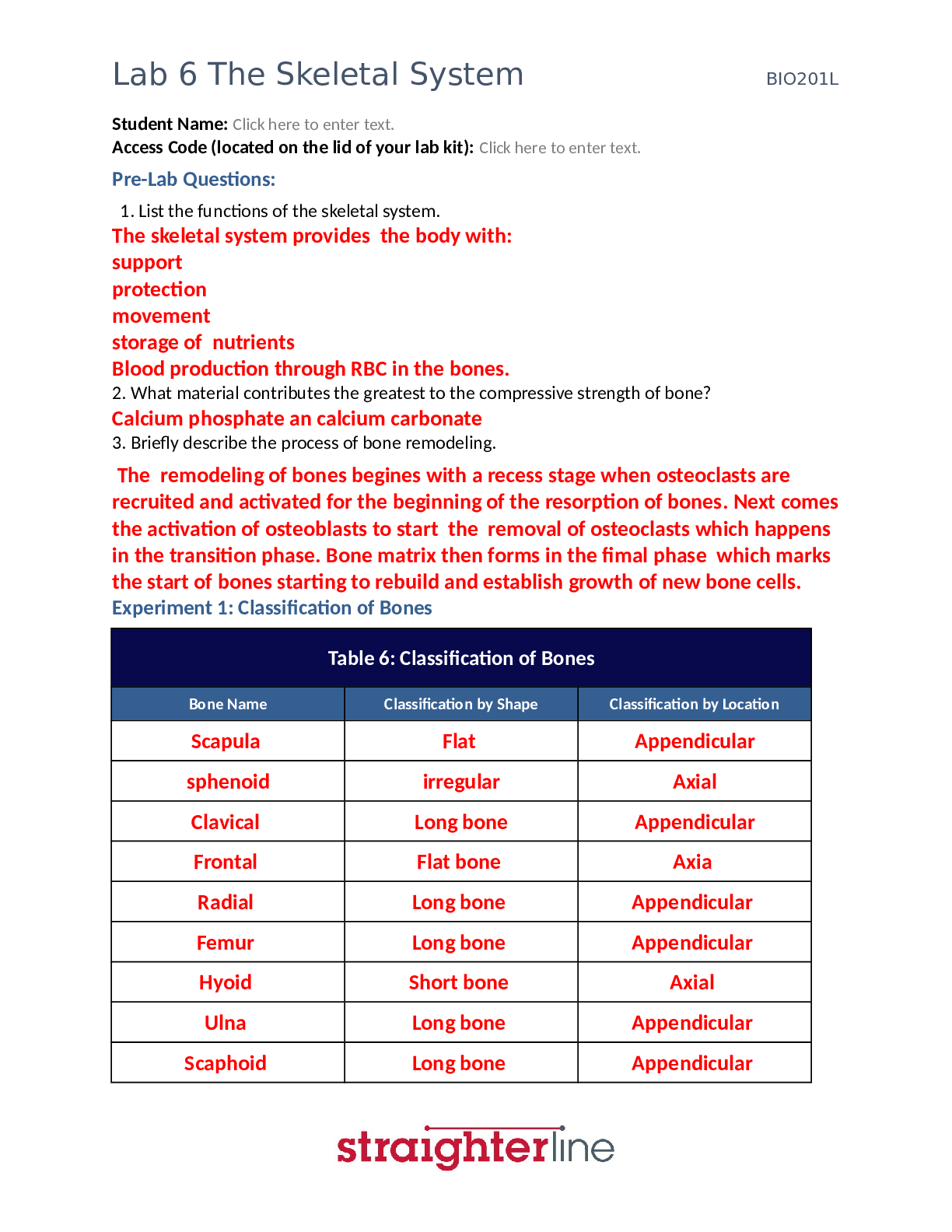
Experiment 1: Classification of Bones
Table 6: Classification of Bones
Bone Name Classification by Shape Classification by Location
Scapula Flat Appendicular
sphenoid irregular Axial
Clavical Long bone Appendicular
Frontal Flat bone Axia
Radial Long bone Appendicular
Femur Long bone Appendicular
Hyoid Short bone Axial
Ulna Long bone Appendicular
Scaphoid Long bone AppendicularLab 6 The Skeletal System BIO201L
Parietl Long bone Axial
Post-Lab Questions
”1. Why is it important to classify bones? ”
To accurately Identify them so as to simplfy the process of studying them for
their location shape and purpose. During disease identification process of in
the case of a process this information comes in handy , with clarity and in
synopsis form.”
2. Aside from length, what are some other common characteristics of a long bone? Are long
bones typically associated with the axial or appendicular skeleton? ”
Long bones are generally on the the appendicular skeleton. They are long and
wide and found on the upper and lower extremities. The long bone has the
Diaphysis, epiphysis peristoneum and articular cartilage, yellow and red bone
marrow where RBC are manufactured. They provide the body with strength and
structure. ”
3. Compare flat bones and long bones. How are they different? How are they the same? ”
Flat bones are made of a spongy network. They have two layers of compact
bone. The main function of flat bones is to protect internal organs.The skull is
an example of a flat bone it protects the brain.
Long bones have :diaphysis, epiphysis, periosteum, endosteum, articular
cartilage, epiphyseal
plate, spongy bone, compact bone, medullary cavity, red marrow, and yellow
marrow. This gives them the framwork they need to provide support the
weight of the body and and facilitate movement.
Experiment 2: Digital Slide Image Examination—Bone
Post-Lab Questions
”1. Label the arrows in the following digital slide images: ”
”Cortical Bone: ”
[Show More]