a. Assessment before surgery
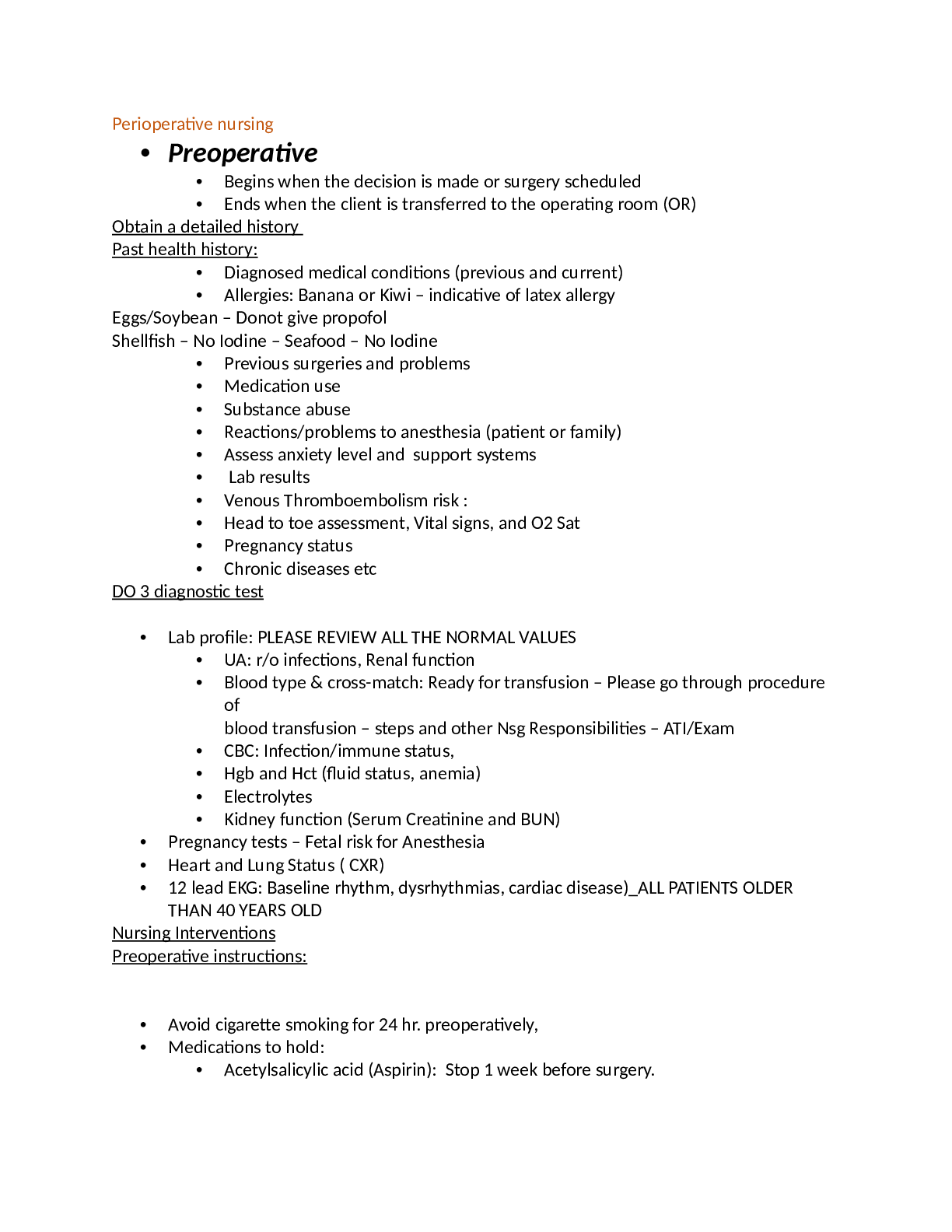
- Verify that informed consent is completed, signed, and witnessed
o The nurse witnesses the informed consent and make sure patient is clear
about the procedure
o The provider responds fo
...
a. Assessment before surgery
- Verify that informed consent is completed, signed, and witnessed
o The nurse witnesses the informed consent and make sure patient is clear
about the procedure
o The provider responds for description of the risks of anesthesia, benefits of
procedure, potential harm, pain, discomfort
- Ensure the preoperative checklist is completed
- Assess psychosocial
o Anxiety
o Common fears - fear of death, pain, discomfort, alteration of body image,
disruption of life functioning (daily activities, financial concern, family)
Therapeutic communications
Consult with social worker, spiritual or cultural advisor, financial
advisor
o Hope – negative/positive
- Heath history
o Past hospitalization
o Previous surgeries and the dates – identify any problems with them
o Female – last menstrual, number of pregnancies, history of C-section
o Family heath history – history of cardiac (sudden cardiac death, MI),
diabetes, hypertension, severe reaction with anesthesia
- Medications
o OTC drugs – aspirin, NSAIDs,
o Herbal supplements
astragalus, ginger increase BP
vitamin E, garlic, ginko, fish oilincrease bleeding
discontinue all herbal supplement 2 -3 weeks before surgery
o Prescribed medications
antihypertensive, antidepressant, anticoagulant can be held until
after the procedure
- Vital signs for baseline, assessment for pain
- Assessment for allergies
o Kiwi, banana latex allergies
o Shellfish iodine
- Assess cardiovascular
o Blood pressure, pulses
o Angina, HF, MI
o Edema, JVD
o Pacemaker, prosthetic heart valve
- Respiration
o COPD, asthma
o Smoking
o Breath sounds, rhythm
- Neurologic assessment
o A&O (x3)
o Confusion
b. Lab work to report
Lab Normal range
WBC 5,000 – 10,000/mm3
RBC Female: 4.7 – 6.1 million/uL
Male: 4.2 – 5.4 million/uL
Hgb Female: 12 – 16 g/dL
Male: 14 – 18 g/dL
Hct Female: 37 – 47%
Male: 42 – 52%
Platelets
PTT, PT, INR
150,000 – 400,000 mm3
Electrolytes
Na+
K+
135 – 145
3.5 – 5.1
BUN Female: 0.6 – 1.1mg/dL
Male: 0.7 – 1.3 mg/dL
Creatinine Female: 88 – 128mL/min
Male: 97 – 137mL/min
Blood sugar 70 - 120
ABGs pH 7.35 – 7.45
PaCO2 35 – 45
HCO3 22 – 26
PaO2 80 – 100
SpO2 95 – 100%
Electrolyte Na 135-145
K 3.5 5.0
Ca 8.5 – 10
Mg 1.5 – 2.5
Hgb A1C 4% - 6%
accepted range for diabetes ppl
6.5% - 8%
target goal: <7%
c. Pre-op drugs ie: anticholinergics, anti-anxiety, PCA
- antibiotics – cefazolin
- anticholinergic – atropine, glycopyrrolate, scopolamine
- antidiabetics – insulin
- antiemetic – Zofran, Reglan
- antianxiety – midazolam, diazepam, lorazepam
- antihypertensive – labetalol
- antihistamine – ranitidine
- opioids – PCA morphine
d. Teaching to patients pre-op
- NPO for 8 – 12 hours before surgery
- ensure denture, jewelry, nail polish, glasses are removed
- the purpose and effects of preoperative medications that will be administered
- post operative pain control techniques – medications, immobilization, PCA,
splinting
- chest therapy - splinting, coughing, deep breathing , incentive spirometer
- ROM, early ambulation after the surgery, SCD, antiembolism stocking
prevent DVT, pneumonia
- Bowel and skin preparation
- Postoperative diet – NPO, clear diet
2. Chapter 19 & 20- Post-Operative
a. Nursing assessment & interventions to prevent complications/problems
- frequent monitoring of vital signs
o every 15 min for first hour
o compare postop vital signs with preop/intraop VS ensure VS returning
to the baseline
- assess LOC
o level consciousness, stimulation needed for arousal (pain, touch, verbal)
o weakness, restlessness, orientation, agitation
- assess for pain level
o provide pain med 30 min before ambulation, dressing change
- assess airway
o gag reflex maintain NPO until return of gag reflex
o swallow ability
o artificial airway
o O2 sat 95%
o Respiratory pattern, rate, depth adequate oxygen
o Lung sounds suctioning needed
- Circulation
o Hypovolemic shock – decreased BP, increased HR, RR
o Skin color, temperature, sensation, cap refill, pulse, edema impaired
circulation, DVT
o Check mucous membrane, nail beds, lips for cyanosis
o Monitor EKG
o Fluid and electrolyte balance
- Observe incision and drain sites
o Report excess drainage the provider will do the first dressing changed
o Asses Incision site fro manifestations of infection – redness, excessive
tenderness, purulent drainage
o Assess for dehiscence/ evisceration
- Urination/bowel movement
o Monitor and report urinary output < 30mL/hr
o Abdominal distension
o Bowel sounds on 4 quadrants
o Maintain diet from clear to regular
b. Teaching to patient post-op
- instruct patient to cough, deep breath at least 1 hr while awake
- instruct to splint with pillow or folded blanket for abdominal incision
- assist with the use of incentive spirometer q1-2 hr while awake
- reposition q2hr
- ambulate early and regularly prevent DVT, pulmonary complications,
cardiovascular disorders
- do not put pillow under knees or elevate the knees gatch on the bed decrease
venous return
- encourage the client to ask for pain medication before pain gets severe
- high in calories, protein, and vitamin C diet
- maintain appropriate blood glucose with diabetic client
3. Ch 12, 23, 24; Wound care
a. What impacts healing
- nutrition deficiencies
o protein – albumin level < 3
- poor circulation
- infection
- smoking impedes blood flow to healing area
- mechanical friction of wound
- aging slower in older adults
- obesity decreased blood supply in fat tissues
- diabetes
- anemia
b. Stages of pressure ulcers, what makes wound healing worse
Stage I – intact skin, nonblancable redness, usually over a bony prominence;
discoloration of skin, warmth, edema, hardness, or pain
[Show More]