Physics  >  Lab Report  >  PHYS 1403 Lab 7: APPARENT & ABSOLUTE VISUAL MAGNITUDE Worksheet (All)

PHYS 1403 Lab 7: APPARENT & ABSOLUTE VISUAL MAGNITUDE Worksheet

Document Content and Description Below

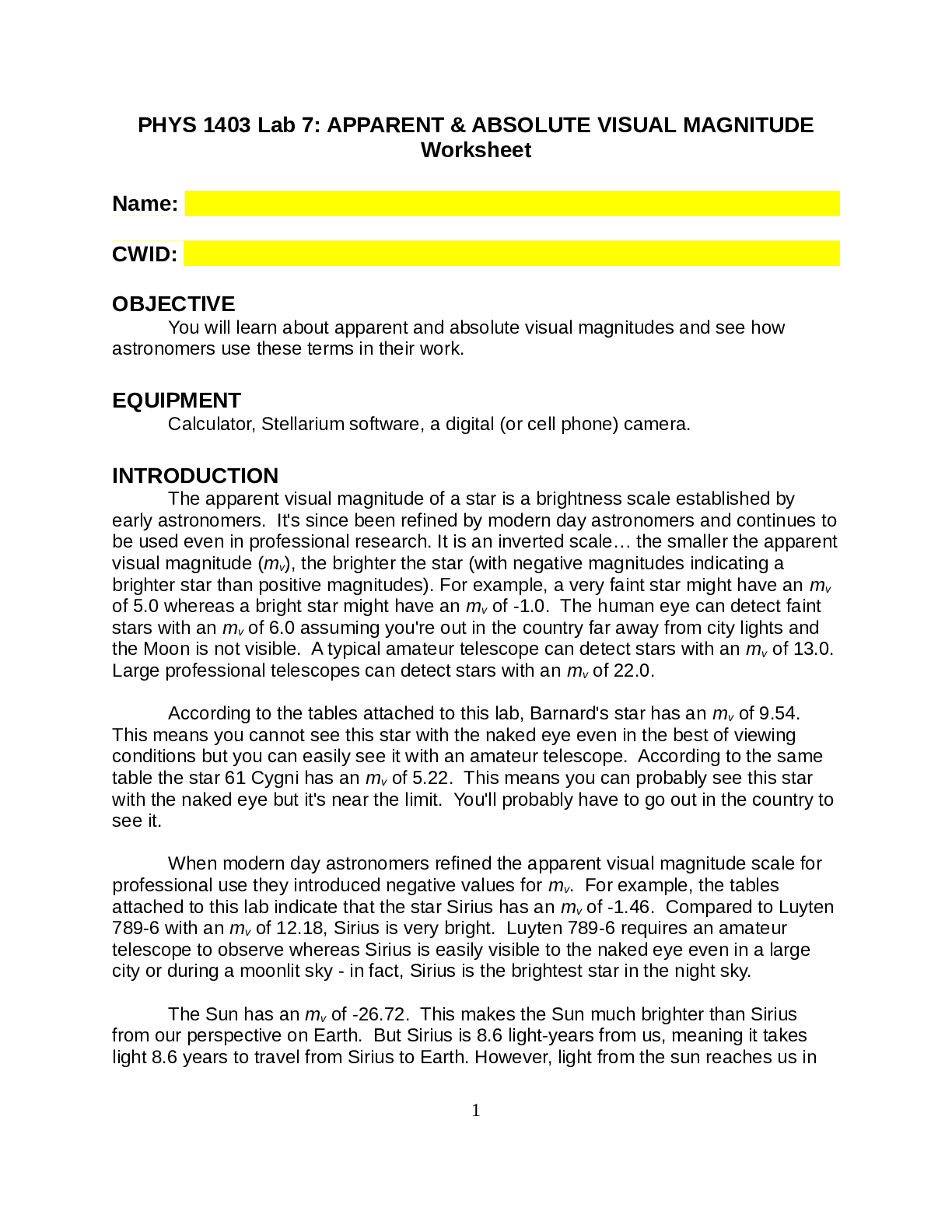
PHYS 1403 Lab 7: APPARENT & ABSOLUTE VISUAL MAGNITUDE Worksheet Name: CWID: OBJECTIVE You will learn about apparent and absolute visual magnitudes and see how astronomers use these terms in thei ... r work. EQUIPMENT Calculator, Stellarium software, a digital (or cell phone) camera. INTRODUCTION The apparent visual magnitude of a star is a brightness scale established by early astronomers. It's since been refined by modern day astronomers and continues to be used even in professional research. It is an inverted scale… the smaller the apparent visual magnitude (mv), the brighter the star (with negative magnitudes indicating a brighter star than positive magnitudes). For example, a very faint star might have an mv of 5.0 whereas a bright star might have an mv of -1.0. The human eye can detect faint stars with an mv of 6.0 assuming you're out in the country far away from city lights and the Moon is not visible. A typical amateur telescope can detect stars with an mv of 13.0. Large professional telescopes can detect stars with an mv of 22.0. According to the tables attached to this lab, Barnard's star has an mv of 9.54. This means you cannot see this star with the naked eye even in the best of viewing conditions but you can easily see it with an amateur telescope. According to the same table the star 61 Cygni has an mv of 5.22. This means you can probably see this star with the naked eye but it's near the limit. You'll probably have to go out in the country to see it. When modern day astronomers refined the apparent visual magnitude scale for professional use they introduced negative values for mv. For example, the tables attached to this lab indicate that the star Sirius has an mv of -1.46. Compared to Luyten 789-6 with an mv of 12.18, Sirius is very bright. Luyten 789-6 requires an amateur telescope to observe whereas Sirius is easily visible to the naked eye even in a large city or during a moonlit sky - in fact, Sirius is the brightest star in the night sky. The Sun has an mv of -26.72. This makes the Sun much brighter than Sirius from our perspective on Earth. But Sirius is 8.6 light-years from us, meaning it takes light 8.6 years to travel from Sirius to Earth [Show More]

Last updated: 3 years ago

Preview 1 out of 13 pages

Buy Now

Instant download

We Accept:

Payment methods accepted on Scholarfriends (We Accept)
Preview image of PHYS 1403 Lab 7: APPARENT & ABSOLUTE VISUAL MAGNITUDE Worksheet document

Buy this document to get the full access instantly

Instant Download Access after purchase

Buy Now

Instant download

We Accept:

Payment methods accepted on Scholarfriends (We Accept)

Reviews( 0 )

$11.00

Buy Now

We Accept:

Payment methods accepted on Scholarfriends (We Accept)

Instant download

Can't find what you want? Try our AI powered Search

62
0

Document information


Connected school, study & course


About the document


Uploaded On

Jul 08, 2021

Number of pages

13

Written in

All

Seller


Profile illustration for Cheryshev
Cheryshev

Member since 4 years

102 Documents Sold

Reviews Received
6
4
1
0
1
Additional information

This document has been written for:

Uploaded

Jul 08, 2021

Downloads

 0

Views

 62

Document Keyword Tags

Recommended For You

Get more on Lab Report »

$11.00
What is Scholarfriends

Scholarfriends.com Online Platform by Browsegrades Inc. 651N South Broad St, Middletown DE. United States.

We are here to help

We're available through e-mail, Twitter, Facebook, and live chat.
 FAQ
 Questions? Leave a message!

Follow us on
 Twitter

Copyright © Scholarfriends · High quality services·