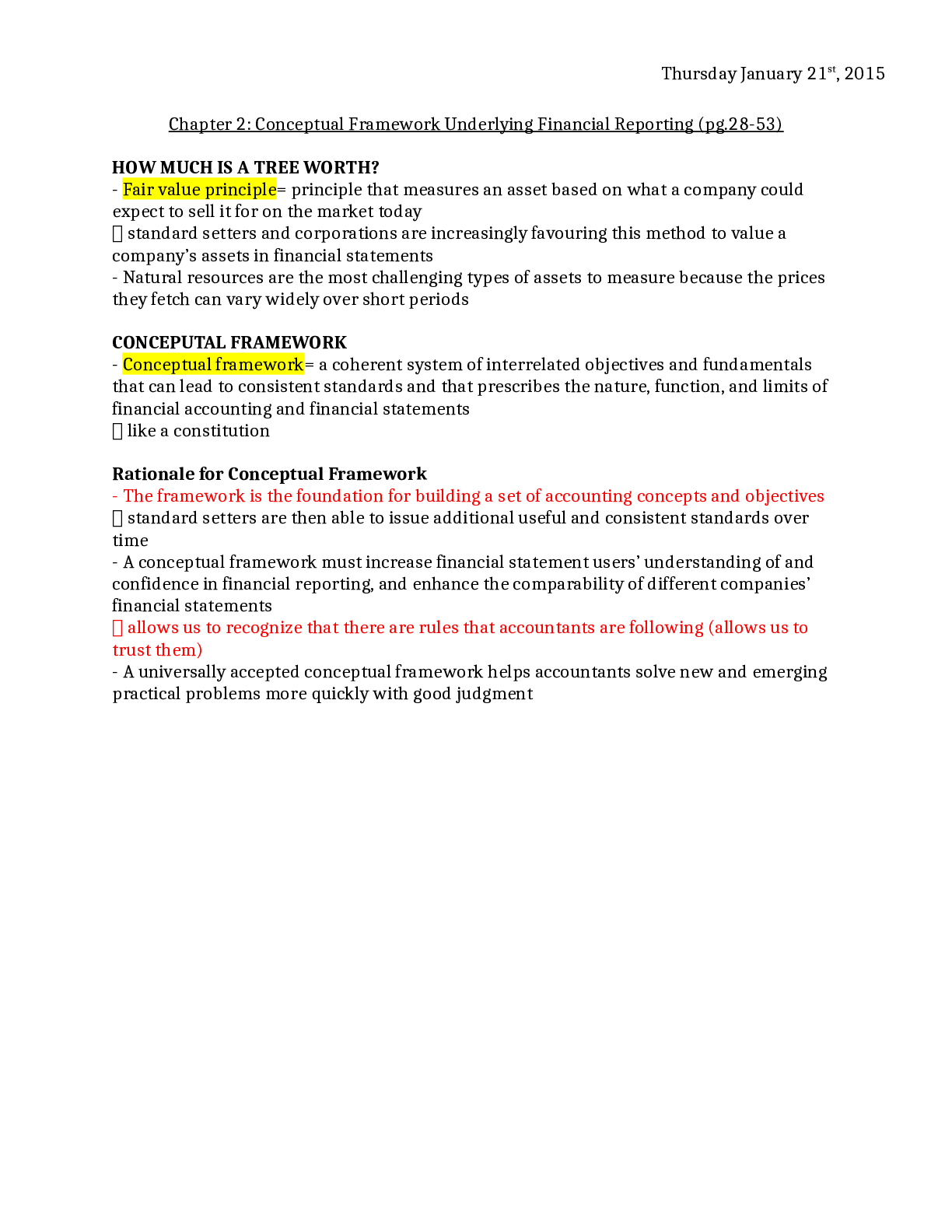
Midterm 2A:
1. Know: Diagram of bladder (a receptor) – 1) Effect of sympathetic stimulation, alpha or
beta adrenergic receptors. Relaxation of muscular wall (beta 2); contraction of internal
urethral sphincter (alpha
...
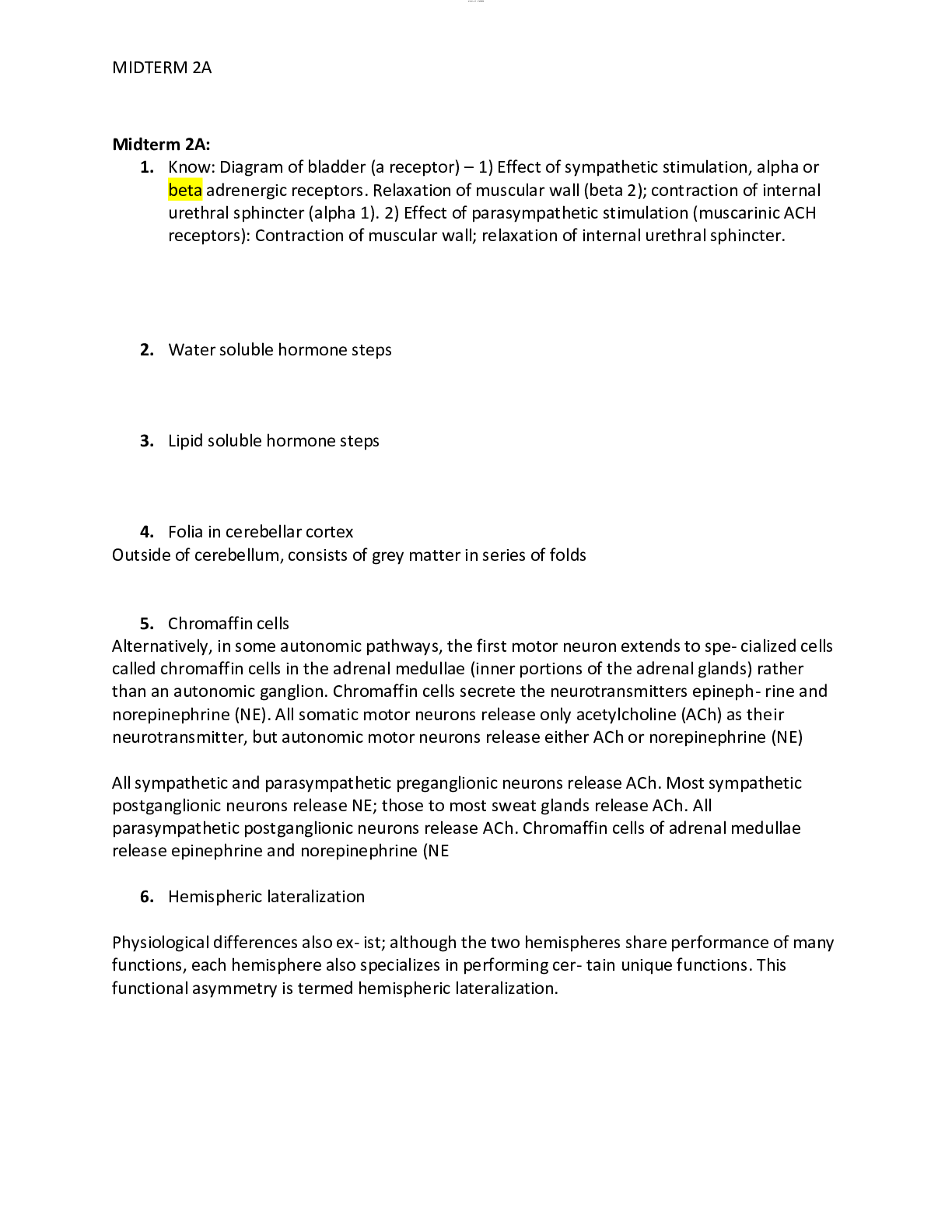
Midterm 2A:
1. Know: Diagram of bladder (a receptor) – 1) Effect of sympathetic stimulation, alpha or
beta adrenergic receptors. Relaxation of muscular wall (beta 2); contraction of internal
urethral sphincter (alpha 1). 2) Effect of parasympathetic stimulation (muscarinic ACH
receptors): Contraction of muscular wall; relaxation of internal urethral sphincter.
2. Watersoluble hormone steps
3. Lipid soluble hormone steps
4. Folia in cerebellar cortex
Outside of cerebellum, consists of grey matter in series of folds
5. Chromaffin cells
Alternatively, in some autonomic pathways, the first motor neuron extends to spe- cialized cells
called chromaffin cells in the adrenal medullae (inner portions of the adrenal glands) rather
than an autonomic ganglion. Chromaffin cells secrete the neurotransmitters epineph- rine and
norepinephrine (NE). All somatic motor neurons release only acetylcholine (ACh) as their
neurotransmitter, but autonomic motor neurons release either ACh or norepinephrine (NE)
Allsympathetic and parasympathetic preganglionic neurons release ACh. Mostsympathetic
postganglionic neurons release NE; those to most sweat glands release ACh. All
parasympathetic postganglionic neurons release ACh. Chromaffin cells of adrenal medullae
release epinephrine and norepinephrine (NE
6. Hemispheric lateralization
Physiological differences also ex- ist; although the two hemispheres share performance of many
functions, each hemisphere also specializes in performing cer- tain unique functions. This
functional asymmetry is termed hemispheric lateralization.
lOMoARcPSD|549 808 2
MIDTERM 2A
Despite some dramatic differences in functions of the two hemispheres, there is considerable
variation from one person to another. Also, lateralization seems less pronounced in fe- males
than in males, both for language (left hemisphere) and for visual and spatial skills (right
hemisphere). For instance, females are less likely than males to suffer aphasia after damage
7. Voltage gated channels -- specifically ones that use sodium ions
Gated channels that open in response to voltage stimulus (change in membrane potential).
Axons of all types of neurons.
Ie threshhod stimulus causes voltage gated na+ channels to open causing depolarization of cell
and propagation of action potential down axon
lOMoARcPSD|549 808 2
MIDTERM 2A
8. astigmatism, nearsightedness and farsightedness
astigmatism is when they eye does no refract light evenly on the retina, leads to blurred
vision at any distance
nearsightedness: Can see close, cant see far. AKA Myopia. Due to issue with refracting
the light, in near sightednees image gets focused in front of retina not on it
farsightedness: Can see far things, but not close things. AKA hyperopia. Visual image
gets focused behinf retina
9. CNS & PNS
10. Resting membrane potential voltage
11. Calcium channels
Muscle action potential along ttubes causes calcium to be pumped out ofsarcolemma
and calcium c hannels to open
12. triggerzones on neurons
axon hillock ( basically the verey beginning of an axon, last space where ESPS and ISPS
are summated to see if a threshold potential is met
lOMoARcPSD|549 808 2
MIDTERM 2A
13. dermatomes
A dermatome is an area of skin in which sensory nerves derive from a single
spinal nerve root (see the following image). Dermatomes of the head, face, and
neck.
14. diverging circuits
In a diverging circuit, the nerve impulse from a single presynap- tic neuron causes the
stimulation of increasing numbers of cells along the circuit. Allows signals to be
amplified
lOMoARcPSD|549 808 2
MIDTERM 2A
15. lumbar and sacral plexus
The roots (anterior rami) of spinal nerves L1–L4 form the lum- bar plexus (LUM-bar) (Figure
13.9). Unlike the brachial plexus, there is minimal intermingling of fibers in the lumbar plexus.
The lumbar plexus supplies the anterolateral abdominal wall, external genitals, and part of the
lower limbs
The roots (anterior rami) of spinal nerves L4–L5 and S1–S4 form the sacral plexus (SAˉ-kral)
(Figure 13.10). This plexus is situated largely anterior to the sacrum. The sacral plexus supplies
the buttocks, perineum, and lower limbs. The largest nerve in the body—the sciatic nerve—
arises from the sacral plexus.
16. muscles that flex thigh
quadriceps femoris, rectus femoris
17. central sulcus diagram - where it is
it is in the cerebrum and it seperates the frontal lobe from the parietal lobe
18. agonist/prime mover
is the prime mover that exerts the force to move the load
lOMoARcPSD|549 808 2
MIDTERM 2A
19. process of hearing
Bending of the stereocilia of the hair cells of the spiral organ causes the release of a neurotransmitter
(probably glutamate), which generates nerve impulses in the sensory neurons that innervate the hair cells.
The cell bodies of the sensory neurons are located in the spiral ganglia. Nerve impulses pass along the axons
of these neurons, which form the cochlear branch of the vestibulocochlear (VIII) nerve (Figure 17.23). These
axons synapse with neurons in the cochlear nuclei in the medulla oblongata on the same side. Some of the
axons from the cochlear nuclei decussate (cross over) in the medulla, ascend in a tract called the lateral
lemniscus on the opposite side, and terminate in the inferior colliculus in the midbrain.
20. descriptive word forsize of muscle – vastus?
Vastus = huge
21. presynaptic and postsynaptic excitations
presynaptic neurons sends the information and postsynaptic receive the info
secretory vesicles get released at the synaptic cleft and can have either an ISPS or ESPS effect
on that neron to inhib or excite the postsynaptic neuron
22. hormone functions
Help regulate:
extracellular fluid
metabolism
biological clock
contraction of cardiac & smooth muscle
glandular secretion
some immune functions
growth and development
reproduction
lOMoARcPSD|549 808 2
MIDTERM 2A
23. diagram ofzygomaticus
The zygomaticus major directs the motion of upper lip outward and superiorly, and it
especially controls smiling......The zygomaticus minor is located anterior towards
the zygomaticus major as well as supports the larger muscle in order to shifts the
upper lip upwards and outwards and backward as wel
24. tongue (what is the taste bud that disappears when you are an adult)
Foliate pappilae
It is located on the back lateral aspect of the tongue
25. sphenoid bone is the one that houses pituitary gland
is in contact with all other bones of the cranium
houses the pituitatry gland
lOMoARcPSD|549 808 2
MIDTERM 2A
26. the stretch reflex
A stretch reflex operates as follows (Figure 13.14):
1 Slight stretching of a muscle stimulates sensory receptors in the muscle called muscle
spindles (shown in more detail in Figure 16.4). The spindles monitor changes in the length of
the muscle.
2 In response to being stretched, a muscle spindle generates one or more nerve impulses
that propagate along a somatic sensory neuron through the posterior root of the spinal nerve
and into the spinal cord.
3 In the spinal cord (integrating center), the sensory neuron makes an excitatory synapse
with, and thereby activates, a motor neuron in the anterior gray horn.
4 If the excitation is strong enough, one or more nerve impulses arises in the motor
neuron and propagates, along its axon, which extends from the spinal cord into the anterior
root and through peripheral nerves to the stimulated muscle. The axon terminals of the motor
neuron form neuromuscu- lar junctions (NMJs) with skeletal muscle fibers of the stretched
muscle.
5 Acetylcholine released by nerve impulses at the NMJs trig- gers one or more muscle
action potentials in the stretched muscle (effector), and the muscle contracts. Thus, muscle
stretch is followed by muscle contraction, which relieves the stretching.
In the reflex arc just described, sensory nerve impulses enter the spinal cord on the same side
from which motor nerve im- pulses leave it. This arrangement is called an ipsilateral reflex (ipsi-LAT-er-al same side). All monosynaptic reflexes are ip- silateral.
27. medulla (adrenal medulla?)
The adrenal medulla, the inner part of an adrenal gland, controls hormones that
initiate the flight or fight response. The main hormones secreted by the adrenal
medulla include epinephrine (adrenaline) and norepinephrine (noradrenaline),
which have similar functions.cranial nerve for vision/location
28. retina
a layer at the back of the eyeball containing cells that are sensitive to light and that
trigger nerve impulses that pass via the optic nerve to the brain, where a visual image is
formed.
29. cochlea
The cochlea is a hollow, spiral-shaped bone found in the inner ear that plays a key role
in the sense of hearing and participates in the process of auditory transduction. Sound
waves are transduced into electrical impulses that can be interpreted by the brain as
individual frequencies of sound.
[Show More]








.png)
.png)


.png)