NR-507 Study Guide
Chapters 1-5, 11-14, 16-20, 21-25, 27-3-33, 34-39, 40-47
1. Types of immunity-e.g. innate, active, etc (ch 7 ,191)
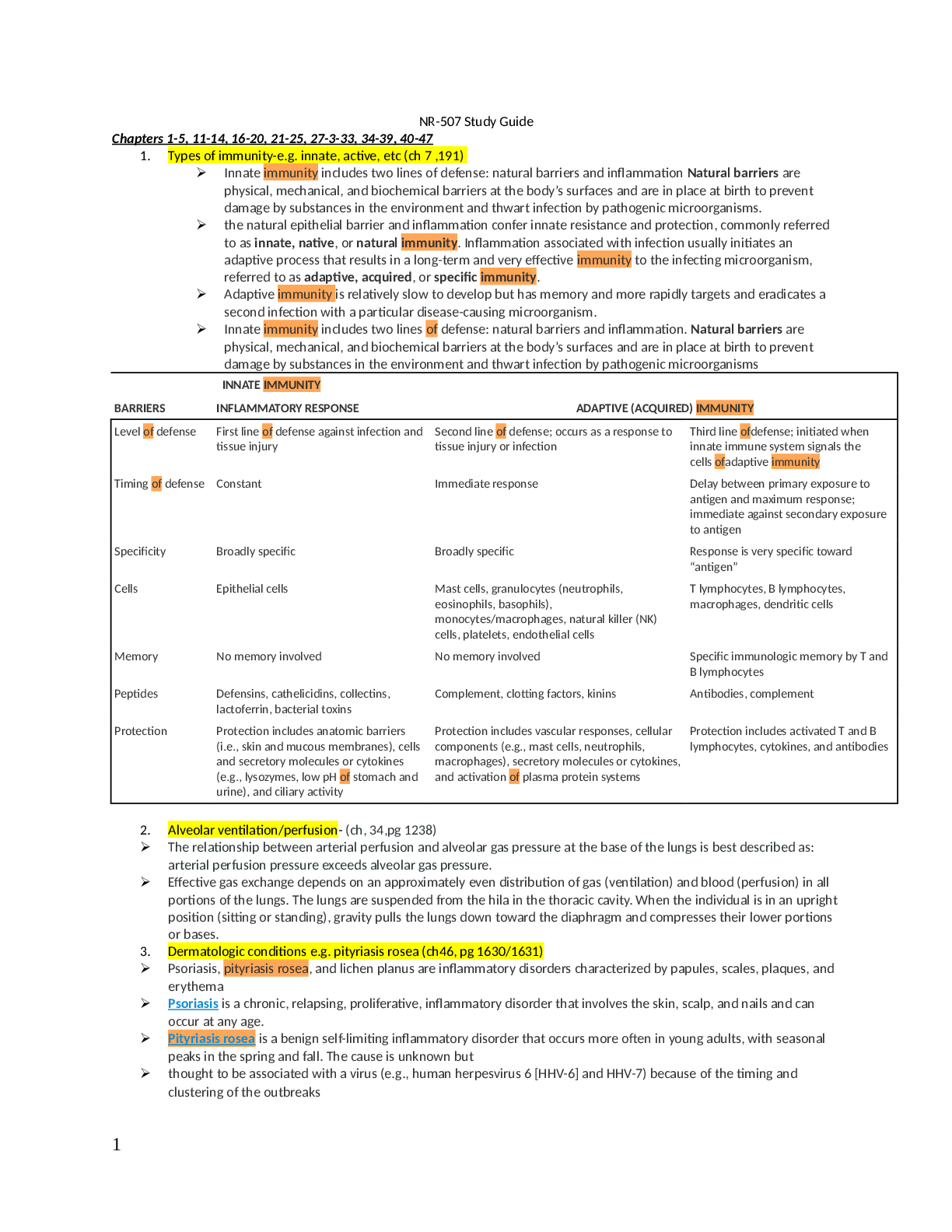
Innate immunity includes two lines of defense: natural barriers and inflammation
...
NR-507 Study Guide
Chapters 1-5, 11-14, 16-20, 21-25, 27-3-33, 34-39, 40-47
1. Types of immunity-e.g. innate, active, etc (ch 7 ,191)
Innate immunity includes two lines of defense: natural barriers and inflammation Natural barriers are
physical, mechanical, and biochemical barriers at the body’s surfaces and are in place at birth to prevent
damage by substances in the environment and thwart infection by pathogenic microorganisms.
the natural epithelial barrier and inflammation confer innate resistance and protection, commonly referred
to as innate, native, or natural immunity. Inflammation associated with infection usually initiates an
adaptive process that results in a long-term and very effective immunity to the infecting microorganism,
referred to as adaptive, acquired, or specific immunity.
Adaptive immunity is relatively slow to develop but has memory and more rapidly targets and eradicates a
second infection with a particular disease-causing microorganism.
Innate immunity includes two lines of defense: natural barriers and inflammation. Natural barriers are
physical, mechanical, and biochemical barriers at the body’s surfaces and are in place at birth to prevent
damage by substances in the environment and thwart infection by pathogenic microorganisms
INNATE IMMUNITY
BARRIERS INFLAMMATORY RESPONSE ADAPTIVE (ACQUIRED) IMMUNITY
Level of defense First line of defense against infection and
tissue injury
Second line of defense; occurs as a response to
tissue injury or infection
Third line ofdefense; initiated when
innate immune system signals the
cells ofadaptive immunity
Timing of defense Constant Immediate response Delay between primary exposure to
antigen and maximum response;
immediate against secondary exposure
to antigen
Specificity Broadly specific Broadly specific Response is very specific toward
“antigen”
Cells Epithelial cells Mast cells, granulocytes (neutrophils,
eosinophils, basophils),
monocytes/macrophages, natural killer (NK)
cells, platelets, endothelial cells
T lymphocytes, B lymphocytes,
macrophages, dendritic cells
Memory No memory involved No memory involved Specific immunologic memory by T and
B lymphocytes
Peptides Defensins, cathelicidins, collectins,
lactoferrin, bacterial toxins
Complement, clotting factors, kinins Antibodies, complement
Protection Protection includes anatomic barriers
(i.e., skin and mucous membranes), cells
and secretory molecules or cytokines
(e.g., lysozymes, low pH of stomach and
urine), and ciliary activity
Protection includes vascular responses, cellular
components (e.g., mast cells, neutrophils,
macrophages), secretory molecules or cytokines,
and activation of plasma protein systems
Protection includes activated T and B
lymphocytes, cytokines, and antibodies
2. Alveolar ventilation/perfusion- (ch, 34,pg 1238)
The relationship between arterial perfusion and alveolar gas pressure at the base of the lungs is best described as:
arterial perfusion pressure exceeds alveolar gas pressure.
Effective gas exchange depends on an approximately even distribution of gas (ventilation) and blood (perfusion) in all
portions of the lungs. The lungs are suspended from the hila in the thoracic cavity. When the individual is in an upright
position (sitting or standing), gravity pulls the lungs down toward the diaphragm and compresses their lower portions
or bases.
3. Dermatologic conditions e.g. pityriasis rosea (ch46, pg 1630/1631)
Psoriasis, pityriasis rosea, and lichen planus are inflammatory disorders characterized by papules, scales, plaques, and
erythema
Psoriasis is a chronic, relapsing, proliferative, inflammatory disorder that involves the skin, scalp, and nails and can
occur at any age.
Pityriasis rosea is a benign self-limiting inflammatory disorder that occurs more often in young adults, with seasonal
peaks in the spring and fall. The cause is unknown but
thought to be associated with a virus (e.g., human herpesvirus 6 [HHV-6] and HHV-7) because of the timing and
clustering of the outbreaks
1 Pityriasis rosea begins as a single lesion known as a herald patch that is circular, demarcated, and salmon-pink; is
approximately 3 to 4 cm in diameter; and is usually located on the trunk
Lichen planus (LP) is a benign, autoimmune inflammatory disorder of the skin and mucous membranes with multiple
clinical variations. The cause is unknown, but T cells, adhesion molecules, inflammatory cytokines, perforin, and
antigen-presenting cells are involved.The infiltrate of T cells mediates immunoreactivity against basal layer
keratinocytes, which have altered surface antigens and adhesion molecules
LP is also linked to hepatitis C virus. Some individuals develop lichenoid lesions after exposure to drugs or filmprocessing chemicals. The age of onset is usually between 30 and 70 years. The disorder begins with flat purple,
polygonal, pruritic, nonscaling papules 2 to 4 mm in size, usually located on the wrists, ankles, lower legs, and
genitalia
New lesions are pale pink and evolve into a dark violet. Persistent lesions may be thickened and red, forming
hypertrophic LP. Oral lesions (oral lichen planus) appear as lacy white rings that must be differentiated from
leukoplakia or oral candidiasis and they may be precancerous lesions
4. Croup (C 36,pg 1294)-
Croup illnesses can be divided into two categories: (1) acute laryngotracheobronchitis (croup) and (2)
spasmodic croup. Diphtheria can be considered a croup illness but is now rare because of
vaccinations. Croup illnesses are all characterized by infection and obstruction of the upper airways.
Croup is an acute laryngotrac
[Show More]