ATI Leadership
(COPD patients with 90% SpO2/patients with pressure ulcers – chronic conditions. NEVER the priority)
Practice A & B (2010/2013/2016)
Chapter 1:
Leadership Styles
1. Authoritative
a. Leader dictat
...
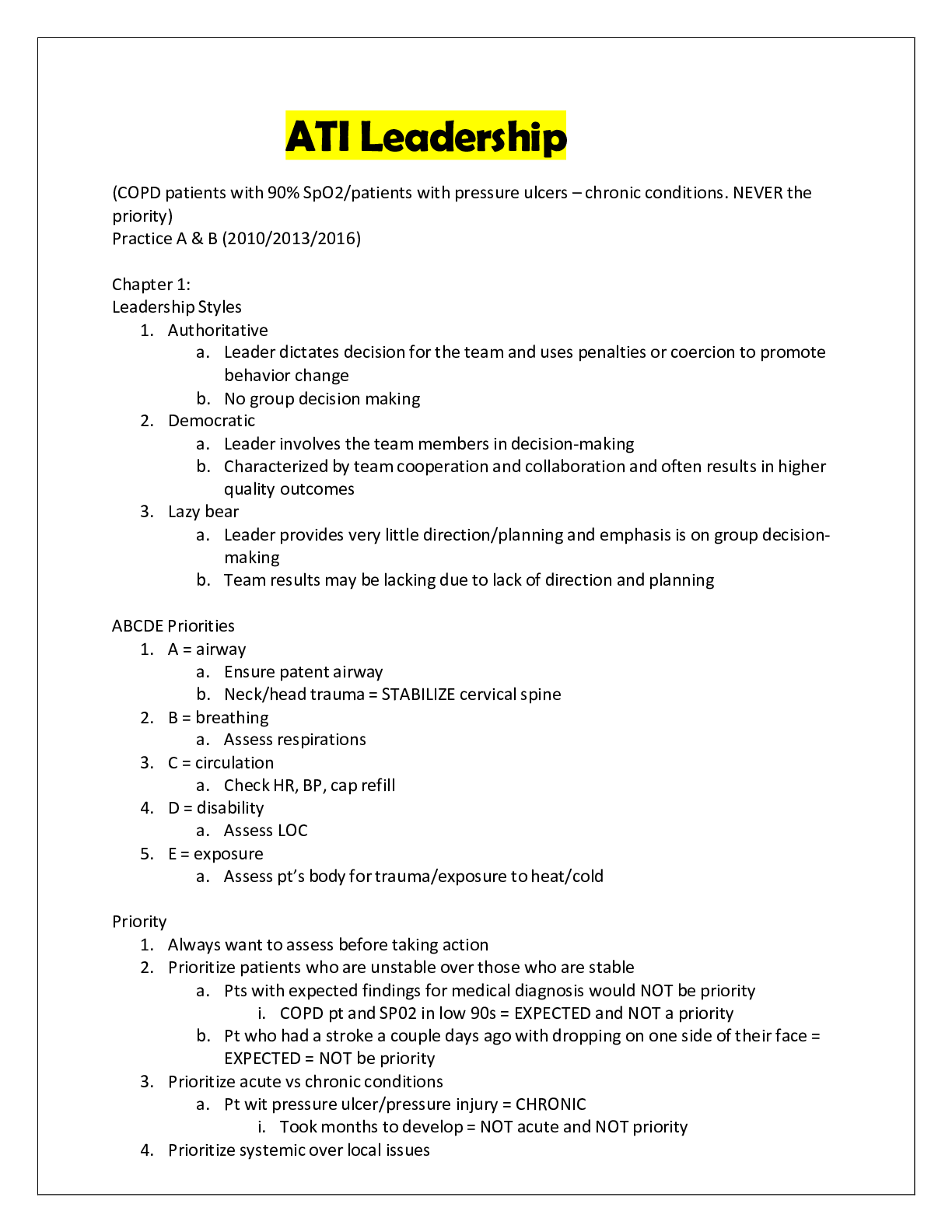
ATI Leadership
(COPD patients with 90% SpO2/patients with pressure ulcers – chronic conditions. NEVER the priority)
Practice A & B (2010/2013/2016)
Chapter 1:
Leadership Styles
1. Authoritative
a. Leader dictates decision for the team and uses penalties or coercion to promote behavior change
b. No group decision making
2. Democratic
a. Leader involves the team members in decision-making
b. Characterized by team cooperation and collaboration and often results in higher quality outcomes
3. Lazy bear
a. Leader provides very little direction/planning and emphasis is on group decision- making
b. Team results may be lacking due to lack of direction and planning
ABCDE Priorities
1. A = airway
a. Ensure patent airway
b. Neck/head trauma = STABILIZE cervical spine
2. B = breathing
a. Assess respirations
3. C = circulation
a. Check HR, BP, cap refill
4. D = disability
a. Assess LOC
5. E = exposure
a. Assess pt’s body for trauma/exposure to heat/cold
Priority
1. Always want to assess before taking action
2. Prioritize patients who are unstable over those who are stable
a. Pts with expected findings for medical diagnosis would NOT be priority
i. COPD pt and SP02 in low 90s = EXPECTED and NOT a priority
b. Pt who had a stroke a couple days ago with dropping on one side of their face = EXPECTED = NOT be priority
3. Prioritize acute vs chronic conditions
a. Pt wit pressure ulcer/pressure injury = CHRONIC
i. Took months to develop = NOT acute and NOT priority
4. Prioritize systemic over local issues
a. Systemic symptoms: BP starts to decrease, it is a big deal and you want to give that patient priority
b. Tachypnea/Tachycardia = SYSTEMIC RED FLAG
c. Local issues = local pain or swelling is more indicative of local problem
5. Prioritize interventions using ABCDE framework
a. Administer O2 to someone with dyspnea takes priority over giving pain medication to a patient
b. Giving pain meds is NEVER the priority!
6. Choose least invasive and restrictive interventions over more invasive/restricting interventions
a. High risk fall patients = move the patient closer to nursing station and set a bed alarm BEFORE putting them in restraints (last resort)
7. In a mass casualty event, prioritize those who have a chance or surviving over those who are expected to diet
a. BLACK TAG (Class 4) = patients expected to die
b. Focus attention on patients who actually have a chance at surviving
Time Management
1. Complete charting on assessment/interventions ASAP
a. Do not wait until after shift to complete charting
2. Try to group tasks that are for a single patient or for a patient that is located closer together to prevent repeated trips back and forth to supply room
a. Mentally work through procedure/intervention and gather supplies as you are thinking about them
3. Complete difficult/time-consuming tasks EARLY on the shift NOT LATER because energy is higher
4. Perform non-essential tasks later on the day
5. Always complete tasks before starting new tasks
6. Always know when to delegate & when to ask for help
a. If drowning in work, ask mentor nurse/charge nurse before it gets bad
7. Do not help other team members with low-priority tasks while you still have outstanding tasks to complete
a. If it’s high priority, help them
Delegation RN
1. As an RN, NEVER delegate anything that requires nursing judgement
a. New admission, evaluate patient’s ability to swallow = ONLY FOR RN
2. Never delegate anything that requires patient education
a. When teaching a patient, education on diagnosis = ONLY FOR RN
3. Nursing assessment
a. Head-to-toe, assessment
4. Blood transfusions
a. Requires 2nd RN to verify all information
Delegating to LPN/LVN
1. Medication administration
2. Enteral feedings through NG/G tube
3. Urinary catheter insertion
4. Suctioning
5. Trach care
6. Reinforce patient teaching
a. RN needs to do initial teaching, LPN/LVN can reinforce teaching
7. Check NG tube patency
Delegating to UAP/CNA
1. Bathing
2. Dressing
3. Ambulating
4. Toileting
5. Feeding patients without swallowing difficulties
a. If patient has swallowing issues, it should NOT be delated to UAP/CNA
6. Positioning
7. Take vital signs on stable patients
8. Make beds
9. Collect specimens
10. Keep track of I&Os
11. Simple dressing change
12. Suction established tracheostomy
If CNA reports something that is out of the norm, RN has to take measurements again to confirm finding/reading
Rights to delegation
1. Right task
a. Tasks that are repetitive, non-invasive and don’t require supervision
2. Right circumstances
a. Never delegate a patient who is unstable
i. Patient who just came from PACU, do not delegate to someone else
ii. Assess patient
3. Right person
a. Make sure person you are delegating to is competent and operating within their own scope of practice
b. Check facility’s job description OR reference skill competency checklist
4. Right direction & communication
a. Communicate specific timeline, expected results, and follow-up communication expectations
5. Right supervision & evaluation
a. May need to intervene if tasks are not done right
b. Provide feedback if needed
Quality Improvement = process used to improve quality of care within a healthcare facility/team and it measures the performance of a unit/team based on a predetermined set of standards
1. First step: establish best practice guidelines/standards of care/benchmark
2. Second step: collect data to see how that nursing team is doing compared to that best practice guidelines
3. If benchmark is not met, a root cause analysis can be done to figure out what they are not at level and how to get to that level
Employee performance Reviews
1. As a manager, collect data on your employee’s performance over time
a. Looking at the performance over a year (annual reviews)
2. Allow for an employee self-appraisal before the review
a. The employees are able to say how they think they did against the different metrics
3. Include peer reviews
a. Get input from other RNs on the team/unit that employees work on
4. Go through performance checklists
a. Compare your RN against the standards of care that have been established not against another RN
b. Focus on comparing their performance against the standards that facility has set
c. Discuss employees’ goals
d. Employees who do not agree with the evaluation can make written comments on the evaluation and make an appeal
Disciplinary Actions
1. If an employee is working under the influence of drugs/alcohol = immediate dismissal
a. No progressive disciplinary action
b. Termination immediately
2. Less serious offenses = progressive discipline method
a. 1st time: verbal reprimand
b. 2nd time: written reprimand
c. suspension
d. termination
Conflict
1. Intrapersonal conflict
a. Internal conflict
i. Part time to spend time with kids vs furthering career and working full time
2. Interpersonal conflict
a. Conflict between 2 or more people
3. *Five stages of Conflict
a. Stage 1: Latent Conflict – no conflict yet, but high likelihood of occurrence
b. Stage 2: Perceived conflict- individual believes that a problem exists, but the other party is unaware
c. Stage 3: Felt conflict- individual has an emotional response to a conflict
d. Stage 4: Manifest conflict – both parties are aware of conflict and action is taken to resolve the conflict
e. Stage 5: conflict aftermath – the conflict is resolved and results are either positive or negative
Negotiation strategies
1. Avoiding withdrawing
a. Both parties refuse to acknowledge/work on a resolution to the conflicts
b. Ignoring the problem
2. Smoothing
a. One party attempts to keep the peace by complimenting the other party and then the conflict remains unresolved
i. “Can you do this because you’re so good at doing it!”
3. Competing Coercing
a. Win-Lose situation
b. 1 party gets their desired solution to the conflict at the expense of the other party
4. Cooperating accommodating
a. Lose-win situation
b. One party gives up what they want (basically cave in) and allow the other party to get their desired solution
5. Compromising
a. Both parties give up something and come to a compromise
6. Collaborating
a. Win-win situation
b. Both parties work together to define a mutually agreeable solution
c. Ideal way to solve a conflict
Chapter 2
Members of the interprofessional team
1. Case manager
a. Does not provide direct patient care
b. Acting as a care coordinator for the healthcare team to safely transition the patient from acute care to home/skilled nursing facility/long-term acute facility
c. Arrange for home health nurse, equipment needs
2. Occupational therapist
a. Help patient regain ability to perform ADLs
b. Work with the patient on brushing their teeth, putting their socks on, moving around to take care of themselves
3. Speech-langauge pathologists
a. Assist the patient with issues regarding speech, language, and swallowing
b. Dysphagia – SLP will do swallow evaluation*
Critical Pathway – used to promote cost effective care by standardizing care for patients with a specific common diagnosis
-complete knee replacements are common and popular
-patients will follow the same type of activities and timeline in general
-post-surgery: get up at this time, give them specific medications, involve PT/OT
-helps cost effectiveness and efficiency
1. developed using evidenced-based strategies that includes: time-bound activities, interventions, and outcomes
Consultation – request from a provider to another physician/resource that can provide expert advice/services for the patient
Referral – when a provider recommends/request management of 1/more of the patient’s concerns/issues to another provider OR refer them to a support service
1. Support groups
2. Churches
3. Transportation services
4. Meal delivery services
Transferring patients from one unit to another
1. Use a communication handoff tool (SBAR)
a. Provide information regarding patient’s diagnosis
b. Let the receiving RN know their advance directives are (full code or DNR)
c. Recent vital signs from that day w. LOC and how they transfer, swallowing ability
Discharge
1. *Discharge planning starts at admission
2. Instructions
a. Diet and activity restrictions
b. Detailed instructions/written for procedures at home
i. Wound care/dressing changes
c. List of medications, when to take them, precautions
d. Idea of S/S of complications and when to seek medical attention
i. Fever and increased erythema, smelly purulent drainage = SEEK
e. Follow-up appointment information
f. Names and numbers of provider and community resources to help them
Chapter 3
Refusal of treatment
1. Any competent adult has the right to refuse
2. Not competent
a. Adult with dementia
b. Adults under the influence of alcohol
i. If blood-alcohol level is greater than or equal to 0.08%
c. Schizophrenic patient who is experiencing command hallucinations
3. If a patient refuses treatment, need to ask them to sign a document that indicates that they understand the risks associated with refusing that treatment and that they are deciding to refuse
Leaving AMA – wants to leave the hospital against medical advice
1. Notify the provider ASAP
2. Attempt to discuss the risk with the patient risks associated with leaving against medical advice
3. Want to have the patient sign an AMA form
a. If the patient refuses to sign AMA form, RN needs to clearly document that in the charting that they refused to sign the form
Informed consent
1. Providers responsibilities
a. Communicating the purpose of procedure and a complete description of the procedure in the patient’s primary language (interpreter may be needed)
b. Communicate the risks and benefits of procedure/surgery
c. Describe other options that are available to treat condition
2. RN responsibilities
a. Make sure provider gave the patient the information
b. Ensure that patient is competent to give consent
i. Adult or emancipated minor
1. If parent/legal guardian of a minor is not available in an emergency situation, another family member/relative can give consent in case of an emergency
ii. Not impaired in any way
iii. Durable power of attorney can give consent if patient is incapacitated
iv. Spouse/close relative
v. Court specified representative
c. Patient needs to sign consent document
3. If patient is asking questions about the procedure and they don’t understand the information given to them, then RN needs to notify provider to talk to the patient
Advanced Directives
1. Living Will – a document that communicates a patient’s wishes regarding medical treatment in case the patient should become incapacitated
-what they want and what they don’t want
-If patient is incompetent at the time that the living will was made, the family could petition to get the living will revoked
2. Durable Power of Attorney (DPOA) – someone that the patient designates as their basically healthcare proxy to make medical decisions for them if they should become incapacitated
3. Providers Orders
-DNR (Do Not Resuscitate) or AND (Allow Natural Death)
-special document that patient/family signs so everyone’s on the same page
Mandatory Reporting
1. RNs are legally obligated to report suspicion of abuse
a. Child abuse, elderly abuse, domestic abuse
b. Report if you suspect right away
2. Nationally notifiable communicable diseases
a. Must be reported to local and state health department
b. Mandated by the state
c. Pertussis, HIV
HIPAA was designed to ensure the confidentiality of health information
1. Only those responsible for patient’s care may access the patient’s medical record
2. Patient has the right to obtain a copy of their medical record
3. Copies of medical record should NOT be made except for exchange of documents between health care facilities
4. Do not use patients’ names on display boards
5. Communication about a patient should happen in a private place
6. Need permission from a patient to share test or lab results with other family members
7. Always password protect your electronic records so you should never share passwords
8. Always log off before walking away from work station!
9. Never share patient information with unauthorized people
a. Get their name and check with patient for their permission to share
b. Code system – someone needs the code in order
Torts
1. Unintentional Torts
a. Negligence – forgetting to set the bed alarm for a high fall risk patient
b. Malpractice – medication error that harms the patient
2. Intentional Torts
a. Assault – threatening the patient
b. Battery – doing physical harm to the patient
c. False imprisonment – nurse inappropriately restrains a person/administers a chemical restraint (sedative)
State Board of Nursing
1. Determines laws and regulations governing Nursing in the state
2. Ensures that healthcare providers comply with state regulations
3. Responsible for issuing and revoking nursing licenses RN Responsibilities
1. Nurses know the laws and regulations the govern the state in which they practice
2. Nurses must have a license in every state in which they practice or reside in a state that is part of the nurse licensure compact
a. If you have license in one of the states, you can safely practice in other states that are involved in the compact
3. Nurses should refuse to practice beyond their legal scope of practice
Sentinel event-unexpected occurrence that causes patient death/serious psychological/physiological injury
1. Requires the organization to perform a root cause analysis
2. Implement improvements to avoid/reduce occurrences in the future
3. Monitor the effectiveness of those improvements Examples:
1. Wrong leg amputated, Full-code patient dues due to negligence
Impaired co-workers
1. If you suspect that one of your co-workers are under the influence of alcohol/other substances, (s/s: smell of alcohol in their breath, impaired coordination/bloodshot eyes), you MUST report your suspicions to the appropriate manager ASAP (Charge nurse)
2. Do not confront co-worker OR delay reporting in order to further observe their behavior
Telephone Orders
1. Have a second RN listen in on the call when receiving a telephone order
2. Make sure you get all components of the prescription including dose, frequency, & route
3. Repeat the prescription back to provider
4. Make sure provider signs off on the prescription, per facility policy, usually within 24 hours
5. If you receive a prescription that seems inappropriate/contraindicated for the patient, question that to the provider and express concerns
a. If they are still prescribing it, go to charge nurse with concerns
Nursing ethical principles
1. Autonomy – right to self-determination even if it’s not in their best interest
2. Beneficence – doing what is best for the patient
3. Fidelity – remaining loyal to the patient
4. Justice- providing fairness and in the care and allocation of resources
5. Non-maleficence – doing no harm to the patient
6. Veracity – telling the truth
Ethical decision making
What constitutes as an ethical dilemma?
Ethical dilemma is a problem that cannot be solved by reviewing scientific data. It involves a conflict between 2 moral imperatives and that decision has a major impact on the patient.
-Appropriate to involve Ethics Committee
-They will present the facts and present the family with options
-They are investigating and presenting facts so family can make a decision Chapter 4
Maintaining a safe environment Precautions
1. Standard Precautions
a. Apply to ALL patients
b. Hand-hygiene
c. Alcohol-based antiseptic unless hands are visible soiled
d. Masks and face shields whenever splashing of bodily fluids is possible when caring for a patient
e. Clean gloves must be worn when touching anything that may contaminate the nurse
f. Moisture resistant bags be used for soiled items
g. Dispose sharps in sharp container
2. Airborne Precautions
a. Patients with measles, varicella (chickenpox), TB
b. If suspected, put on airborne precautions
c. Private room with negative airflow
d. Nurse and visitors need to wear a N-95 high-efficiency particulate mask whenever going into the patient’s room
i. N95 must be fitted each year for the right size
3. Droplet Precautions
a. Influenza, PNA, Pertussis, mumps, sepsis, rubella, and bacterial meningitis
b. Private room or room with another patient with same condition
c. Masks must be worn for nurses, caregivers, and visitors
4. Contact Precautions
a. Impetigo, scabies, shigella, MRSA, herpes, VRE, C. Diff and other enteric infections, RSV, and wound infections
b. Private room or roomed with another patient with same infection
c. Gloves and gowns are requires for all caregivers and visitors
d. Keep dedicated equipment in the room for these patients
i. VS machines should stay in the room
Medical equipment safety
1. Equipment should be inspected by engineering or maintenance department on a regular basis
2. Make sure equipment is grounded
3. Unplug equipment by the plug, not the cord
4. Take malfunctioning equipment out of use immediately
a. Take it out, label it
Needle Stick Injury
1. Prevention
a. Retractable needles
b. Needles with capping mechanisms
c. Needleless connections
2. Injury
a. Notify supervisor ASAP
b. Patient and nurse will need to be tested for blood borne illness such as HIV/Hepatitis
c. Incident report must be created
i. Never reference or include the incident report in patient’s record
Preventing Falls
1. Complete a fall risk assessment on admission
2. Advise patients who have orthostatic hypotension to sit on side of bed, hang out for a minute, slowly get up
a. Do not change positions fast because blood pressure will drop and they will fall
3. Provide regular toileting to patients requiring assistance
a. Regular schedule and assist
4. Provide with skid proof socks
5. Place high risk fall patients near nursing station
6. Round on patients hourly
7. Respond to call lights in a timely manner
8. Frequently used items are within reach
9. Position the bed in the lowest position, lock the breaks, and set the alarm
10. *Do not want to put all 4 side rails up!
a. Try to crawl over side rails
b. Keep at least 1 side rail down
c. Considered restraint
Seizures
1. Lower the patient to the floor/bed and turn the patient on their side
2. Loosen any restrictive clothing
3. Do not restrain or put anything in their mouth!
4. Note onset and duration of seizure
5. After seizure, take vital signs and perform neurological checks. Reorient patient and identify triggers
6. Implement seizure precautions
a. Padding the bed rails
Restraints
1. Physical
a. Vest, belt, mitten
2. Chemical
a. Sedative or antipsychotic
3. Try alternatives before you apply restraints of any kind
a. Reorient the patient
b. Supervise the patient
c. Diversion
4. Should be last resort!
5. In an emergency, an RN can place restraints on a patient, but they must get a prescription from the Dr. ASAP within 1 hour
6. Orders can be written for up to 4 hours for adults
7. PRN prescription are not allowed
8. Remove each restraint one at a time q2hr to assess for skin integrity, do a neurovascular check, and provide ROM exercises
9. Always want to use least restrictive restrain as possible
a. Mittens are less restrictive than a wrist restraint
10. Apply restraint so that 2 fingers can fit between the restraint and the patient and ALWAYS use a quick-release knot
11. Place the restraints on an immovable portion of the bed
a. Not the side rails
12. Belt restraints over a patient’s gown or clothing
Fire safety
1. RACE sequence
a. R – Rescue
i. Move patients to a safer location
ii. Horizontal evacuation first and then lateral (moving to a different floor) evacuation if needed
b. A – Alarm
c. C – contain
i. Close doors and windows and turn off O2
d. E – Extinguish
2. PASS sequence – what you use with the fire extinguisher
a. P – pull the pin
b. A – aim at the base of fire
c. S – squeeze handle
d. S – sweep from side to side
Home Safety
1. Injury prevention
a. Infant and toddler
i. Avoid feeding infant/toddler any foods that can cause choking
1. Ex: popcorn, raisins, peanuts, grapes, raw carrots, hot dogs, celery, peanut butter, candy, and tough meat
ii. Place infants on their back when they sleep
iii. Do not place anything in the crib with the infants
iv. Make sure crib slats are less than or equal to 2 and 3/8 inches apart
v. Keep plastic bags, houseplants, cleaning agents out of reach
vi. Lock up medications
vii. Rear-facing car seat for kinds under 2 years old
viii. Care seats with a 5-point harness and place in backseat
ix. Turn pot handles away form front of the stove
x. Close bathroom doors and keep toilet lids down to prevent drowning
b. School-aged children
i. Car booster seat until child is at least 40 lbs or over 4”9in
ii. Keep the child in the back seat until they are 12 years old
iii. Protective gear
1. Helmets and pads for bicycling/sports
iv. Reduce your water heater setting in home to less than 120 degrees F
v. Keep any guns locked up and keep bullets stored in a separate location
vi. Enclose pool with a locked fence and always supervise children around pools/water
c. Adolescents
i. Educate teens on risks with smoking, drugs, alcohol, and unprotected sex
ii. Warn against distracted/impaired driving
1. No texting and driving
iii. Reinforce the need to wear seatbelts
iv. Monitor teen for mental health issues
1. Depression/anxiety
d. Older Adults
i. Remove trip hazards from their homes
1. Scatter bugs or loose carpeting has to go
ii. Electrical cords against wall behind furniture
iii. Install grab bars in the bathroom/showers
iv. Use non-skid mat in the shower
v. Make sure there is adequate lighting in the home especially over stairs and use colored tape on the step edges
Oxygen safety
Oxygen equipment increases the risk of combustion.
Place no smoking sign at the front door of the home
Make sure electrical equipment is grounded and in good shape Do not use extension cords at all
Use cotton betting and clothes
Do NOT use synthetic fabrics (Nylon or wool)
Keep flammable items away from the oxygen equipment Ex: Nail polish remover
Carbon Monoxide Poisoning
Carbon monoxide is an odorless, tasteless gas that binds to the hemoglobin in the body which reduces the amount of oxygen that is supplied to the tissues. Dangerous!
Use carbon monoxide detectors in the home.
Maintain proper ventilations when using fuel burning items (wood stoves/gas fireplaces) Get gas burning fireplaces appliances and water heaters inspected annually
Make sure flus and chimneys are unobstructed
S/S of carbon monoxide poisoning: N/V, headache, loss of consciousness
Food poisoning
1. #1 prevention is frequent hand hygiene
2. Immunocompromised individuals are at a higher risk
a. Try to consume a low microbial diet
3. Refrigerate perishable products within 2 hours or within 1 hour if food is outside in temperatures of 90 degrees/higher
4. Do not consume unpasteurized dairy products/untreated water
5. Prevent cross-contamination during food prep by handing raw and fresh foods separately
6. Cook foods to their recommended temperatures
Ergonomics
1. Spread your feet apart to lower your center of gravity
a. This increases your stability
2. Distribute your weight between the major muscles in your arm and legs when lifting
3. When lifting, hold it as close to your body as possible and tighten abdominal muscles
4. Avoid twisting or bending at the waist
5. Call for help when repositioning a patient
6. When possible, pull objects towards the center of your gravity vs sending them away
7. Use smooth movements when you are moving patients
Chapter 5 Facility protocols
1. Incident reports
a. Created when an accident/unusual event occurs at the facility
i. Ex: Medication error, needle stick injury, or a patient fall
b. Used for quality improvement at the facility
c. When an incident occurs, it’s important to provide immediate care to the patient to decrease further injury and then notify provider
d. Should be created within 24 hours within incident
e. Confidential and should not be shared with the patient
f. A description of the incident should be done in the patient’s record, but the incident report is NOT included in the patient’s medical record, and no reference to that incident report should be made in the patient’s record
2. Triage (mass casualty)
a. Class 1: Red tag
i. Given to patients who have life-threatening conditions such as breathing issues/hemorrhagic would
ii. Need immediate attention and their condition is life threatening
b. Class 2: Yellow tag
i. These patients have a major injury that does need medical attention, but it’s not as immediate as a red tag (bone fracture)
c. Class 3: Green tag
i. Given to patients who do not require immediate attention
1. Abrasions or sprains
d. Class 4: Black tag
i. Given to patients who are expected and allowed to die
1. Penetrating head wound or crushing chest injury
ii. Very serious injury that they are not expected to survive from
iii. Divert attention to Class 1: Red Tag
3. Nursing care during a disaster (need to clear up space in the facility)
a. Discharge ambulatory patients who require minimal care
b. Transfer patients that require care but can be provided at the home/skilled nursing facility
c. Patients who are unstable do not get discharged
i. Acute conditions that makes them unstable – needs to stay at the hospital
d. During tornadoes/severe thunderstorms
i. Close shades and move patients away from the windows ideally in the hallway
ii. Place blankets over patients who are bed bound
e. Chemical Exposure
i. Undress patient, irrigate the patient profusely
ii. Dry chemical
1. Brush the chemical off the patient’s clothing and skin
f. Hazardous material accident
i. Locate the safety data sheet (which should be readily available)
ii. Water is the universal antidote but not in all cases
g. Bomb threat
i. Keep the caller on the phone as long as possible
ii. Listen to background noises and clues to help identify
Safe wheelchair use
-Stand between the patient and the bottom of the incline when moving down a ramp
-lock brakes on both wheels
-raise foot plates when transferring a patient
-Want to back the wheelchair into the elevator with rear wheels first
Therapeutic communication
-Never ask “Why?”
-“Tell me more about how you’re feeling”
-Encourage them to talk more Medical abbreviations to avoid
1. Do not use MS or MSO4 for morphine: WRITE IT OUT
2. Do not use MG SO4 for Magnesium sulfate: WRITE IT OUT
3. Do not use decimal points without a leading zero
a. Use 0.5 mg instead of .5 mg
4. Do not use a trailing zero
a. Use 2 mg instead of 2.0 mg
5. Do not use U or IU for units
6. Do not use qd or Q.D. for daily
7. Do not use qod or Q.O.D. for every other day
8. Do not use sc, sq, or SubQ for subcutaneously
Planning and implementing teaching for patient/group of patients
1. Assessment
a. Determine the knowledge needed by the patient/group
2. Planning
a. Develop learning objectives for program
3. Implementation
a. Encourage participation from the patients’ families because it helps with learning and adherence
4. Evaluation
a. Determine outcomes and effectiveness of teaching
Appropriate patient identifiers
1. Photograph
2. Hospital issues wristband
3. Medical record number
4. Birthdate
5. DO NOT USE ROOM NUMBER
Relaying information to a patient that does not speak English
1. Use a translation dictionary
2. Get assistive personnel involved in helping to translate
3. Medical interpreter
4. Family members are NOT recommended
Gather information about their diagnosis/treatment
1. Refer them to some credible information online
a. Government affiliated websites .gov
Patient care of patients who have a sealed radiation therapy implant
1. Wear an apron when providing care and make sure that apron is facing towards the radiation sites. Do not turn back
2. Visitors stand 6 feet away of more
3. Door should be closed
4. Visitors should only be allowed to stay for 30 minutes a day or less
Pain
Always subjective! Their report is the best indicator of pain.
Report urine output less than 30 mL/hr
[Show More]

![Preview of eBook [PDF] Barash, Cullen, and Stoelting's Clinical Anesthesia 9th Edition By Bruce F. Cu](https://browseimages.nyc3.digitaloceanspaces.com/paper-images/2024/Aug/29/8DF2QRTq2024-08-29-10-3966d0259b7c4b5.png)
![Preview of eBook [PDF] Fundamentals of Nursing 3rd Edition By Joanne Tollefson, Sue C. DeLaune, Patri](https://browseimages.nyc3.digitaloceanspaces.com/paper-images/2024/Aug/26/U6SQ8mmq2024-08-26-01-4766cc5d40d7385.png)
![Preview of eBook [PDF] Burns' Pediatric Primary Care 7th Edition BY Dawn Lee Garzon Maaks,, Nancy Bar](https://browseimages.nyc3.digitaloceanspaces.com/paper-images/2024/Aug/26/WR2rowXX2024-08-26-02-0966cc625bea839.png)


![Preview of eBook [PDF] AACN Essentials of Progressive Care Nursing 5th Edition By Sarah Delgado](https://browseimages.nyc3.digitaloceanspaces.com/paper-images/2025/Aug/06/lAjhFV4A2025-08-06-09-286892f5fd83090.png)