NR 602 WK 8 EXAM QUESTIONS with ANSWERS
NR-507-Advanced Pathophysiology
Study Guide
Quiz 2-Week 2
1. Question Fluid & Electrolytes
Differentiate between normal the balance movement of water & solutes between ICF & E
...
NR 602 WK 8 EXAM QUESTIONS with ANSWERS
NR-507-Advanced Pathophysiology
Study Guide
Quiz 2-Week 2
1. Question Fluid & Electrolytes
Differentiate between normal the balance movement of water & solutes between ICF & ECF =
isovolemia . regulation of water balance- hypothalamic , pituitary, adrenal cortical , renal , cardiac,
gastrointestinal regulation, insensible water loss.
Abnormal cellular- changes in solute levels of ICF & ECF,
Hypovolemia- ECF has lower osmolality than ICF which draws water INTO the cell causing cellular
swelling & plasma volume decrease.
Immune structure
Function – body fluids functional compartments ICF (%40 of body weight) & ECF (%20 body weight)
moving by osmosis. Intrvascular (IV) – blood plasma (<5 %), interstitial fluid (IF) fluid between the
cells & outside blood vessels ( <15 % , other fluids lymph, synovial, CSF, intestinal, sweat, urine,
intraocular, & body cavity fluids= 3 spaces
ALL fluids in the body are called TBW, body temp regulation, lubrication (synovium, pleura &
pericardium
Fluids – normal, contracted & exp&ed
Electrolytes- isotonic, hypertonic & hypotonic
Values of electrolytes
Sodium- 135-145
Potassium 3.5 -5
Chloride 106-106
Calcium 9-11
Bun 10-20
creatine 0.7- 1.2
Co2 (bicarb) 22-26
Magnesium 1.5-2.5
2. Question Fluid & Electrolytes
Dehydration The excretion of ketone bodies results in loss of water & electrolytes
Explore age-specific- Loss of fluids from diarrhea can represent a significant proportion of body weight in
infants. Renal mechanisms that regulate fluid & electrolyte conservation may not be mature enough to
counter the losses, so dehydration can develop rapidly.
developmental alterations in cellular ematous fluid accumulates, it is trapped in a “third space” (i.e., the
interstitial space) & dehydration can develop as a result of this sequestering of fluid. Such sequestration
immune processes- increased sodium (hypernatremia) ICF, water deficit ICF, Hyperglycemia ICF
3. Question Fluid & Electrolytes
Analyze pathophysiologic mechanisms associated with alterations in cellular
immune function
4. Question Fluid & Electrolytes
Dehydration
Analyze pathophysiologic mechanisms associated with alterations in cellularimmune function- Marked water deficit is manifested by symptoms of dehydration: headache, thirst, dry
skin & mucous membranes, weight loss, decreased urine output, & concentrated urine (with the exception
of diabetes insipidus). Skin turgor may be normal or decreased. Symptoms of hypovolemia, including
tachycardia, weak pulses, & postural hypotension, may be present.
Water deficit, or hypertonic dehydration, can be caused by lack of access to water, pure water losses,
hyperventilation, arid climates, or increased renal clearance.
5. Question Fluid & Electrolytes kidneys- filter electrolytes from the blood,
Chronic Renal Failure
Relate pathophysiological alterations in cellular chronic renal failure pruritus is phosphate deposits in
the skin, Decreased renal excretion of potassium is commonly associated with
hyperkalemia. Renal failure that results in oliguria (urine output <30 ml/hr) is accompanied by elevations
of serum K+ concentration. The severity of hyperkalemia is related to the severity of renal dysfunction, the
amount of K+ intake, & the degree of acidosis from the renal failure.
immune processes to the development slower rises associated with chronic renal failure. cute or chronic
renal failure with significant loss of glomerular filtration; treatment of metastatic tumors with
chemotherapy that releases large amounts of phosphate into serum; long-term use of laxatives or enemas
containing phosphates; hypoparathyroidism
diagnosis hronic renal failure (a condition in which almost all affected individuals are anemic)
treatment of select health problems
6. Question Fluid & Electrolytes
Relate pathophysiological alterations in cellular
immune processes to the development
diagnosis
treatment of select health problems.
Acid/Base Disturbances in fluid & electrolyte or acid-base balance are common & can be life
threatening. The respiratory system regulates acid-base balance by controlling the rate of ventilation
when there is metabolic acidosis or alkalosis.
7. Question
Differentiate between normal Phosphate acts as an intracellular & extracellular anion buffer in the
regulation of acid-base balance; in the form of ATP it provides energy for muscle contraction. The lungs,
kidneys, & bone are the major organs involved in the regulation of acid-basebalance. The systems are
interrelated & work together to regulate short- or long-term changes in acid-base status.
abnormal cellular
immune structure & function. odium is important in other body functions, including maintenance of
neuromuscular irritability for conduction of nerve impulses (in conjunction with potassium & calcium),
regulation of acid-base balance (through sodium bicarbonate & sodium phosphate), participation in
cellular chemical reactions, & transport of substances across the cellular membrane8. Question Acid/Base
Metabolic Alkalosis- systemic increase in H+ concentration or decrease in bicarbonate (base)
Differentiate between normal increased CNS responsiveness dizziness, cramping, agitation, seizure
abnormal cellular- high blood PH & elevation of HCO3- cause excessive loss of metabolic acids,
vomiting, gi suction, excessive intake of alkaline drugs (antacids)
immune structure compensation hypoventilation to decrease CO2 release.
function.
9. Question Acid/Base
Renal Failure- kidneys- filter electrolytes from the blood,
Relate pathophysiological alterations in cellular- n acute renal failure K+ levels rise more rapidly with
more serious consequences. cute or chronic renal failure with significant loss of glomerular filtration;
treatment of metastatic tumors with chemotherapy that releases large amounts of phosphate into serum;
long-term use of laxatives or enemas containing phosphates; hypoparathyroidism
immune processes to the development
diagnosis
treatment of select health problems. Acute renal failure, severe congestive heart failure, & cirrhosis are
clinical conditions that can precipitate water excess. Decreased urine formation from renal disease or
decreased renal blood flow contributes to water excess
10. Question Acid/Base
Metabolic Acidosis- systemic increase in H + concentration or increase in bicarbonate (base)
Analyze pathophysiologic mechanisms associated with alterations in cellular- decreased CNS
responsiveness, headache, confusion, lethargy, coma
immune function- causes loss of bicarbonate from intestine, diarrhea, decreased excreation of H+,
renal failure excessive production of nonvolatile acids- ketosis due to exercise, DM, hypoxia,
starvation, ingestion of exogenous acid- drugs, poisons. Compensation hyperventilation to increase
CO2 release
Chamberlain College of Nursing
NR-507-Advanced Pathophysiology
Study Guide
Quiz 2-Week 2
Concepts: Alterations in Acid/Base; Fluid &
Electrolytes
Concept Disease Couse Objective Weekly Objective
Fluid &
Electrolytes
N/A Analyze
pathophysiological
mechanisms
associated with select
disease states.
Differentiate
between normal
& abnormal
cellular
&
immune structure
&
function.
Fluid &
Electrolytes
Dehydration Distinguish risk
factors associated with
selected disease states.
Explore agespecific &
developmentalalterations in
cellular & immune
processes.
Concept Disease Couse Objective Weekly Objective
Fluid &
Electrolytes
N/A Analyze
pathophysiological
mechanisms
associated with select
disease states.
Analyze
pathophysiologic
mechanisms
associated with
alterations in
cellular & immune
function.
Fluid &
Electrolytes
Dehydration Analyze
pathophysiological
mechanisms
associated with select
disease states.
Analyze
pathophysiologic
mechanisms
associated with
alterations in
cellular & immune
function.
Fluid &
Electrolytes
Chronic
Renal
Failure
Integrate advanced
pathophysiological
concepts in the
diagnosis & treatment
of health problems in
selected populations.
Relate
pathophysiological
alterations in
cellular & immune
processes to the
development,
diagnosis &
treatment of select
health problems.
Concept Disease Couse Objective Weekly Objective
Fluid &
Electrolytes
N/A Integrate advanced
pathophysiological
concepts in the
diagnosis & treatment
of health problems in
selected populations.
Relate
pathophysiological
alterations in
cellular & immune
processes to the
development,
diagnosis &
treatment of select
health problems.
Acid/Base N/A Analyze
pathophysiological
mechanisms
associated with select
disease states.
Differentiate
between normal &
abnormal cellular
& immune
structure &
function.
Acid/Base Metabolic
Alkalosis
Analyze
pathophysiological
mechanisms
associated with select
disease states.
Differentiate
between normal &
abnormal cellular
& immune
structure &
function.Concept Disease Couse Objective Weekly Objective
Acid/Base Renal
Failure
Integrate advanced
pathophysiological
concepts in the
diagnosis &
treatment of health
problems in selected
populations.
Relate
pathophysiological
alterations in
cellular & immune
processes to the
development,
diagnosis &
treatment of select
health problems.
Acid/Base Metabolic
Acidosis
Analyze
pathophysiological
mechanisms
associated with
select disease states.
Analyze
pathophysiologic
mechanisms
associated with
alterations in
cellular & immune
function.ACOG guidelines regarding well women exams
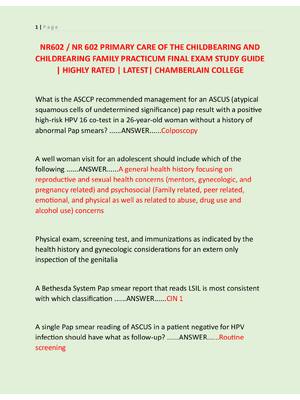
What is the ASCCP recommended management for an ASCUS (atypical squamous cells of undetermined
significance) pap result with a positive high-risk HPV 16 cotest in a 26-year-old woman without a history of
abnormal pap smears?
Colposcopy
A well-woman visit for an adolescent should include which of the following?
A general health history focusing on reproductive and sexual health concerns (menses, gynecologic,
and pregnancy related) and psychosocial (family related, peer related, emotional, and physical as
well as related to abuse, drug use, and alcohol use) concerns
Physical exam, screening tests, and immunizations as indicated by the health history and gynecologic
considerations for an external-only inspection of the genitalia
ACOG Pap smear guidelines
A Bethesda system Pap smear report that reads LSIL is most consistent with which classification?
CIN 1
A single Pap smear reading of ASCUS in a patient negative for HPV infection should have what as follow-up?
Routine screening
A female patient is 35 years old. She has never had an abnormal PAP smear and has had regular screening since age
18. If she has a normal PAP smear with HPV testing today, when should she have the next cervical cancer
screening?
5 years
A young sexually active client at the family planning clinic is advised to have a Papanicolaou (Pap) smear. She has
never had a Pap smear before. What should the nurse include in the explanation of this procedure?
The Pap smear can detect cancer of the cervix
Lab results on your 26-year-old patient show a negative Pap smear with a positive human papillomavirus (HPV)
screen. Which procedure will be required next?
Repeat Pap and HPV screen
Which of the following is not part of the criteria for an older woman to cease having any future Pap tests performed?
Over 55 years of age
Amenorrhea (Primary and Secondary)
You are evaluating a 17-year-old Emily who presented with amenorrhea and normal secondary sex characteristics.
The purpose of the progesterone challenge is to ascertain the presence of?
Endogenous estrogen
A 17-year-old female patient presents with amenorrhea for 4 months she did experience menarche at age 15 but had
not had a menstrual cycle since. On physical examination, it is noticed that she has normal secondary sexual
characteristics. The nurse practitioner will consider a progesterone challenge to determine the presence of adequate
Endogenous estrogen
A teenage patient presents with amenorrhea and moral secondary sex characteristics. A progesterone challenge is
ordered. The purpose is to determine the presence of ____________?
Endogenous estrogen
A 16year old girl who comes to your office with a history of secondary amenorrhea. She experienced menarche at
age 10, regular cycles for 2 years. She has not menstruated now for 4 years. In your initial consideration of
differential diagnoses, what is the most frequent etiology of this problem:
Eating disorder
18yo female c/o secondary amenorrhea. On exam, there is normal secondary sex characteristics and normal
genitalia. Pregnancy is ruled out. What would necessitate further eval?
Galactorrhea
Primary amenorrhea is best described as:
Failure to menstruation to occur by 13 yr
A nurse practitioner is caring for a woman with primary and secondary amenorrhea. The pelvic exam was normal.
Which of the following may be the cause if etiology originates in the hypothalamus?
Sheehan’s syndrome2
American Cancer Society recommendations
A nurse practitioner is participating in a women’s health fair. When educating the women about risk factors for
breast cancer, which of the following statements is incorrect?
Fibrocystic breast disease
When educating women about breast cancer risk factors, which statement is incorrect?
Fibrocystic breast disease
A woman with lobular carcinoma in situ has a relative risk of developing invasive breast cancer of
8.0
Androgen insensitivity/resistance syndrome
Changes in hormonal regulation during menopause result in the gradual cessation of menstruation. From which
gland is Androstenedione secreted?
Adrenals
ASCUS/HSIL results from Paper Test Report
A Pap smear result of atypical squamous cells of undetermined significance—rule out high-grade squamous
intraepithelial lesion (ASCUS r/o HGSIL) will require which procedure next?
Colposcopy
A Pap smear result of atypical squamous cells of undetermined significance (ASCUS) will require which procedure
next?
Follow up pap smear
Bartholin glands and cysts
A 25-year-old presents with a report of a very tender area just near her introitus and to the left of her
perineum. Very painful sex is how she knew "something wasn't right." She showered and when washing, she felt a
"pea-sized" painful lump on the left side of her "bottom." She tells you she looked at it with a mirror and it was very
small, but now it is the size of a ping-pong ball and getting worse.
When you inspect her external genitalia, you are amazed at the size and appearance of the "lump."
You note what appears to be an abscess on the left medial side of the labia minora, and there is some edema
extending into the perineum. Your diagnosis for this presentation is:
Bartholin’s cyst
You explain to this young woman what this "lump" is and let her know you will be referring her to a gynecologist
you consult with regularly. You explain to her the likely treatment as follows:
A possible incision might be necessary and a catheter placed for two to four weeks to allow
for drainage and appropriate healing.
A client at the women's health clinic complains of swelling of the labia and throbbing pain in the labial area after
sexual intercourse. For what condition does the nurse anticipate the client will be treated?
Bartholinitis
25yo female c/o tender area near her introitus and to the L of her perineum. Very painful sex was first sign. Initially
bump was very small, but now is ping-pong ball size. On exam, abscess is present on L medial side of labia minora
and there's edema extending into perineum. What is dx?
Bartholin’s cyst
Which of the following choices represents a disorder of the reproductive tract that causes pain, erythema,
dyspareunia, and a perineal mass?
Bartholin’s cyst
A nurse practitioner instructor is reviewing the anatomy of the external genitalia. At the opening of the vagina are
the Bartholin's glands. Which of the following describes the function of these glands?
Production of alkaline secretions for sperm viability
BMI
CDC recommendations regarding STDs and PID
Cervical cancer screening
A 23-year-old women presents to your practice with a chief complaint of postcoital bleeding. Which of the
following would NOT be included in the initial assessment of this patient?
Uterine biopsy3
a nurse practitioner is educating a woman who has a colposcopy ordered. Which of the following most accurately
describes a colposcopy?
A procedure that visualizes the vaginal, vulvar or cervical epithelium with magnification to
identify abnormal areas that may need to be biopsied
A 33-year-old women presents to your clinic complaining of a dark brown watery vaginal discharge and postcoital
bleeding. There is a strong history of multiple unprotected sexual encounters. Which of the following findings on
examination would be suspicious for cervical cancer?
A very firm, easily friable cervix
A 23-year-old woman comes to the clinic for a Pap smear. After the examination, the client confides that her mother
died of endometrial cancer 1 year ago and says that she is afraid that she will die of the same cancer. Which risk
factor stated by the client after an education session on risk factors indicates that further teaching is needed?
Late onset menarche
The frequency for cervical screening depends on the patient and her age. What is the longest recommended time
interval between cervical screens for patients who are 65 years-old or younger?
5 years
What is the leading cause of death from a gynecologic malignancy in American women?
Cervical cancer
Cervix/Uterus examination
A 49-year-old female patient presents with a chief complaint of dark, watery brown vaginal discharge. Part of the
differential diagnosis includes that of cervical cancer. Which of the following best describes what might be
visualized?
Ulcerated firm cervix
A nurse practitioner is completing a speculum exam on a female patient. Which of the following findings world be
considered a normal surface characteristic of the cervix?
Small, yellow, raised around area on the cervix
In collection of a specimen for a PAP smear, how is the endocervical specimen collected?
After the ectocervical specimen with a brush
Cimetidine
Condyloma acuminate
Treatment options for patients with condyloma acuminatum include:
Imiquimod (aldera)
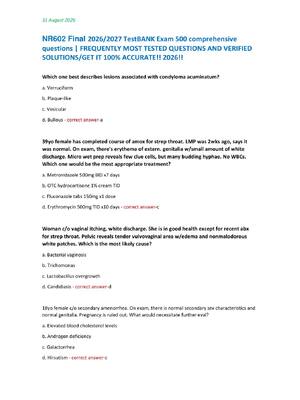
Which of the following best describes lesions associated with condyloma acuminatum?
Verruciform
Treatment options for patients with condyloma acuminatum include all of the following except:
Topical acyclovir
All of the following findings are associated with secondary stage of an infection by the organism Treponema
pallidum except :
Condyloma acuminate
Patient education for condylomata acuminata should include all the following except:
Treatment and elimination of visible warts is a sign of cure, and transmission will not
occur
Jenna was evaluated and diagnosed with condyloma acuminatum. Treatment options for Jenna will include all of
the following except:
Topical acyclovir
Condyloma lata
Which condyloma do we see in syphilis?
Condyloma lata-flat
Contraceptives
the cytology (Pap smear) result for a 21-year-old sexually active student whose partner uses condoms inconsistently
shows a large amount of inflammation. Which of the following is the best follow-up?
Call the patient and tell her that she needs return to the clinic for chlamydia and gonorrhea
testing4
A college freshman who is using oral contraceptives calls the nurse practitioner's office asking for advice. She forgot
to take her pills 2 days in a row during the second week of the pill cycle and wants to know what to do. What is the
best advice?
Take 2 pills today and two pills tomorrow, and have your partner use condoms for the rest
of the pill cycle
A 17-year-old high school student is considering her birth control options. She wants to know more about Seasonale.
Which of the following statements is false?
It is a progesterone only method of birth control and does not contain estrogen
A 35-year-old smoker is being evaluated for birth control choices. The patient has a history of pelvic inflammatory
disease (PID) along with an embolic episode after her last pregnancy. Which of the following methods of birth
control would you recommend?
Condoms and the vaginal sponge (TODAY sponge)
A 20-year-old woman visiting the clinic says that she wishes to begin using depot medroxyprogesterone acetate
(Depo-Provera) as a form of birth control. What important information should the nurse include when teaching the
client about Depo-Provera?
Calcium intake and exercise should be increased because of the possible loss of bone mineral
density with increasing duration of use
A woman questions the nurse about the effectiveness of oral contraceptives. What most important factor about the
effectiveness of oral contraceptives should be included in the reply to this question?
User motivation
A female client who has been sexually active for 5 years is found to have gonorrhea. The client is upset and asks the
nurse, "What can I do to keep from getting another infection in the future?" Which statement by the client indicates
that the teaching by the nurse was effective?
My partner has to use a condom all the time
Contraceptives that contain estrogen-like and/or progesterone-like compounds are prepared in a variety of forms.
Which contraceptives should the nurse tell clients have a hormonal component?
Oral drugs, transdermal agents
A client seeking advice about contraception asks a nurse about how an intrauterine device (IUD) prevents
pregnancy. How should the nurse respond?
It produces a spermicidal intrauterine environment
A nurse is teaching a group of women about the side effects of different types of contraceptives. What frequent side
effect associated with the use of an intrauterine device (IUD) should the nurse discuss during the teaching session?
Excessive menstrual flow
A nurse is teaching a female client about the side effects of estrogen in an oral contraceptive. Which common side
effect identified by the client indicates to the nurse that the teaching was effective?
Nausea
A nurse is counseling a female client with type 1 diabetes who requests contraceptive information. What
contraceptive method should the nurse recommend?
Diaphragm with spermicide
What instruction should a nurse include when teaching about the correct use of a female condom?
Remove the condom before standing up
A client asks the nurse about the use of an intrauterine device (IUD) for contraception. What information should the
nurse include in the response?
Expulsion of the device, occasional dyspareunia, risk for perforation of the uterus
A 16-year-old client has a steady boyfriend with whom she is having sexual relations. She asks the nurse how she
can protect herself from contracting HIV. What should the nurse advise her to do?
Insist that her partner use a condom when having sex
Which form of birth control presents the highest risk to a female patient if she is exposed to a sexually transmitted
disease (STD)?
Intrauterine device
What choice below has no precautions for oral contraceptive pill use?
Varicose veins
A 21-year-old woman comes into your practice seeking birth control. She has only recently become sexually active
and has consistently used condoms for safe sex. Your history reveals that she does not use tampons during her5
menses and has very little knowledge about female reproductive anatomy. Based on this information, which of the
following birth control choices would be least likely to meet her needs for contraceptive management?
Nuvaring
Cystocele
Cystocele is best defined as
Descent or prolapse of the bladder
While a speculum is retracting the posterior vaginal wall, a 51-year-old patient is asked to strain down. There is a
bulge from the anterior vaginal wall. This is most likely
Cystocele
The situation where the bladder forces the anterior vaginal wall down and out is termed
Cystocele
Which of the following is an effect of estrogen deficiency on paravaginal tissue?
Cystocele
A woman is admitted for repair of cystocele and rectocele. She has nine living children. In taking her health history,
which of the following would the nurse expect to find?
Stress incontinence with feeling low abdominal pressure
Dysmenorrhea
Which of the following substances is responsible for the symptoms of dysmenorrhea?
Prostaglandins
the first line treatment of severe menstrual cramps that having been occurring for 4 months in a patient with primary
dysmenorrhea includes which of the following?
Ibuprofen
A 40-year-old female presents with an abnormal menstrual cycle with menorrhagia and intermenstrual bleeding. The
nurse practitioner suspects the patient may have dysfunctional uterine bleeding (DUB) and orders tests for follicle
stimulating hormone (FSH) and luteinizing hormone (LH) levels. Both of these lab values are elevated. What is the
most likely cause of DUB in this patient?
Onset of climacteric
A patient who a nurse practitioner is seeing for the first time has the past medical history of primary dysmenorrhea.
She recalls that which of the following is considered as the primary etiology?
Prostaglandin production
Dysfunctional uterine bleeding (DUB). She is concerned about why this is happening to her. You recall which of the
following is the most common cause of DUB?
Anovulation
Sylvia is 44-year-old women with dysfunctional uterine bleeding (DUB) and is unable to use oral contraceptives.
Which of the following medications can be used for management of DUB?
Medroxyprogesterone
a 24-year-old female patient has been diagnosed with primary dysmenorrhea. Which of the following medications
would be would be used as a first line to help control her symptoms?
Non-steroidal anti-inflammatory drugs
A nurse practitioner is teaching an undergraduate course in women’s health. A student asks about the etiology of the
pain that occurs with primary dysmenorrhea. Which of the following response is correct?
Prostaglandin release and synthesis
Anna, 25-year-old, presents with dysmenorrhea. She states that her sister and mother have endometriosis, so she
would like to be evaluated for it. Which of the following is consistent with a diagnosis of endometriosis?
Pelvic pain and dyspareunia
Which is not a common cause of irregular menstrual bleeding?
Anovulation
Which of the following is a "classic" symptom of endometriosis?
Progressive dysmenorrhea
A 16-year-old female is diagnosed with primary dysmenorrhea. She has taken over the counter ibuprofen in 800 mg
increments every 8 hours during menses for the past 3 months with minimal relief of symptoms. What intervention
will provide greatest relief of dysmenorrhea symptoms?
Combined oral contraceptives6
A woman visits the clinic because she has dysmenorrhea. What goal should the nurse identify for this client?
Easing the pain of the client’s menstruation
This is defined as "cramping pain in the lower abdomen occurring just before or during menstruation in the absence
of other diseases."
Dysmenorrhea
Gravida/Para
Interstitial cystitis/ Painful bladder syndrome
After treatment for a bladder infection, a client asks whether there is anything she can do to prevent cystitis in the
future. What is the best response by the nurse?
Increase daily fluid consumption
A patient has been diagnosed with interstitial cystitis. The nurse practitioner remembers that this is best defined as
_____.
A noninfectious disorder of the urinary bladder
The nurse practitioner is examining a 29-year-old female with a 3 day history of dysuria and urinary frequency.
On examination, the patient is positive for suprapubic tenderness and negative for costovertebral angle (CVA)
tenderness. This most likely represents which of the following?
Cystitis
A twenty-five-year-old patient presents with urinary frequency and urgency. These symptoms have been occurring
for three days without fever. A patient with interstitial cystitis would most likely describe their symptoms as
_______.
Urinary urgency and frequency in the morning and at night
Lichen sclerosus
A 65-year-old female presents for a health maintenance examination. She complains of a vulvar itching due to what
she calls "recurrent yeast infections," and her symptoms have worsened over the last few months. She is sexually
active with her husband and has experienced dyspareunia with penetration lately. She always uses a water-based
lubricant with intercourse. On examination, you find complete loss of the borders of the labia minora, constriction of
the vaginal outlet, and several thin white plaques (like parchment paper) on the vulva. There is no other skin or
mucosal involvement.
Lichen sclerosus
A 65-year-old patient is diagnosed with lichen sclerosus. The woman asks the nurse what this really means. What is
the nurse's best response?
Lichen sclerosus is a benign condition that is easily treated.”
Lichen simplex chronicus
The appearance of lichen simplex chronicus is best described as
Diffusely red to red-brown
Mammogram
A patient ask why she needs a breast ultrasound when she already has had a mammogram. Which of the following
would be the best response of the use?
to determine if a breast lesion is cystic or solid
A 55-year-old female patient presents with pain in the upper outer quadrant of her left breast for over 1month now.
The best course of action would be to _________.
Perform a breast examination and order a mammogram
A 24-year-old female presents to the practice with a painless 2 cm, lobular mass in the right breast that is freely
mobile and firm. This has noted on self-breast examination, and she reports it has been unchanged for the past 3
months. The best course of action by the nurse practitioner would be to __________.
Order a diagnostic ultrasound or diagnostic mammogram
When educating a patient about the rationale for obtaining a mammogram, which of the following statements is
false?
Mammography detects all breast cancers
A 55-year-old women presents to the clinic for evaluation of a breast mass. Which of the following is not a typical
presenting sign of breast cancer?7
A 2cm, rubbery, tender lesion
During a breast exam of a 30-year-old nulliparous female, the nurse practitioner palpates several rubbery mobile
areas of the breast tissue. They are slightly tender to palpation. Both breasts have symmetrical findings. There are no
skin changes or any nipple discharge. The patient is expecting her menstrual period in 5 days. Which of the
following would you recommend?
Tell her to return 1 week after her period so her breast can be rechecked
Which of the following statements is accurate regarding the usefulness of mammo in screening and detection of
breast cancer?
All women >40 year should have a mommo on an annual basis
A 45-year-old woman has an abnormal screening mammogram. The next step in management should be
Diagnostic mammogram
What recommendation should be made to a 70-year-old female regarding mammograms?
She should have them annually as long as she has a reasonable life expectancy
Metronidazole
A nurse is caring for a client who has contracted a trichomonal infection. Which oral drug should the nurse
anticipate that the health care provider will most likely prescribe?
Metronidazole (flagyl)
An important part of patient education for the patient with bacterial vaginosis who is receiving a prescription for
oral Metronidazole is:
Avoid alcohol for 48 hours after completing medication
For the patient with chronic bacterial vaginosis, the nurse practitioner will prescribe:
Metronidazole gel .75% vaginally 1-2 times a week for 4-6 months
Molluscum contagiosum
The differential diagnosis for genital ulceration includes all of the following except :
Molluscum contagiosum
When molluscum contagiosum is found on the genital area of children, which of the following is the best
explanation?
It should raise the suspicion of child abuse
Tina is evaluated and diagnosed with Molluscum Contagiosum. The nurse practitioner understands that clinical
presentation of this disease is characterized by:
Fleshy, popular skin colored lesions with indented centers that contain white curdlike
material
Nabothian glands
Small, pale yellow, raised, and rounded areas are visualized on the surface of the cervix. You should:
chart this as nabothian cysts.
PCOS
Elevated triglyceride levels, low HDL levels, and elevated LDL levels are associated with
PCOS
A 34-year-old woman comes to see you in the office complaining of facial and abdominal hair growth and severe
acne. She tells you that although her sister also has some facial hair, her worsening changes are dramatic as
compared with family members. Which of the following is the most likely explanation for her symptoms?
PCOS
The blood test result most consistent with supporting the diagnosis of PCOS is
Androstenedione at the upper limits of normal or increased
An adolescent female has had normal menses for almost 2 years. She has not had menses in 3 months. She is
diagnosed with polycystic ovarian syndrome (PCOS). What else is a common finding?
Elevated insulin levels
A woman has been diagnosed with polycystic ovary syndrome (PCOS). Management of PCOS includes all of the
following except ___________.
Daily basal insulin to reduce blood sugar
A nurse practitioner is reviewing the chart of a woman who has findings consistent with polycystic ovary syndrome
(PCOS).The diagnostic criteria for PCOS include all of the following except:8
Male pattern baldness
A nurse practitioner is reviewing the signs of polycystic ovary syndrome (PCOS) for a differential diagnosis for a
female patient. Which of the following would be a positive finding?
Chronic anovulation
PID
An 18-year-old waitress is diagnosed with pelvic inflammatory disease (PID). The cervical Gen-Probe result is
positive for Neisseria gonorrhoeae and negative for Chlamydia trachomatis. All of the following statements are true
regarding the management of this patient except:
Repeat the gen probe test for chlamydia trachomatis to ensure that the previous test was not
a false negative result
Women often tend to reschedule a well woman visit but they don’t do so often with a problem such as pelvic pain.
This symptom can present as an acute or chronic, insult. When a woman presents with pelvic pain, the term can
encompass many possibilities. Differentiating acute from chronic assists with narrowing down the possibilities but
nonetheless can originate from more than one system as a referred pain or discomfort. Which of the following
choices are of a reproductive and pelvic origin?
Salpingo-oohoritis (fallopian tube/ovary) secondary to PID
Women with PID typically present with all of the follow except:
Leukopenia
22yo female c/o pelvic pain. Exam reveals cervical motion and uterine tenderness. Which supports PID dx?
Mucopurulent vaginal discharge
women with a history of pelvic inflammatory disease (PID) have an increased risk for all of the following except:
ovarian cyst
The nurse practitioner understands that a complication of gonoccocal and chlamydial genitourinary infection in
women include which of the following:
PID
Pyelonephritis
Complications of gonococcal and chlamydial genitourinary infection in women include all of the following except:
Acute pyelonephritis
Rectocele
Rectocele is best defined as
Decent or prolapse of the rectum
Skene’s glands
A nurse is describing the Skene glands, explaining that these glands would be found at which location?
On either side of the urethral opening
Which of the following findings indicates a possible gonococcal infection?
Discharge from urethra or Skene glands
STDs
Patients who are diagnosed with gonorrhea should also be treated for which of the following infections?
Chlamydia trachomatis
Which of the following is the best method to diagnose a vaginal trichomonas infection?
Wet smear with microscopy
A 30-year-old woman who is sexually active complains of a large amount of milk-like vaginal discharge for several
weeks. A microscopy slide reveals a large number of cells that have blurred margins. Very few white blood cells are
seen. The vaginal pH is at 6.0. What is most likely?
Bacterial vaginosis
A 25-year-old woman complains of dysuria, severe vaginal pruritus, and a malodorous vaginal discharge. Pelvic
examination reveals a strawberry-colored cervix and frothy yellow discharge. Microscopic examination of the
discharge reveals mobile organisms that have flagella. The correct pharmacological therapy for the condition is:
Oral metronidazole (flagyl)
A patient diagnosed with bacterial vaginosis should be advised that her sexual partner:
Does not need treatment
All of the following are infections that affect mostly the labia and vagina except:
Chlamydia trachomatis9
A 25-year-old obese female with type 2 diabetes mellitus presents to your office with a complaint of vaginal itching
and burning for 2 weeks. She has tried douching with an OTC cream with no relief. Physical examination, the vulva
is deep red with some thick white adherent material. Which of the following conditions would be most likely cause
of her symptoms?
Fungal infection
A young woman presents to your practice with vaginal itching and white discharge. She denies sexual activity or
douching. She has been in good health except for a recurrent strep throat. Pelvic examination reveals a tender
vulvovaginal area with edema and white patches, no odor is detected. Which of the following is the most likely
cause of this problem?
Candidiasis after antibiotic treatment
A patient has symptoms consistent with chlamydia. Which laboratory test gold standard? In the diagnosis?
Nucleic acid amplification test
A woman presents to your practice with vaginal itching and a white discharge. She has been in good health except
for recent treatment for strep throat. Pelvic examination reveals a tender vulvovaginal area with edema and nonmalodorous white patches. Which of the following is most likely cause of this problem?
Candidiasis
A 39-year-old female has just completed a course of amoxicillin for treatment of streptococcal pharyngitis. Her
LMP was 2 weeks ago and reports that it was normal for her. On physical examination, there is some erythema of
the eternal genitalia with a small amount of white discharge. The macroscopic wet prep examination revels few clue
cells but an abundance of budding hyphae. There are no WBC’s present. considering the differential diagnoses and
results of the microscopic examination, which of the following would be the most appropriate.
Fluconazole tablets 150mg as one-time dose
A 24-year-old female presents to the office with a complaint of vaginal itching in addition to thick mucoid
discharge. She also has some mild urinary discomfort. The wet mount preparation using potassium hydroxide.
(KOH) reveals a negative whiff test and few clue cells. There was no trichomonas visualized but the WBCs were too
numerous to count. Which of the following would be the most likely diagnosis in the patient?
Chlamydia
The patient has been diagnosed with trichomoniasis. Which of the following medications would be the best options?
Metronidazole 2g
25yo female c/o vaginal irritation and discharge. On exam, cervix is easily friable and erythematous. No adnexal
tenderness. Wet prep reveals mobile protozoa on NS slide. This most likely represents:
Trichomonas
Woman is experiencing vaginal discharge. Wet mount with KOH would be used to confirm:
Candidiasis
A 21-year-old female presents with three 0.5 cm human papilloma virus (HPV) lesions on her vulva. An appropriate
treatment option for this patient would be:
podophyllin
A 25-year-old woman comes to the clinic complaining of increased vaginal discharge, milky gray in color with a
"fishy" odor that both she and her husband have noticed. A wet smear is performed and the presence of "clue cells"
confirmed. Which type of infection does the nurse suspect?
Bacterial vaginosis
A nurse in the family planning clinic reviews the health history of a sexually active 16-year-old girl whose chief
concern is a thick, burning discharge accompanied by a burning sensation and lower abdominal pain. After an
examination the girl is informed that she may have a sexually transmitted infection (STI) that requires treatment.
The adolescent is concerned that her parents will discover that she has been sexually active and asks the nurse
whether her parents will be contacted. The nurse explains that her parents will:
Not be contacted, because treatment at the clinic is confidential
A woman visits the clinic for an annual physical examination, and herpes genitalis is diagnosed. The client asks how
the disease can be diagnosed without any tests. How should the nurse reply?
You have blisters on the skin around your vagina
The clinic nurse is planning care for a client found to have Chlamydia. Which treatment should the nurse plan to
implement?
Administration of azithromycin (Zithromax)1 g orally in a single dose
The clinical syndrome resulting from replacement of normal vaginal flora with anaerobic bacteria is:
Bacterial vaginosis10
A patient has symptoms consistent with Chlamydia. Which laboratory test would aid in the diagnosis?
Culture and sensitivity
A 19-year-old sexually active female presents to your urgent care center with a foul smelling vaginal discharge. She
has noted the discharge for about 3 days. On examination, she is in no acute distress, and her vital signs are normal.
Her pelvic examination is remarkable for mild vaginal erythema and a frothy gray discharge. You note a malodorous
discharge and suspect Trichomonas (bacterial vaginosis can also be malodorous, of course, with a fishy smell). A
wet prep confirms your diagnosis.
Chlamydia and gonorrhea
Stein-Leventhal Syndrome
The Stein-Leventhal syndrome is characterized by each of the following except
Many corpora lutea present in the ovaries
Turner’s syndrome
Which of the following is NOT a characteristic of Turner syndrome?
Increased risk for leukemia
Which of the following statements is NOT true about Turner syndrome?
Unlike Down syndrome, risk does not increase with an increase in maternal age
Which of the following is common treatment for individuals with Turner syndrome?
Estrogen therapy. This helps the girls with breast development and their menstrual cycle.
Does the X chromosome more commonly come from the mother or father in girls with Turner syndrome?
The x more commonly comes from mom
USPSTF recommendations regarding breast exams
Uterine Prolapse
During a pelvic exam on a seventy-year-old, the nurse practitioner notices the position of the cervix at the introitus.
The diagnosis is most likely _____.
Uterine prolapse
Uterine prolapse is caused by a relaxation of the ?
Cardinal ligaments
UTI
In women, most urinary tract infections occur through:
Ascending contamination from the urethra
A woman with a lower urinary tract infection is least likely to experience which of the following symptoms?
Fever
Approximately what percent of women will suffer a urinary tract infection at some point in their lives?
60%
Urinary tract infections are commonly seen in primary care. A 25-year-old female presents with a new onset of
dysuria and suprapubic pain for the last twenty-four hours. The examination reveals only mild tenderness
without any peritoneal signs on the lower abdomen. A urinalysis reveals the presence of WBCs. The urine is
sent for a culture and sensitivity. In addition to Escherichia coli one might typically expect to see the presence
of which bacterium?
Klebisiella
Vulvar carcinoma/ Pelvic mass
What percent of vulvar carcinomas are of the squamous cell type?
90%
[Show More]



![Preview of NR667 Complete Question Bank with Correct Answers: Final Exam Study Guide [2026 Updated]](https://browseimages.nyc3.digitaloceanspaces.com/paper-images/2026/02/25/AULA53fD2026-02-25-02-58699ee3d811bc7.png)