Domain 1
steps of developing a disaster recovery and continuity plan (PI, ST, BIA, Dev, I, T, M)
• Project initiation,
• Strategy development,
• Business impact analysis,
• Plan development
• Implementation,
• T
...
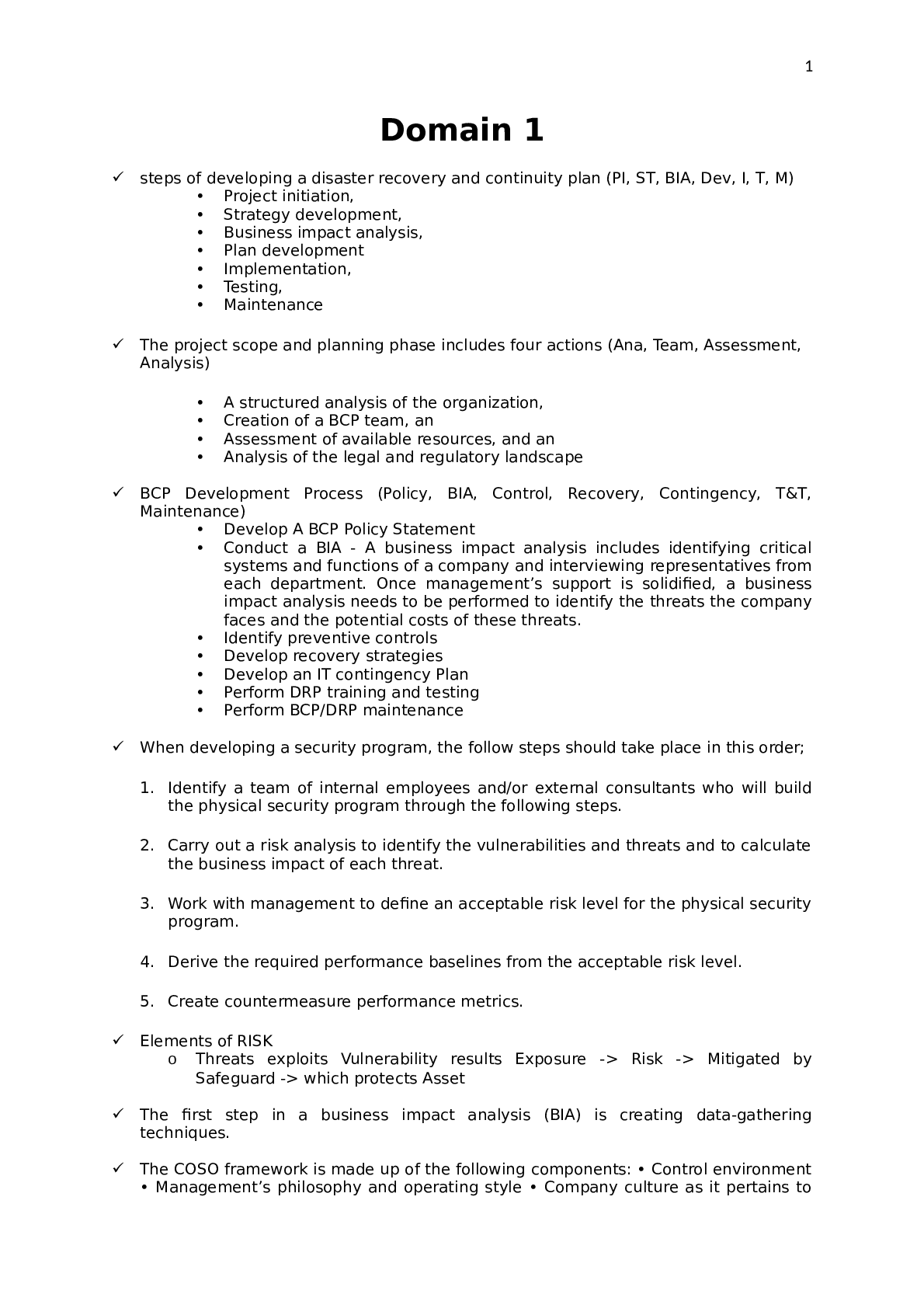
Domain 1
steps of developing a disaster recovery and continuity plan (PI, ST, BIA, Dev, I, T, M)
• Project initiation,
• Strategy development,
• Business impact analysis,
• Plan development
• Implementation,
• Testing,
• Maintenance
The project scope and planning phase includes four actions (Ana, Team, Assessment,
Analysis)
• A structured analysis of the organization,
• Creation of a BCP team, an
• Assessment of available resources, and an
• Analysis of the legal and regulatory landscape
BCP Development Process (Policy, BIA, Control, Recovery, Contingency, T&T,
Maintenance)
• Develop A BCP Policy Statement
• Conduct a BIA - A business impact analysis includes identifying critical
systems and functions of a company and interviewing representatives from
each department. Once management’s support is solidified, a business
impact analysis needs to be performed to identify the threats the company
faces and the potential costs of these threats.
• Identify preventive controls
• Develop recovery strategies
• Develop an IT contingency Plan
• Perform DRP training and testing
• Perform BCP/DRP maintenance
When developing a security program, the follow steps should take place in this order;
1. Identify a team of internal employees and/or external consultants who will build
the physical security program through the following steps.
2. Carry out a risk analysis to identify the vulnerabilities and threats and to calculate
the business impact of each threat.
3. Work with management to define an acceptable risk level for the physical security
program.
4. Derive the required performance baselines from the acceptable risk level.
5. Create countermeasure performance metrics.
Elements of RISK
o Threats exploits Vulnerability results Exposure -> Risk -> Mitigated by
Safeguard -> which protects Asset
The first step in a business impact analysis (BIA) is creating data-gathering
techniques.
The COSO framework is made up of the following components: • Control environment
• Management’s philosophy and operating style • Company culture as it pertains to2
ethics and fraud • Risk assessment • Establishment of risk objectives • Ability to
manage internal and external change • Control activities • Policies, procedures, and
practices put in place to mitigate risk • Information and communication • Structure
that ensures that the right people get the right information at the right time •
Monitoring • Detecting and responding to control deficiencies
COBIT is broken down into four domains: Plan and Organize, Acquire and Implement,
Deliver and Support, and Monitor and Evaluate. (PO, AI, DS, ME)
COBIT defines IT goals where ITIL provides the process-level steps on how to achieve
them
The correct definition mappings are below:
i. Civil (Code) Law Civil law is rule-based law not precedence based
ii. Common Law Based on previous interpretations of laws
iii. Customary Law Deals mainly with personal conduct and patterns of behaviour
iv. Religious Law Systems Based on religious beliefs of the region
The United States Code (USC) contains the text of all federal criminal and civil laws
passed by the legislative branch and signed by the president (or where the president’s
veto was overruled by Congress).
Data Classification
Government VS Private (TSCU – CPSP)
• Top Secret Confidential
• Secret Private
• Confidential Sensitive
• Unclassified Public
SLE = AV*EF
ARO = Annual rate of occurrence
ALE = SLE * ARO
ACS (Annual cost safeguard) = ALE before safeguards - ALE after safeguard - cost of
the safe guard
Security Activity – IDIOD – Intiaition- Development/Acquisition–
Implementation/Assessment–Operation – Assessment
RISK Frameworks
It is guideline for how risk to be assessed resolved and monitored
RISK Framework: RMF, OCTAVE, FAIR & TARA
Six Steps of RMF (Categorize, SIA (Control), Authorize, Monitor)
o Categorize Information System
o Select Security Controls
o Implement Security Controls
o Assess Security Controls
o Authorize Information System
o Monitor Security Controls
FAIR is a risk framework that develops baselines of probabilities for the frequency and
magnitude of loss events.
Threat Modelling
Secure by Design, Secure by Default, Secure in Deployment and Communication
(SD3+C)3
Thread Modelling Phases (IDRP)
o Identifying Threats
o Determining and Diagraming Potential Attacks
o Performing Reduction Analysis
o Prioritization and Response
Threat Identifying Approach – Focused on Assets, Focused on Attackers & Focused on
Software
DREAD – Rating Matrix for Threat – Damage-Reproduce-Exploit-Affected UsersDiscoverability
Threat Model – STRIDE(Microsoft), PASTA, Trike, VAST, DREAD(Quantity based)
STRIDE is an aggregated threat-modelling technique
o Spoofing-Tempering-Repudiation-Information Disclosure-Destruction-Elevation
of Priveleges
PASTA Steps: Process of Attack Simulation & Threat Analysis
o Define Business Objectives
o Define Tech Scope
o App Decomposition
o Threat Analysis
o Vuln Detection
o Attack Enumertaion
o Risk/Impact Analysis
The OCTAVE framework is comprised of three phases, which include (1) identifying
assets and threats, (2) identifying vulnerabilities and potential safeguards, and (3)
conducting a risk analysis
The guide describes a nine-step risk analysis process: 1. System Characterization 2.
Threat Identification 3. Vulnerability Identification 4. Control Analysis 5. Likelihood
Determination 6. Impact Analysis 7. Risk Determination 8. Control Recommendations
9. Results Documentation6
FRAP is designed to be performed by a team of business managers and technical staff
from within the organization. The team’s goal is to brainstorm and identify risk. As the
FRAP team identifies risk, they apply a group of 26 common controls designed to
categorize each type of risk. Delphi requires answers to be submitted in written form
EU-US Privacy Shield
Framework
To enable companies in the US tp process personal
information of individuals in EU member nations
ITAR Defence Goods, Arms Export Control
FERPA Education
GLBA Financial Institutions
US Privacy Act Privacy Act of Individual citizens
OECD Data Collection, specification & Safeguards
ECPA Electronics Privacy of Individual
USA PARTIOT Terrorism
COPPA Children
CALEA Communication - Wiretap
CFAA it a federal crime to maliciously cause damage in excess
of $5,000 to a federal computer system during any oneyear period
Safe Harbour & Privacy Shield European Union Privacy Law
SOX A US law that requires internal controls assessments
including IT transaction flows for publicly traded
companies4
GDPR The Gener
[Show More]