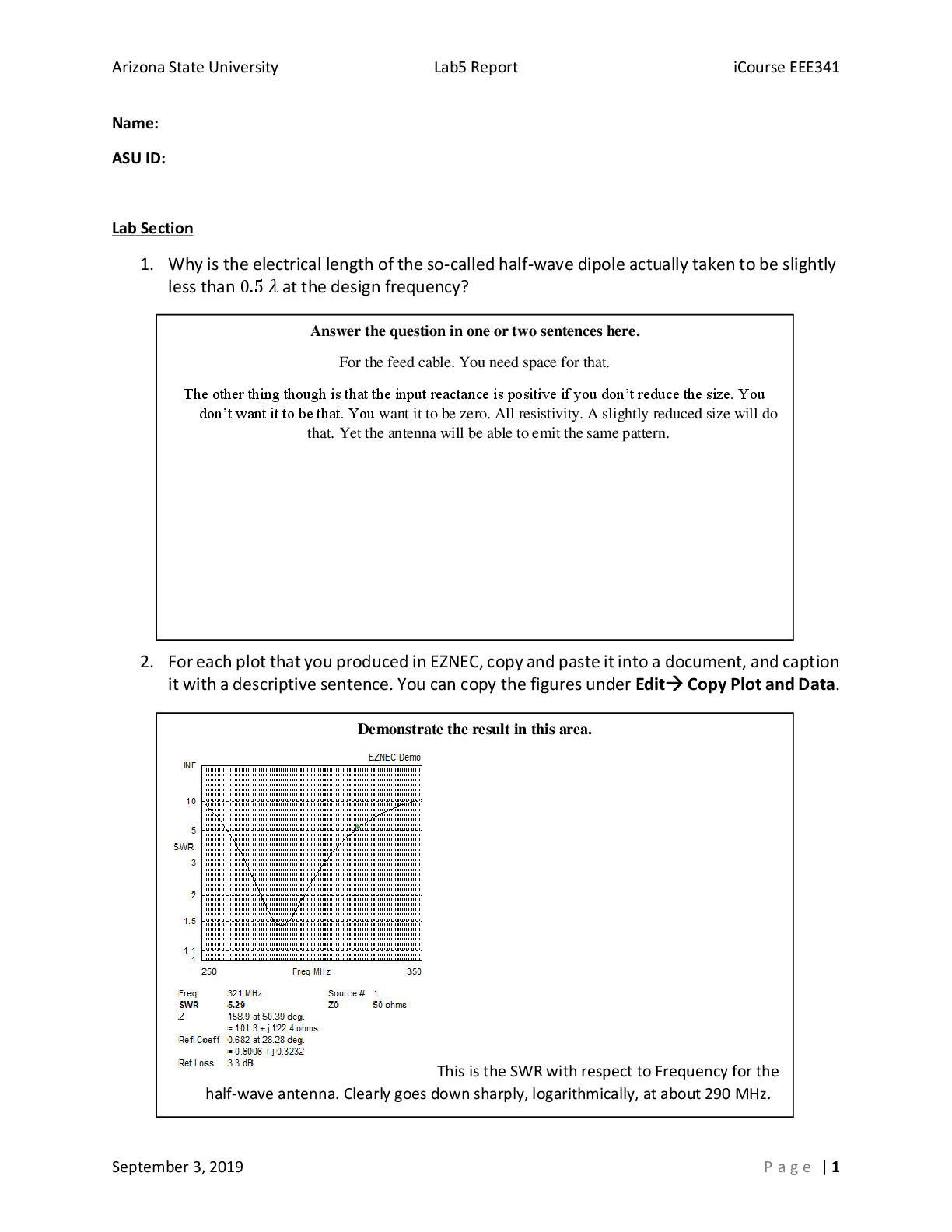
Electrical Engineering > Lab Report > EEE 102EE102 Lab_1. EE102 LAB 1 REPORT Fundamental for Electrical and Electronics Engineering (All)
NAME STUDENT ID Monish Mohit Chand S11170591 Folauhola Toumoua S11143270 Aditiya Jeet S11175234 AIM • learn the usage of basic electronics lab equipment, and • do simple circuit analysis usi ... ng the Circuit Maker software. THEORY The unit aims to provide students with a sound knowledge of electrical circuits, circuit analysis techniques, transformers, motors, generators as well as digital electronic circuits. Electrical circuits begins with a revision of basic fundamentals including Direct-Current (DC) circuits. The concept of nodal-analysis (node-voltage method) for the analysis of DC circuits is introduced. The principle of Superposition, derivation of There in and Norton equivalent circuits are discussed in detail as well as the maximum power transfer theorem. Alternating-Current (AC) circuits are explored and the analysis of these circuits using complex numbers is covered. Three-phase AC systems are studied and the concept of power factor correction is introduced. An overview of electrical transformers is given. Finally, DC and AC motors are examined as well as synchronous generators. Digital Electronics begins with a discussion of arithmetic operations, Boolean expressions and their reduction techniques. INSTRUMENTS • All equipment mounted on a typical electronics workbench such as power supply, oscilloscope, signal generator, and multimeter • 3 × Randomly selected resistors • BNC to BNC cables • PC installed with Circuit Maker METHODOLOGY Part I – Reading Resistor Values The lab group was required to determine the resistance of the three random resistors given using the resistor color coding system (also available on Moodle). Next the multimeter was used to measure the resistance and all the results were noted down in Table 8.1. Also, the percentage error between the measured and calculated values were calculated. Part II – Power Supply Basics Using the digital power supply, the DC voltages at increments of 2.5V from 0 – 30V were generated. The meter on the power supply was used for this. At each increment, the voltage was measured using the multimeter. The results were noted in Table 8.2. [Show More]
Last updated: 3 years ago
Preview 1 out of 9 pages
Buy this document to get the full access instantly
Instant Download Access after purchase
Buy NowInstant download
We Accept:
Can't find what you want? Try our AI powered Search
Connected school, study & course
About the document
Uploaded On
Aug 26, 2021
Number of pages
9
Written in
All
This document has been written for:
Uploaded
Aug 26, 2021
Downloads
0
Views
347
Scholarfriends.com Online Platform by Browsegrades Inc. 651N South Broad St, Middletown DE. United States.
We're available through e-mail, Twitter, Facebook, and live chat.
FAQ
Questions? Leave a message!
Copyright © Scholarfriends · High quality services·