Electronics > Lab Report > ELET 2105Lab Report 4. (All)
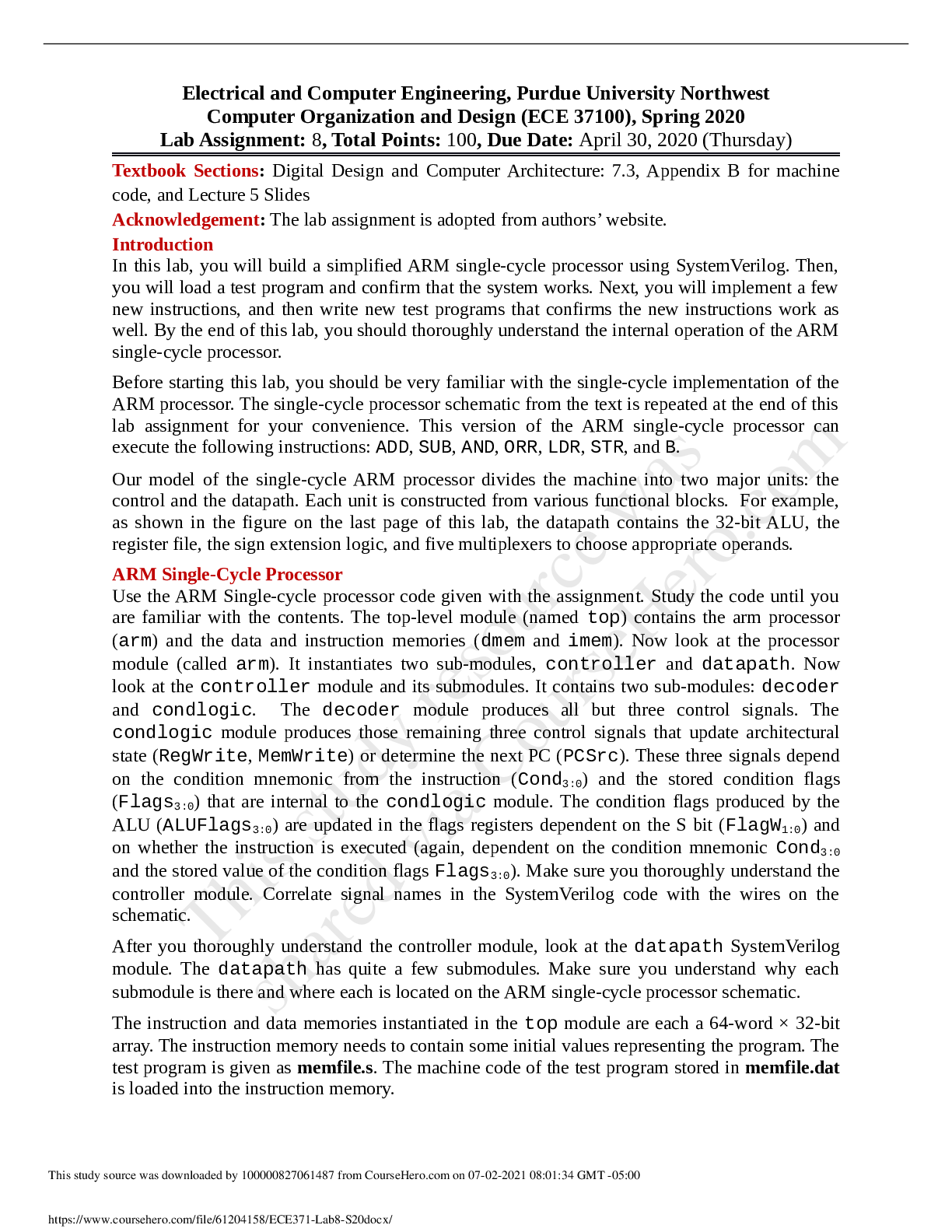
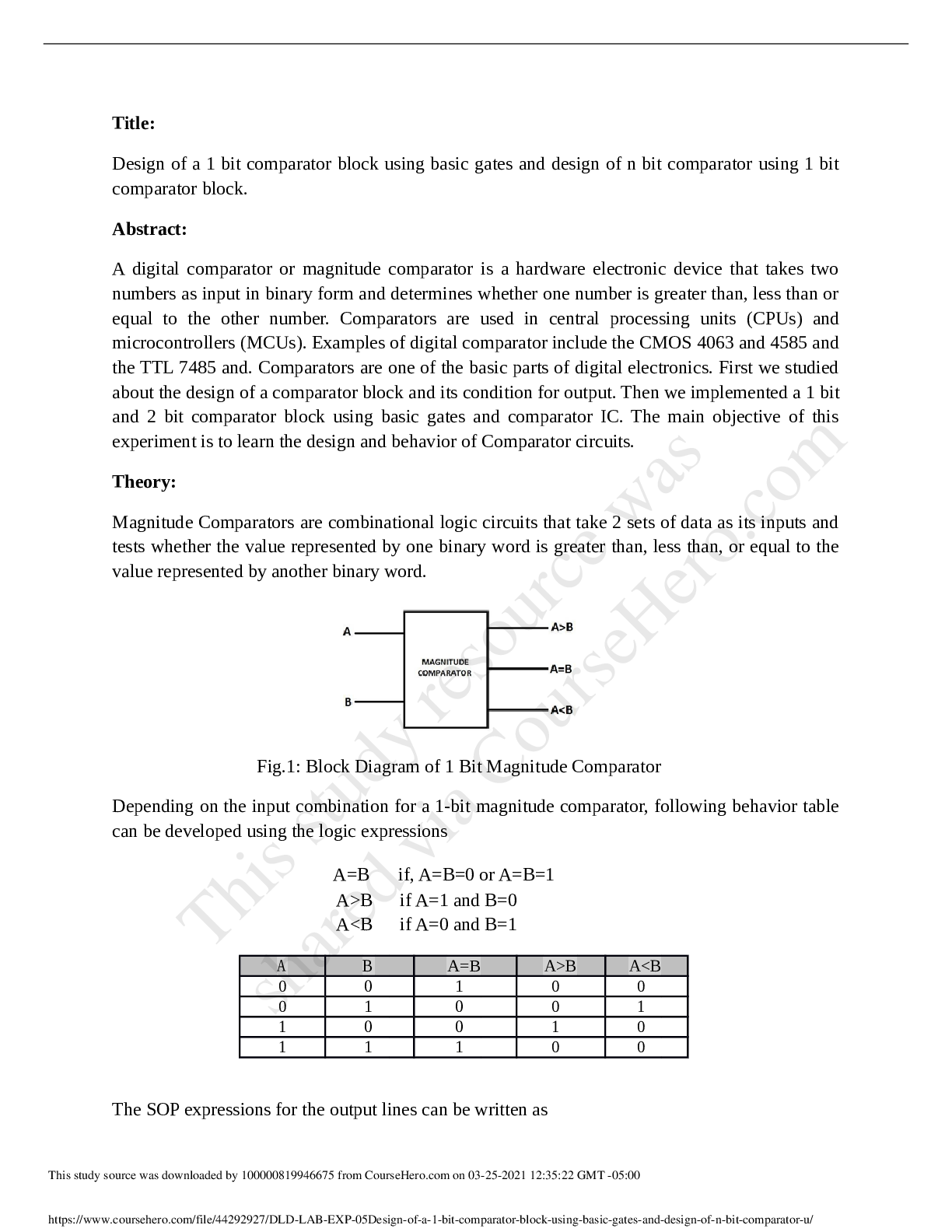
4.1 Half-wave Rectification 1. Measure the threshold voltage of one of the silicon diodes using the DMM and record the value. 2. Construct the circuit diagram below onto the breadboard and measure t ... he value of resistor used in the figure. 3. Set the function generator to 1Khz, 8Vp-p, sinusoidal wave. 4. Calculate and record the theoretical value of Vo 5. Use the oscilloscope to obtain and record the output wave of Vo 6. Measure the value of Vo using the DC scale of the DMM. 7. Find the percent difference between the measured value and the calculated value of Vo. 8. Reverse the diode in the circuit and repeat steps 5-7. 4.3 Half-wave Rectification (Continued..) 1. Construct the circuit diagram below and measure the value of the resistor being used. 2. Set the function generator to 1Khz, 8Vp-p, sinusoidal wave. 3. Calculate the theoretical value of Vo 4. Use the oscilloscope with coupling switch to the DC position, obtain the output wave of Vo. 5. Measure the value of Vo using the DC scale of the DMM. 6. Calculate the percent difference between the measure and calculated value of Vo 4.4 Full-wave Rectification 1. Construct the full-wave bridge rectifier below with and AC supply voltage of 8Vp-p sinusoidal. 2. Calculate the Vrms of the circuit. 3. Use the oscilloscope with the coupling at DC position to obtain the waveform of Vo and record it. 4. Calculate the theoretical value of Vo. 5. Measure Vo using the DC scale of the DMM. 6. Find the percent difference between the measure and calculated values of Vo’ 7. Replace diodes 3 and 4 in the circuit with 2.2k ohm resistors. 8. Calculate the theoretical value of Vo 9. Use the oscilloscope to obtain the output waveform of Vo and record it. 10. Measure Vo using the DC scale of the DMM. 11. Find the percent difference between the measure and calculated values of Vo’ Related Graphs: Numerical Data/ Analysis: 4.1 4.2 4.3 4.4 VT | 0.544 | V R1 (Measured) | 2180 | Ω VDC (Calculated) | 1.01 | V VDC (Measured) | 1.00 | V Difference | 1 | % VDC (calculated) | -1.01 | V VDC (measured) | -1.01 | V Difference | 0 | % R1 (Measured) | 2180 | Ω VDC (Calculated) | 1.16 | V VDC (Measured) | 1.02 Difference | 12 | % VRMS (Measured) | 2.82 | V Conclusion: In this experiment my partner and I were able to understand how a half-wave and full-wave rectifier functions. Fortunately, we did not run into any issues while performing the experiment. We were able to view the output waveforms of each experiment through the oscilloscope and was able to confirm if the experiment was being performed correctly. Overall, we learned a lot about full-wave and half-wave rectification through this experiment. References: 1 Fundamental of Analog Circuit – Thomas L Floyd, David M. Buchla 2 Microelectronic Circuits - Adel Sedra, Kenneth C. Smith 3 The Art of Electronics – Thomas Hayes, Paul Horowitz 4 Introductory Circuit Analysis – Robert Boylestad 5 Electronic Devices and Circuit Theory – Robert Boylestad 6 Electronic Devices and Circuit Theory Lab Manual – Robert Boylestad 7 Datasheet – 1N4007 : https://www.vishay.com/docs/88503/1n4001.pdf [Show More]
Last updated: 3 years ago
Preview 1 out of 19 pages
Buy this document to get the full access instantly
Instant Download Access after purchase
Buy NowInstant download
We Accept:
Can't find what you want? Try our AI powered Search
Connected school, study & course
About the document
Uploaded On
Sep 01, 2021
Number of pages
19
Written in
All
This document has been written for:
Uploaded
Sep 01, 2021
Downloads
0
Views
94
Scholarfriends.com Online Platform by Browsegrades Inc. 651N South Broad St, Middletown DE. United States.
We're available through e-mail, Twitter, Facebook, and live chat.
FAQ
Questions? Leave a message!
Copyright © Scholarfriends · High quality services·