*NURSING > QUESTIONS & ANSWERS > FNP NR-506 LEIK EXAM TIPS TEST PREP 100% CORRECT ANSWERS (All)
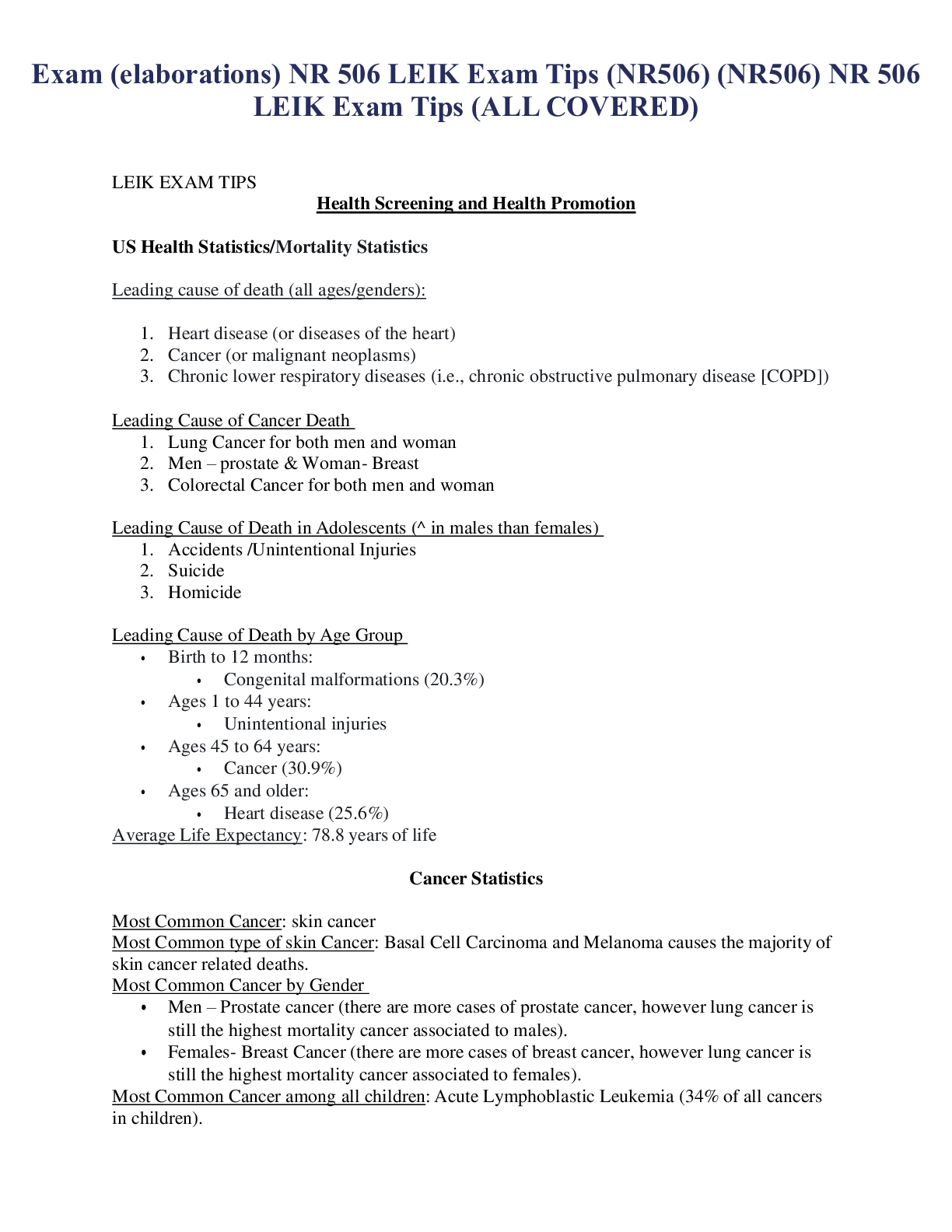
FNP NR-506 LEIK EXAM TIPS Health Screening and Health PromotionUS Health Statistics/Mortality Statistics Leading cause of death (all ages/genders):1.Heart disease (or diseases of the heart)2.Cancer ( ... or malignant neoplasms)3.Chronic lower respiratory diseases (i.e., chronic obstructive pulmonary disease [COPD])Leading Cause of Cancer Death 1.Lung Cancer for both men and woman 2.Men – prostate & Woman- Breast3.Colorectal Cancer for both men and womanLeading Cause of Death in Adolescents (^ in males than females) 1.Accidents /Unintentional Injuries 2.Suicide 3.Homicide Leading Cause of Death by Age Group Birth to 12 months:Congenital malformations (20.3%)Ages 1 to 44 years:Unintentional injuriesAges 45 to 64 years:Cancer (30.9%)Ages 65 and older:Heart disease (25.6%)Average Life Expectancy: 78.8 years of life Cancer StatisticsMost Common Cancer: skin cancerMost Common type of skin Cancer: Basal Cell Carcinoma and Melanoma causes the majority of skin cancer related deaths. Most Common Cancer by Gender Men – Prostate cancer (there are more cases of prostate cancer, however lung cancer is still the highest mortality cancer associated to males). Females- Breast Cancer (there are more cases of breast cancer, however lung cancer is still the highest mortality cancer associated to females). Most Common Cancer among all children: Acute Lymphoblastic Leukemia (34% of all cancers in children). Sensitivity vs. Specificity Sensitivity: is a good way of detecting those people who have the disease (i.e. true positive). Specificity: is a good way of detecting those people without the disease (i.e. true negative). Top Three Cancers in ChildrenLeukemia (34%)Brain and nervous system tumors (27%)Neuroblastoma (7%)Health PromotionAspirin Use to prevent Cardiovascular Disease or Colorectal Cancer Begin at age 50-59 with =/> 10 % risk for cardiovascular disease (ASCVD score) Breast Cancer Risk factors oage 50 or greater, oprevious hx of breast CA, otwo or more first * relativesonulliparity, early menarche, late menopause (longer exposure to estrogen) oObesity (adipose cells can synthesize small amounts of estrogen) Baseline mammogram starts at 50 years of ageRepeat every 2 years from ages 50-74 years of ageNOTE: Does NOT apply to those individuals with known genetic mutations (BRCA1 or 2), familial breast cancer history, history of chest radiation at a young age or previously diagnosed with high risk breast lesions, who may benefit from starting screenings at age 40. So, essentially if at high risk start screenings at age 40-49. Cervical Cancer Risk factors oMultiple sexual partnersoYounger age onset of sexoImmunosuppressed and/ or smoking individuals. Age GroupRecommendations for Pap/Liquid CytologyAge 20 years or youngerDo not screen (even if sexually active with multiple partners). [Show More]
Last updated: 3 years ago
Preview 1 out of 81 pages
Buy this document to get the full access instantly
Instant Download Access after purchase
Buy NowInstant download
We Accept:
Can't find what you want? Try our AI powered Search
Connected school, study & course
About the document
Uploaded On
Sep 08, 2021
Number of pages
81
Written in
All
This document has been written for:
Uploaded
Sep 08, 2021
Downloads
0
Views
128
Scholarfriends.com Online Platform by Browsegrades Inc. 651N South Broad St, Middletown DE. United States.
We're available through e-mail, Twitter, and live chat.
FAQ
Questions? Leave a message!
Copyright © Scholarfriends · High quality services·