(SOLVED MCQ) NURSING 01 Chapter 17 Health Problems of School-Age Children and Adolescents
Document Content and Description Below
(SOLVED MCQ) NURSING 01 Chapter 17: Health Problems of School-Age Children and Adolescents MULTIPLE CHOICE
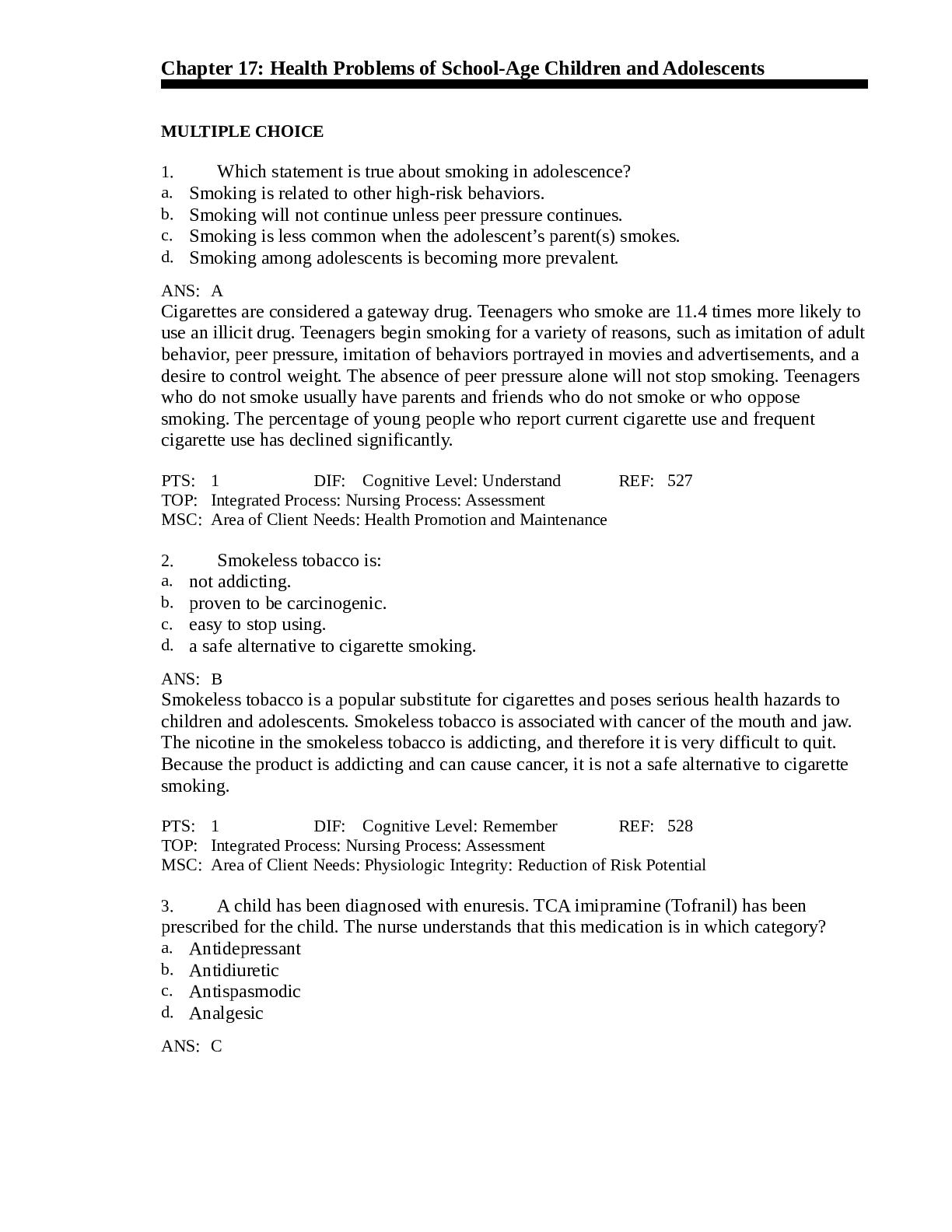
1. Which statement is true about smoking in adolescence? a.
Smoking is related to other hi
...
gh-risk behaviors.
b. Smoking will not continue unless peer pressure continues. Smoking is less common when the adolescent’s parent(s) smokes.
c.
d. Smoking among adolescents is becoming more prevalent. ANS: A
Cigarettes are considered a gateway drug. Teenagers who smoke are 11.4 times more likely to use an illicit drug. Teenagers begin smoking for a variety of reasons, such as imitation of adult behavior, peer pressure, imitation of behaviors portrayed in movies and advertisements, and a desire to control weight. The absence of peer pressure alone will not stop smoking. Teenagers who do not smoke usually have parents and friends who do not smoke or who oppose smoking. The percentage of young people who report current cigarette use and frequent cigarette use has declined significantly.
PTS: 1 DIF: Cognitive Level: Understand
TOP: Integrated Process: Nursing Process: Assessment MSC: Area of Client Needs: Health Promotion and Maintenance
2. Smokeless tobacco is:
a. not addicting. b.
proven to be carcinogenic.
c. easy to stop using. d. a safe alternative to cigarette smoking.
ANS: B Smokeless tobacco is a popular substitute for cigarettes and poses serious health hazards to children and adolescents. Smokeless tobacco is associated with cancer of the mouth and jaw. The nicotine in the smokeless tobacco is addicting, and therefore it is very difficult to quit. Because the product is addicting and can cause cancer, it is not a safe alternative to cigarette smoking.
PTS: 1 DIF: Cognitive Level: Remember REF: 528
TOP: Integrated Process: Nursing Process: Assessment MSC: Area of Client Needs: Physiologic Integrity: Reduction of Risk Potential
3. A child has been diagnosed with enuresis. TCA imipramine (Tofranil) has been
prescribed for the child. The nurse understands that this medication is in which category? a.
Antidepressant b. Antidiuretic c. Antispasmodic
d. Analgesic ANS: C
REF: 527Drug therapy is increasingly being prescribed to treat enuresis. Three types of drugs are used:
tricyclic antidepressants (TCAs), antidiuretics, and antispasmodics. The selection depends on
the interpretation of the cause. The drug used most frequently is the TCA imipramine
(Tofranil), which exerts an anticholinergic action in the bladder to inhibit urination. Tofranil is
in the antispasmodic category. Analgesics are not used to treat enuresis.
PTS: 1
DIF: Cognitive Level: Remember
REF: 499
TOP: Integrated Process: Nursing Process: Evaluation
MSC: Area of Client Needs: Physiologic Integrity: Pharmacologic and Parenteral Therapies
4.
A 12-year-old male has short stature because of a constitutional growth delay. The
nurse should be the most concerned about which of the following?
a.
Proper administration of thyroid hormone
b. Proper administration of human growth hormones
Child’s self-esteem and sense of competence
c.
d. Helping child understand that his height is most likely caused by chronic illness
and is not his fault
ANS: C
Most cases of constitutional growth delay are caused by simple constitutional delay of
puberty, and the child can be assured that normal development will eventually take place.
Listening to distressed adolescents and conveying interest and concern are important
interventions for these children and adolescents. They should be encouraged to focus on the
positives aspects of their bodies and personalities. Thyroid hormones and human growth
hormones would not be beneficial in a constitutional growth delay. A constitutional growth
delay is not caused by a chronic illness.
PTS: 1
DIF: Cognitive Level: Understand
TOP: Integrated Process: Nursing Process: Planning
MSC: Area of Client Needs: Psychosocial Integrity
5. Which syndrome involves a common sex chromosome defect?
a.
Down
b. Turner
c. Marfan
d. Hemophilia
ANS: B
Turner syndrome is caused by an absence of one of the X chromosomes. Down syndrome is
caused by trisomy 21, three copies rather than two copies of chromosome 21. Marfan
syndrome is a connective tissue disorder inherited in an autosomal dominant pattern.
Hemophilia is a disorder of blood coagulation inherited in an X-linked recessive pattern.
PTS: 1
DIF: Cognitive Level: Understand
REF: 507
TOP: Integrated Process: Nursing Process: Assessment
MSC: Area of Client Needs: Physiologic Integrity: Physiologic Adaptation
6.
Turner syndrome is suspected in an adolescent girl with short stature. This is caused
by:
a. absence of one of the X chromosomes.
b.
presence of an incomplete Y chromosome.
REF: 507c.
precocious puberty in an otherwise healthy child.
d. excess production of both androgens and estrogens.
ANS: A
Turner syndrome is caused by an absence of one of the X chromosomes. Most girls who have
this disorder have one X chromosome missing from all cells. No Y chromosome is present in
individuals with Turner syndrome. This young woman has 45 rather than 46 chromosomes.
PTS: 1
DIF: Cognitive Level: Understand
REF: 507
TOP: Integrated Process: Nursing Process: Assessment
MSC: Area of Client Needs: Physiologic Integrity: Physiologic Adaptation
7.
An adolescent asks the nurse what causes primary dysmenorrhea. The nurse’s response
should be based on which statement?
a.
It is an inherited problem.
b. Excessive estrogen production causes uterine pain.
c. There is no physiologic cause; it is a psychological reaction.
d. There is a relation between prostaglandins and uterine contractility.
ANS: D
The exact etiology of primary dysmenorrhea is debated. Overproduction of uterine
prostaglandins has been implicated, as has overproduction of vasopressin. Dysmenorrhea is
not known to be inherited. Excessive estrogen has not been implicated in the etiology. It has a
physiologic cause. Women with dysmenorrhea have higher prostaglandin levels.
PTS: 1
DIF: Cognitive Level: Apply
REF: 508-509
TOP: Integrated Process: Teaching/Learning
MSC: Area of Client Needs: Physiologic Integrity: Physiologic Adaptation
8.
An adolescent girl asks the school nurse for advice because she has dysmenorrhea. She
says that a friend recommended she try an over-the-counter nonsteroidal anti-inflammatory
drug (NSAID). The nurse’s response should be based on which statement?
a.
Aspirin is the drug of choice for the treatment of dysmenorrhea.
b. Over-the-counter NSAIDs are rarely strong enough to provide adequate pain relief.
c. NSAIDs are effective because of their analgesic effect.
d. NSAIDs are effective because they inhibit prostaglandins, leading to reduction in
uterine activity.
ANS: D
First-line therapy for adolescents with dysmenorrhea is NSAIDs. This group of drugs blocks
the formation of prostaglandins. NSAIDs, not aspirin, are the drugs of choice in
dysmenorrhea. NSAIDs are potent anti-inflammatory agents that inhibit prostaglandin.
Although NSAIDs have analgesic effects, the mechanism of action in dysmenorrhea is most
likely the antiprostaglandin effect.
PTS: 1
DIF: Cognitive Level: Apply
REF: 508
TOP: Integrated Process: Teaching/Learning
MSC: Area of Client Needs: Physiologic Integrity: Pharmacologic and Parenteral Therapies
9.
The school nurse is discussing testicular self-examination with adolescent boys. Why
is this important?
a.
Epididymitis is common during adolescence.b. Asymptomatic sexually transmitted diseases may be present.
c. Testicular tumors during adolescence are generally malignant.
d. Testicular tumors, although usually benign, are common during adolescence.
ANS: C
Tumors of the testes are not common, but when manifested in adolescence, they are generally
malignant and demand immediate evaluation. Epididymitis is not common in adolescence.
Asymptomatic sexually transmitted disease would not be evident during testicular self-
examination. The focus of this examination is on testicular cancer. Testicular tumors are most
commonly malignant.
PTS: 1
DIF: Cognitive Level: Apply
REF: 510
TOP: Integrated Process: Teaching/Learning
MSC: Area of Client Needs: Physiologic Integrity: Reduction of Risk Potential
10. Which is the usual presenting symptom for testicular cancer?
a.
Hard, painful mass
b. Hard, painless mass
c. Epididymis easily palpated
d. Scrotal swelling and pain
ANS: B
The usual presenting symptom for testicular cancer is a heavy, hard, painless mass that is
either smooth or nodular and palpated on the testes. A hard, painful mass, an epididymis easily
palpated, and scrotal swelling and pain are not the clinical presentations of testicular cancer.
PTS: 1
DIF: Cognitive Level: Understand
REF: 509
TOP: Integrated Process: Nursing Process: Assessment
MSC: Area of Client Needs: Physiologic Integrity: Physiologic Adaptation
11. A 14-year-old boy and his parents are concerned about bilateral breast enlargement.
The nurse’s discussion of this should be based on which statement?
a.
This is usually benign and temporary.
b. This is usually caused by Klinefelter syndrome.
c. Administration of estrogen effectively reduces gynecomastia.
d. Administration of testosterone effectively reduces gynecomastia.
ANS: A
The male breast responds to hormonal changes. Some degree of bilateral or unilateral breast
enlargement occurs frequently in boys during puberty. Although individuals with Klinefelter
syndrome can have gynecomastia, it is not a common cause for male breast enlargement.
Estrogen is not a therapy for gynecomastia. Administration of testosterone has no benefit for
gynecomastia and may aggravate the condition.
PTS: 1
DIF: Cognitive Level: Understand
REF: 510
TOP: Integrated Process: Teaching/Learning
MSC: Area of Client Needs: Physiologic Integrity: Physiologic Adaptation
12. An adolescent tells the school nurse that she is pregnant. Her last menstrual period was
4 months ago. She has not received any medical care. She smokes but denies any other
substance use. The priority nursing action is to:
a. notify her parents.b. refer for prenatal care.
c. explain the importance of not smoking.
d. discuss dietary needs for adequate fetal growth.
ANS: B
Teenage girls and their unborn children are at greater risk for complications during pregnancy
and delivery. With improved therapies, the mortality for teenage pregnancy is decreasing, but
the morbidity is high. A pregnant teenager needs careful assessment by the nurse to determine
the level of social support available to her and possibly her partner. Guidance from the adults
in her life would be invaluable, but confidentiality should be maintained. Although it is
important to explain the importance of not smoking and to discuss dietary needs for adequate
fetal growth, because of her potential for having a high-risk pregnancy, she will need a
comprehensive prenatal program to minimize maternal-fetal complications.
PTS: 1
DIF: Cognitive Level: Apply
REF: 510-511
TOP: Integrated Process: Nursing Process: Implementation
MSC: Area of Client Needs: Physiologic Integrity: Reduction of Risk Potential
13. An adolescent girl calls the nurse at the clinic because she had unprotected sex the
night before and does not want to be pregnant. The nurse should explain that:
a.
it is too late to prevent an unwanted pregnancy.
b. an abortion may be the best option if she is pregnant.
c.
Norplant can be administered to prevent pregnancy for up to 5 years.
d. postcoital contraception is available to prevent implantation.
ANS: D
Several emergency methods of contraception are available. Postcoital contraception options
do exist. It is nontherapeutic to tell her it is too late or that an abortion is the best option.
Norplant is not a postcoital contraceptive.
PTS: 1
DIF: Cognitive Level: Apply
REF: 514
TOP: Integrated Process: Teaching/Learning
MSC: Area of Client Needs: Physiologic Integrity: Reduction of Risk Potential
14. A sexually active female adolescent asks the nurse about the contraceptive Depo-
Provera. The nurse should explain that it:
a. requires injections every 3 months.
b. requires daily administration of medication by mouth.
c.
provides long-term continuous protection, up to 5 years.
d. prevents pregnancy if given within 72 hours of unprotected sex.
ANS: A
The contraceptive Depo-Provera is administered by injection every 3 months. Oral
contraceptives, not Depo-Provera, require daily administration of medication by mouth.
Norplant, not Depo-Provera, provides long-term continuous protection for up to 5 years.
Postcoital contraception, not Depo-Provera, prevents pregnancy if given within 72 hours of
unprotected sex.
PTS: 1
DIF: Cognitive Level: Understand
REF: 511
TOP: Integrated Process: Teaching/Learning
MSC: Area of Client Needs: Physiologic Integrity: Pharmacologic and Parenteral Therapies15. Which statement is true about gonorrhea?
a.
It is caused by Treponema pallidum.
b. Treatment is by multidose administration of penicillin.
c. Treatment is by topical applications to lesions.
d. Treatment of all sexual contacts is an essential part of treatment.
ANS: D
The treatment plan should include finding and treating all sexual partners. Gonorrhea is
caused by Neisseria gonorrhoeae. Syphilis is caused by T. pallidum. Primary treatment is with
different antibiotics because of N. gonorrhoeae resistance to penicillin. Systemic therapy is
necessary to treat this disease.
PTS: 1
DIF: Cognitive Level: Understand
REF: 515
TOP: Integrated Process: Nursing Process: Assessment
MSC: Area of Client Needs: Physiologic Integrity: Reduction of Risk Potential
16. Which statement regarding chlamydia infection is correct?
a.
Treatment of choice is oral penicillin.
b. Treatment of choice is nystatin or miconazole.
c.
Clinical manifestations include dysuria and urethral itching in males.
d. Clinical manifestations include small, painful vesicles on genital areas.
ANS: C
Symptoms of chlamydia infection in males include meatal erythema, tenderness, itching,
dysuria, and urethral discharge. Some infected males have no symptoms. Oral penicillin and
nystatin or miconazole are not the antibiotics of choice. Small, painful vesicles on genital
areas are clinical manifestations true of chlamydia infection but may also indicate herpetic
lesions.
PTS: 1
DIF: Cognitive Level: Understand
REF: 515
TOP: Integrated Process: Nursing Process: Implementation
MSC: Area of Client Needs: Physiologic Integrity: Physiologic Adaptation
17. A nurse is conducting a class for adolescent girls about pelvic inflammatory disease
(PID). Why should the nurse emphasize the importance of preventing pelvic inflammatory
disease (PID)?
a.
PID can be sexually transmitted.
b. PID cannot be treated.
c.
PID can have devastating effects on the reproductive tract.
d. PID can cause serious defects in future children of affected adolescents.
ANS: C
PID is a major concern because of its devastating effects on the reproductive tract. Short-term
complications include abscess formation in the fallopian tubes, whereas long-term
complications include ectopic pregnancy, infertility, and dyspareunia. PID is an infection of
the upper female genital tract, most commonly caused by sexually transmitted infections but it
is not sexually transmitted to another person. PID can be treated by treating the underlying
cause. There is a possibility of ectopic pregnancy but not birth defects in children.
PTS: 1
DIF: Cognitive Level: Apply
REF: 514
TOP: Integrated Process: Teaching/Learning
MSC: Area of Client Needs: Physiologic Integrity: Reduction of Risk Potential18. Which statement is correct about childhood obesity?
a.
Heredity is an important factor in the development of obesity.
b.
c.
Childhood obesity in the United States is decreasing.
Childhood obesity is the result of inactivity.
d. Childhood obesity can be attributed to an underlying disease in most cases.
ANS: A
Heredity is an important fact that contributes to obesity. Identical twins reared apart tend to
resemble their biologic parents to a greater extent than their adoptive parents. It is difficult to
distinguish between hereditary and environmental factors. The number of overweight children
is increasing in the United States. Inactivity is related to childhood obesity, but it is not the
only component. Underlying diseases such as hypothyroidism and hyperinsulinism account
for only a small number of cases of childhood obesity.
PTS: 1
DIF: Cognitive Level: Understand
REF: 518
TOP: Integrated Process: Nursing Process: Assessment
MSC: Area of Client Needs: Physiologic Integrity: Reduction of Risk Potential
19.
The psychological effects of being obese during adolescence include:
a. sexual promiscuity.
b.
poor body image.
c.
feelings of contempt for thin peers.
d. accurate body image but self-deprecating attitude.
ANS: B
Common emotional consequences of obesity include poor body image, low self-esteem, social
isolation, and feelings of depression and isolation. Sexual promiscuity, feelings of contempt
for thin peers, and accurate body image but self-deprecating attitude are not usually associated
with obesity.
PTS: 1
DIF: Cognitive Level: Understand
REF: 519
TOP: Integrated Process: Nursing Process: Assessment
MSC: Area of Client Needs: Psychosocial Integrity: Coping and Adaptation
20. Anorexia nervosa may best be described as:
a. occurring most frequently in adolescent males.
b. occurring most frequently in adolescents from lower socioeconomic groups.
c. resulting from a posterior pituitary disorder.
d. resulting in severe weight loss in the absence of obvious physical causes.
ANS: D
The etiology of anorexia remains unclear, but a distinct psychological component is present.
The diagnosis is based primarily on psychological and behavioral criteria. Females account
for 90% to 95% of the cases. No relation has been identified between socioeconomic groups
and anorexia. Posterior pituitary disorders are not associated with anorexia nervosa.
PTS: 1
DIF: Cognitive Level: Remember
REF: 522
TOP: Integrated Process: Nursing Process: Assessment
MSC: Area of Client Needs: Physiologic Integrity: Physiologic Adaptation
21. Young people with anorexia nervosa are often described as being:a. b.
independent. disruptive.
c. conforming. d. low achieving.
ANS: C Individuals with anorexia nervosa are described as perfectionist, academically high achievers, conforming, and conscientious. “Independent,” disruptive,” and “low achieving” are not part of the behavioral characteristics of anorexia nervosa.
PTS: 1 DIF: Cognitive Level: Understand
TOP: Integrated Process: Nursing Process: Assessment MSC: Area of Client Needs: Psychosocial Integrity
22. The weight loss of anorexia nervosa is usually triggered by
a. sexual abuse. b. school failure. c.
independence from family.
d. traumatic interpersonal conflict. ANS: D
Weight loss may be triggered by a typical adolescent crisis such as the onset of menstruation or a traumatic interpersonal incident; situations of severe family stress, such as parental separation or divorce; or circumstances in which the young person lacks personal control, such as being teased, changing schools, or entering college. “Sexual abuse,” “school failure,” and “independence from family” are not part of the behavioral characteristics of anorexia nervosa.
PTS: 1 DIF: Cognitive Level: Understand
TOP: Integrated Process: Nursing Process: Assessment MSC: Area of Client Needs: Psychosocial Integrity
23. Which symptoms should the nurse expect to observe during the physical assessment of an adolescent girl with severe weight loss and disrupted metabolism associated with anorexia nervosa? a.
Dysmenorrhea and oliguria b. Tachycardia and tachypnea c. Heat intolerance and increased blood pressure
d. Lowered body temperature and brittle nails ANS: D
Symptoms of anorexia nervosa include
[Show More]
Last updated: 3 years ago
Preview 1 out of 16 pages











.png)




.png)