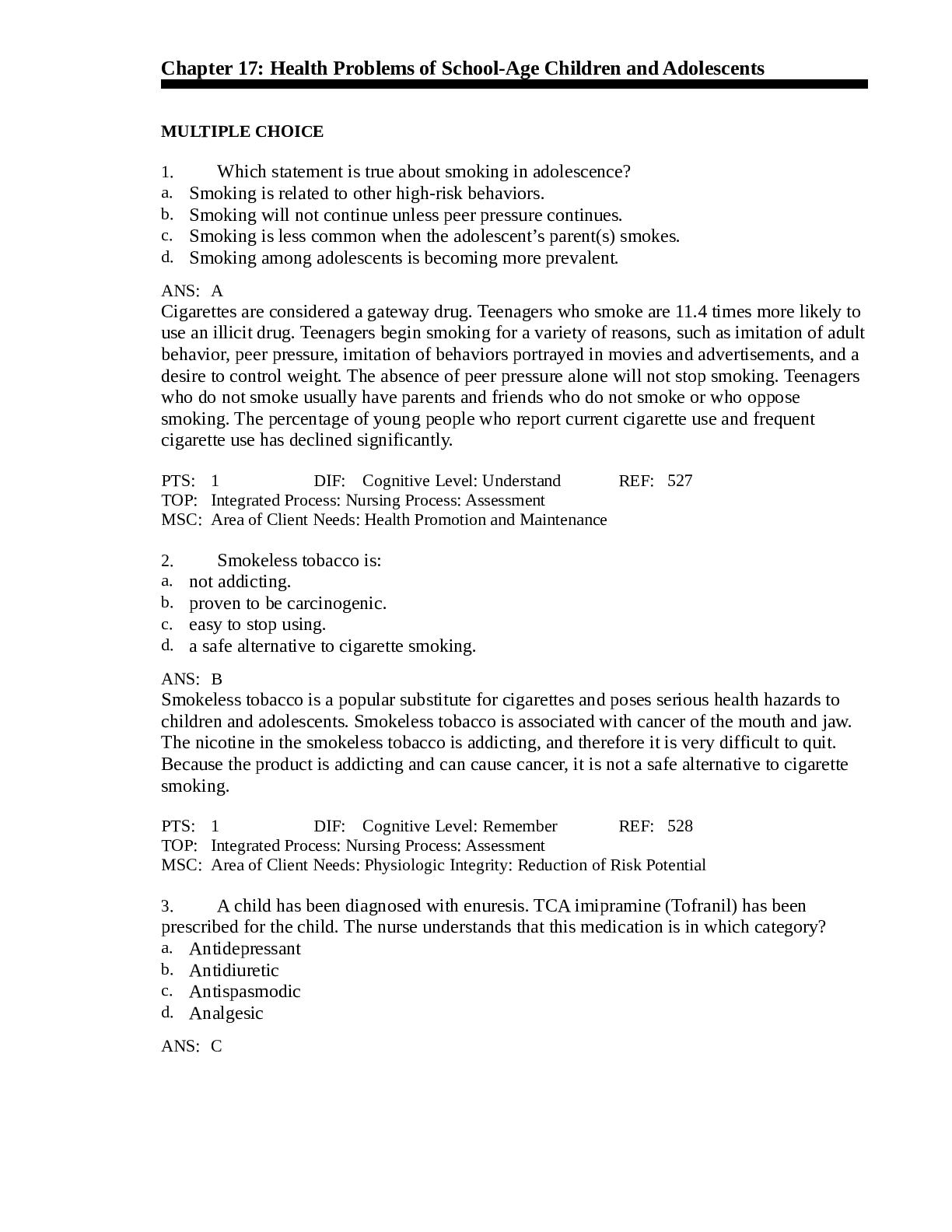
Chapter 27: The Child with Genitourinary Dysfunction MULTIPLE CHOICE
1. The nurse is conducting a staff in-service on renal ultrasounds. Which statement describes this diagnostic test?
a. Computed tomography uses exter
...
Chapter 27: The Child with Genitourinary Dysfunction MULTIPLE CHOICE
1. The nurse is conducting a staff in-service on renal ultrasounds. Which statement describes this diagnostic test?
a. Computed tomography uses external radiation to visualize the renal system.
b. Visualization of the renal system is accomplished without exposure to radiation or radioactive isotopes.
c. Contrast medium and x-rays allow for visualization of the renal system.
d. External radiation for x-ray films is used to visualize the renal system, before, during, and after voiding.
ANS: A A renal ultrasound transmits ultrasonic waves through the renal parenchyma allowing for visualization of the renal system without exposure to external beam radiation or radioactive isotopes. Computed tomography uses external radiation and sometimes contrast media to visualize the renal system. An intravenous pyelogram uses contrast medium and external radiation for x-ray films. The voiding cystourethrogram visualizes the renal system with injection of a contrast media into the bladder through the urethral opening and use of x-ray before, during, and after voiding.
PTS: 1 DIF: Cognitive Level: Understand REF: 908
TOP: Integrated Process: Teaching/Learning MSC: Area of Client Needs: Physiologic Integrity: Reduction of Risk Potential
2. The nurse is admitting a school-age child in acute renal failure with reduced glomerular filtration rate. Which urine test is the most useful clinical indication of glomerular filtration rate?
a. pH
b. Osmolality c.
Creatinine d. Protein level
ANS: C The most useful clinical indication of glomerular filtration is the clearance of creatinine. It is a substance that is freely filtered by the glomerulus and secreted by the renal tubule cells. The pH and osmolality are not estimates of glomerular filtration. Although protein in the urine demonstrates abnormal glomerular permeability, it is not a measure of filtration rate.
PTS: 1 DIF: Cognitive Level: Understand REF: 904
TOP: Integrated Process: Nursing Process: Assessment MSC: Area of Client Needs: Physiologic Integrity: Reduction of Risk Potential
3. The nurse is conducting an assessment on a school-age child with urosepsis. Which assessment finding should the nurse expect? Fever with a positive blood culture
a. b. Proteinuria and edemac. Oliguria and hypertension
d. Anemia and thrombocytopenia
ANS: A
Symptoms of urosepsis include a febrile UTI coexisting with systemic signs of bacterial
illness; blood culture reveals presence of urinary pathogen. Proteinuria and edema are
symptoms of minimal change nephrotic syndrome (MCNS). Oliguria and hypertension are
symptoms of acute glomerulonephritis (AGN). Anemia and thrombocytopenia are symptoms
of hemolytic uremic syndrome (HUS).
PTS: 1
DIF: Cognitive Level: Analyze
REF: 906
TOP: Integrated Process: Nursing Process: Assessment
MSC: Area of Client Needs: Physiologic Integrity: Physiologic Adaptation
4. The nurse is teaching parents about prevention of urinary tract infections in children. Which
factor predisposes the urinary tract to infection?
a.
Increased fluid intake
b. Short urethra in young girls
c.
Prostatic secretions in males
d. Frequent emptying of the bladder
ANS: B
The short urethra in females provides a ready pathway for invasion of organisms. Increased
fluid intake and frequent emptying of the bladder offer protective measures against urinary
tract infections. Prostatic secretions have antibacterial properties that inhibit bacteria.
PTS: 1
DIF: Cognitive Level: Understand
REF: 908
TOP: Integrated Process: Teaching/Learning
MSC: Area of Client Needs: Physiologic Integrity: Reduction of Risk Potential
5. Which should the nurse recommend to prevent urinary tract infections in young girls?
a. Wear cotton underpants.
b. Limit bathing as much as possible.
c.
Increase fluids; decrease salt intake.
d. Cleanse perineum with water after voiding.
ANS: A
Cotton underpants are preferable to nylon underpants. No evidence exists that limiting
bathing, increasing fluids/decreasing salt intake, or cleansing the perineum with water after
voiding decrease urinary tract infections in young girls.
PTS: 1
DIF: Cognitive Level: Apply
REF: 910
TOP: Integrated Process: Teaching/Learning
MSC: Area of Client Needs: Physiologic Integrity: Reduction of Risk Potential
6. The nurse is admitting a newborn with hypospadias to the nursery. The nurse expects which
finding in this newborn?
a. Absence of a urethral opening is noted.
b. Penis appears shorter than usual for age.c.
The urethral opening is along the dorsal surface of the penis.
d. The urethral opening is along the ventral surface of the penis.
ANS: D
Hypospadias is a congenital condition in which the urethral opening is located anywhere
along the ventral surface of the penis. The urethral opening is present, but not at the glans.
Hypospadias refers to the urethral opening, not to the size of the penis. Urethral opening along
ventral surface of penis is known as epispadias.
PTS: 1
DIF: Cognitive Level: Understand
REF: 912
TOP: Integrated Process: Nursing Process: Assessment
MSC: Area of Client Needs: Physiologic Integrity: Physiologic Adaptation
7. The nurse is conducting a staff in-service on newborn defects of the genitourinary system.
Which describes the narrowing of the preputial opening of the foreskin?
a. Chordee
b. Phimosis
c.
Epispadias
d. Hypospadias
ANS: B
Phimosis is the narrowing or stenosis of the preputial opening of the foreskin. Chordee is the
ventral curvature of the penis. Epispadias is the meatal opening on the dorsal surface of the
penis. Hypospadias is a congenital condition in which the urethral opening is located
anywhere along the ventral surface of the penis.
PTS: 1
DIF: Cognitive Level: Remember
REF: 912
TOP: Integrated Process: Teaching/Learning
MSC: Area of Client Needs: Physiologic Integrity: Physiologic Adaptation
8. Which is an objective of care for a 10-year-old child with minimal change nephrotic
syndrome?
a. Reduce blood pressure.
b. Reduce excretion of urinary protein.
c.
Increase excretion of urinary protein.
d. Increase ability of tissues to retain fluid.
ANS: B
The objectives of therapy for the child with minimal change nephrotic syndrome include
reduction of the excretion of urinary protein, reduction of fluid retention, prevention of
infection, and minimization of complications associated with therapy. Blood pressure is
usually not elevated in minimal change nephrotic syndrome. Excretion of urinary protein and
fluid retention are part of the disease process and must be reversed.
PTS: 1
DIF: Cognitive Level: Apply
REF: 914
TOP: Integrated Process: Nursing Process: Planning
MSC: Area of Client Needs: Physiologic Integrity: Physiologic Adaptation
9. Which is instituted for the therapeutic management of minimal change nephrotic syndrome?a. Corticosteroids
b. Antihypertensive agents
c.
Long-term diuretics
d. Increased fluids to promote diuresis
ANS: A
Corticosteroids are the first line of therapy for minimal change nephrotic syndrome. Response
is usually seen within 7 to 21 days. Antihypertensive agents and long-term diuretic therapy are
usually not necessary. A diet that has fluid and salt restrictions may be indicated.
PTS: 1
DIF: Cognitive Level: Apply
REF: 914
TOP: Integrated Process: Nursing Process: Implementation
MSC: Area of Client Needs: Physiologic Integrity: Pharmacologic and Parenteral Therapy
10. Which is a common side effect of short-term corticosteroid therapy?
a.
Fever
b. Hypertension
c. Weight loss
d. Increased appetite
ANS: D
Side effects of short-term corticosteroid therapy include an increased appetite. Fever is not a
side effect of therapy. It may be an indication of infection. Hypertension is not usually
associated with initial corticosteroid therapy. Weight gain, not weight loss, is associated with
corticosteroid therapy.
PTS: 1
DIF: Cognitive Level: Understand
REF: 914
TOP: Integrated Process: Nursing Process: Implementation
MSC: Area of Client Needs: Physiologic Integrity: Pharmacologic and Parenteral Therapy
11. The nurse closely monitors the temperature of a child with minimal change nephrotic
syndrome. The purpose of this assessment is to detect an early sign of which possible
complication?
a.
Infection
b. Hypertension
c.
Encephalopathy
d. Edema
ANS: A
Infection is a constant source of danger to edematous children and those receiving
corticosteroid therapy. An increased temperature could be an indication of an infection.
Temperature is not an indication of hypertension or edema. Encephalopathy is not a
complication usually associated with minimal change nephrotic syndrome. The child will
most likely have neurologic signs and symptoms.
PTS: 1
DIF: Cognitive Level: Understand
REF: 914
TOP: Integrated Process: Nursing Process: Assessment
MSC: Area of Client Needs: Physiologic Integrity: Physiologic Adaptation12. A hospitalized child with minimal change nephrotic syndrome is receiving high doses of
prednisone. Which is an appropriate nursing goal related to this?
a.
Prevent infection.
b. Stimulate appetite.
c.
Detect evidence of edema.
d. Ensure compliance with prophylactic antibiotic therapy.
ANS: A
High-dose steroid therapy has an immunosuppressant effect. These children are particularly
vulnerable to upper respiratory tract infections. A priority nursing goal is to minimize the risk
of infection by protecting the child from contact with infectious individuals. Appetite is
increased with prednisone therapy. The amount of edema should be monitored as part of the
disease process, not necessarily related to the administration of prednisone. Antibiotics would
not be used as prophylaxis.
PTS: 1
DIF: Cognitive Level: Apply
REF: 914
TOP: Integrated Process: Nursing Process: Planning
MSC: Area of Client Needs: Physiologic Integrity: Physiologic Adaptation
13. Which is included in the diet of a child with minimal change nephrotic syndrome?
a.
High protein
b. Salt restriction
c.
Low fat
d. High carbohydrate
ANS: B
Salt is usually restricted (but not eliminated) during the edema phase. The child has little
appetite during the acute phase. Favorite foods are provided (with the exception of high-salt
ones) in an attempt to provide nutritionally complete meals.
PTS: 1
DIF: Cognitive Level: Understand
REF: 914
TOP: Integrated Process: Nursing Process: Implementation
MSC: Area of Client Needs: Physiologic Integrity: Basic Care and Comfort
14. Which best describes acute glomerulonephritis?
a.
Occurs after a urinary tract infection
b. Occurs after a streptococcal infection
c.
Associated with renal vascular disorders
d. Associated with structural anomalies of genitourinary tract
ANS: B
Acute glomerulonephritis is an immune-complex disease that occurs after a streptococcal
infection with certain strains of the group A â-hemolytic streptococcus. Acute
glomerulonephritis usually follows streptococcal pharyngitis and is not associated with renal
vascular disorders or genitourinary tract structural anomalies.
PTS: 1
DIF: Cognitive Level: Understand
REF: 915
TOP: Integrated Process: Nursing Process: Assessment
MSC: Area of Client Needs: Physiologic Integrity: Physiologic Adaptation15. A child is admitted with acute glomerulonephritis. The nurse should expect the urinalysis during this acute phase to show: bacteriuria, hematuria.
a.
b. hematuria, proteinuria. c.
bacteriuria, increased specific gravity.
d. proteinuria, decreased specific gravity. ANS: B Urinalysis during the acute phase characteristically shows hematuria and proteinuria. Bacteriuria and changes in specific gravity are not usually present during the acute phase.
PTS: 1 DIF: Cognitive Level: Understand REF: 915
TOP: Integrated Process: Nursing Process: Assessment MSC: Area of Client Needs: Physiologic Integrity: Physiologic Adaptation
16. A mother asks the nurse what would be the first indication that acute glomerulonephritis is improving. The nurse’s best response should be that the: blood pressure will stabilize.
a.
b. the child will have more energy. c.
urine will be free of protein.
d. urinary output will increase. ANS: D An increase in urinary output may signal resolution of the acute glomerulonephritis. If blood pressure is elevated, stabilization usually occurs with the improvement in renal function. The child having more energy and the urine being free of protein are related to the improvement in urinary output.
PTS: 1 DIF: Cognitive Level: Apply REF: 916
TOP: Integrated Process: Teaching/Learning MSC: Area of Client Needs: Physiologic Integrity: Physiologic Adaptation
17. The nurse notes that a child has lost 8 pounds after 4 days of hospitalization for acute glomerulonephritis. This is most likely the result of: poor appetite.
a.
b. increased potassium intake. c. reduction of edema. d. restriction to bed rest.
ANS: C This amount of weight loss in this period is a result of the improvement of renal function and mobilization of edema fluid. Poor
[Show More]


 Med Surg test Latest Verified Questions and all Correct Answers with Explanations Problems Chapter 27 Management of Patients with Coronary.png)


.png)





.png)



.png)