Module 4 Discussion - Discussion
Group 2
This is a group discussion. Click on your group link above.
The Assignment:
Question 1: In two paragraphs, discuss the productivity and ethical
implications of the diverg
...
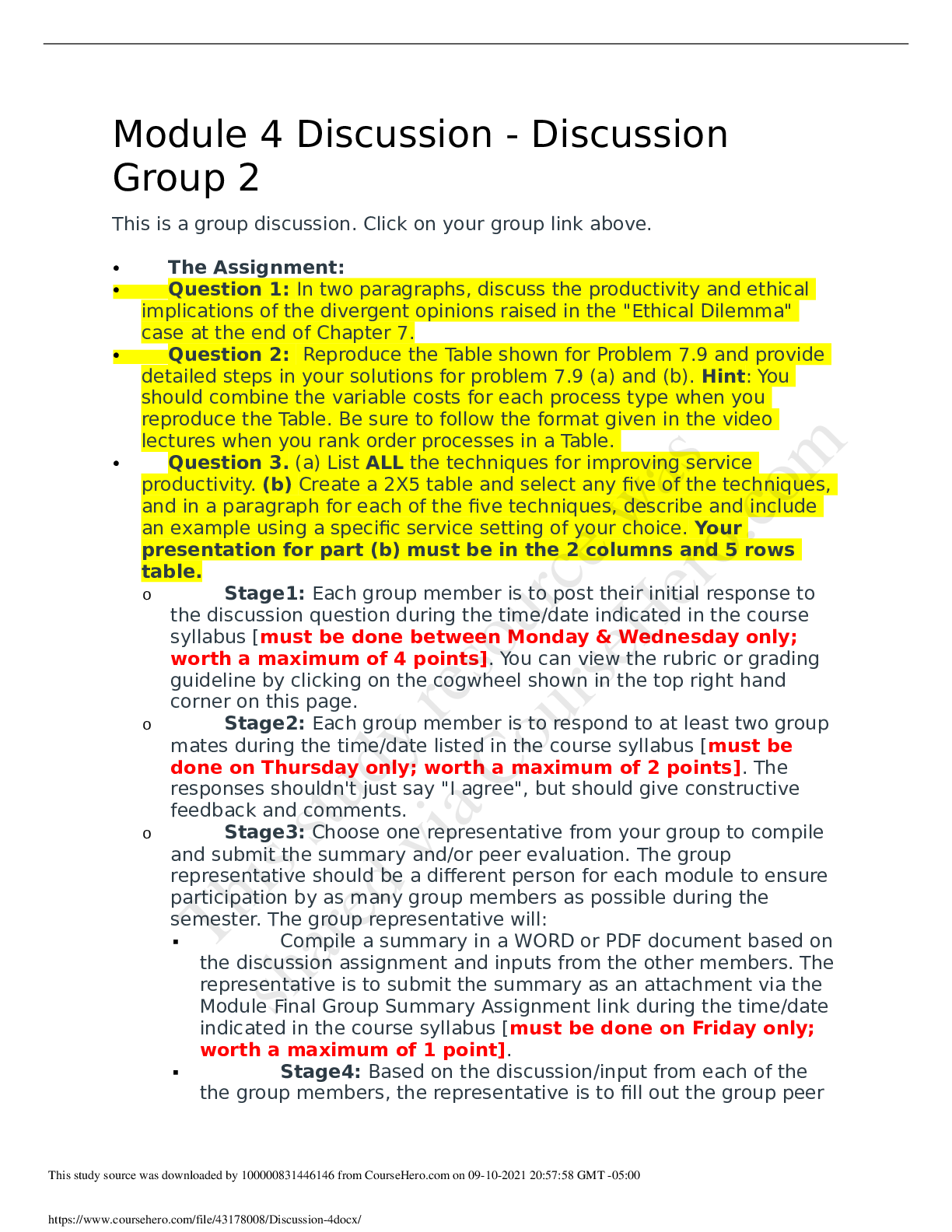
Module 4 Discussion - Discussion
Group 2
This is a group discussion. Click on your group link above.
The Assignment:
Question 1: In two paragraphs, discuss the productivity and ethical
implications of the divergent opinions raised in the "Ethical Dilemma"
case at the end of Chapter 7.
Question 2: Reproduce the Table shown for Problem 7.9 and provide
detailed steps in your solutions for problem 7.9 (a) and (b). Hint: You
should combine the variable costs for each process type when you
reproduce the Table. Be sure to follow the format given in the video
lectures when you rank order processes in a Table.
Question 3. (a) List ALL the techniques for improving service
productivity. (b) Create a 2X5 table and select any five of the techniques,
and in a paragraph for each of the five techniques, describe and include
an example using a specific service setting of your choice. Your
presentation for part (b) must be in the 2 columns and 5 rows
table.
o Stage1: Each group member is to post their initial response to
the discussion question during the time/date indicated in the course
syllabus [must be done between Monday & Wednesday only;
worth a maximum of 4 points]. You can view the rubric or grading
guideline by clicking on the cogwheel shown in the top right hand
corner on this page.
o Stage2: Each group member is to respond to at least two group
mates during the time/date listed in the course syllabus [must be
done on Thursday only; worth a maximum of 2 points]. The
responses shouldn't just say "I agree", but should give constructive
feedback and comments.
o Stage3: Choose one representative from your group to compile
and submit the summary and/or peer evaluation. The group
representative should be a different person for each module to ensure
participation by as many group members as possible during the
semester. The group representative will:
Compile a summary in a WORD or PDF document based on
the discussion assignment and inputs from the other members. The
representative is to submit the summary as an attachment via the
Module Final Group Summary Assignment link during the time/date
indicated in the course syllabus [must be done on Friday only;
worth a maximum of 1 point].
Stage4: Based on the discussion/input from each of the
the group members, the representative is to fill out the group peer
evaluation form showing a list the names of all members in the
group, and indicating the appropriate points for each group
member based on their inputs during stages 1-3. Note that giving
everyone in the group a perfect score is not expected, unless
everyone made excellent contributions in stages 1-3. The
representative is to submit the peer evaluation document as an
attachment in the Module Peer Evaluation Assignment link during
the time/date indicated in the course syllabus [must be done on
Saturday only; worth a maximum of 3 points].
QUESTION 1:
It is possible to see both sides of arguments for this ethical dilemma. I am not a huge animal
lover for pigs, and I love pork, but it is also hard to image treating any animal the way these pigs
are being treated. As a manager, the productivity in which the slaughter houses are ran is easy to
understand. The limited mobility would speed up agriculture processes but would also limit stock
losses and facility sizes. Premium Standard Farms of Princeton has more than likely spent many
hours and a lot of money expanding their productivity model. It’s hard to argue that with
thousands of animals in inventory, the cost to assist a quality of life to satisfy the loads of swine
would be excessive. In the U.S. mixed market economic system, the companies that offer the
same products at a higher price, due to unnecessary costs accumulated while making the product
comfortable in their care, are typically fighting a losing battle.
QUESTION 2:
Process type
Annualized
Fixed Cost of
Plant &
Equipment
Variable Costs (Per Unit) ($)
Labor Material Energy
Mass
Customization
$1,260,000 30 18 12
Intermittent $1,000,000 24 26 20
Repetitive $1,625,000 28 15 12
Continuous $1,960,000 25 15 10
Metters Cabinets projects an annual demand of 24,000 units for the Maxistand. The
Maxistand will sell for $120 per unit.
a) Which process type will maximize the annual profit from producing the Maxistand?
Since the annual profit of Intermittent process type is highest among all the alternatives,
Intermittent process maximizes the annual profi
[Show More]