Chapter 35: Care of Patients with Cardiac Problems
Ignatavicius: Medical-Surgical Nursing, 8th Edition
MULTIPLE CHOICE
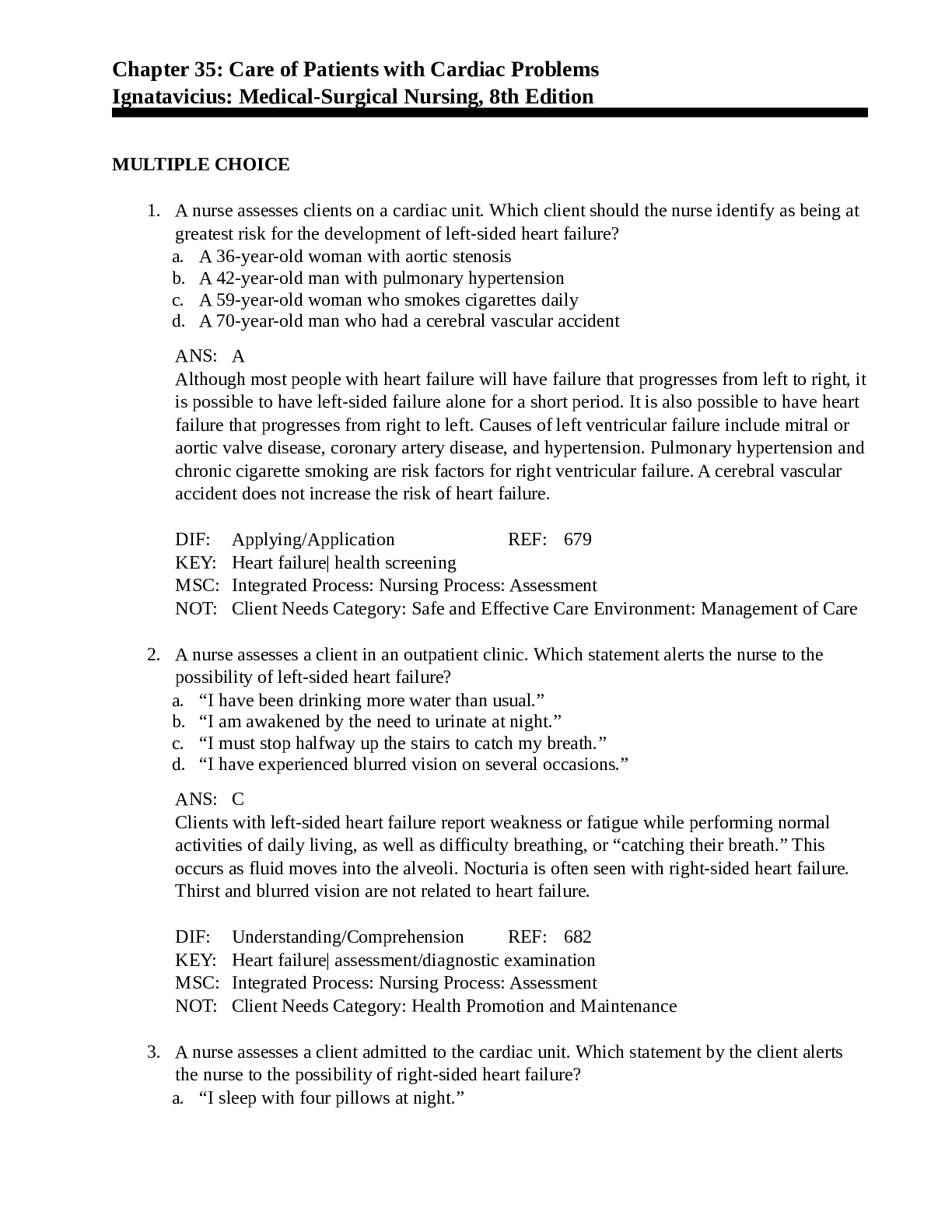
1. A nurse assesses clients on a cardiac unit. Which client should the nurse identify as being at
...
Chapter 35: Care of Patients with Cardiac Problems
Ignatavicius: Medical-Surgical Nursing, 8th Edition
MULTIPLE CHOICE
1. A nurse assesses clients on a cardiac unit. Which client should the nurse identify as being at
greatest risk for the development of left-sided heart failure?
a. A 36-year-old woman with aortic stenosis
b. A 42-year-old man with pulmonary hypertension
c. A 59-year-old woman who smokes cigarettes daily
d. A 70-year-old man who had a cerebral vascular accident
ANS: A
Although most people with heart failure will have failure that progresses from left to right, it
is possible to have left-sided failure alone for a short period. It is also possible to have heart
failure that progresses from right to left. Causes of left ventricular failure include mitral or
aortic valve disease, coronary artery disease, and hypertension. Pulmonary hypertension and
chronic cigarette smoking are risk factors for right ventricular failure. A cerebral vascular
accident does not increase the risk of heart failure.
DIF: Applying/Application REF: 679
KEY: Heart failure| health screening
MSC: Integrated Process: Nursing Process: Assessment
NOT: Client Needs Category: Safe and Effective Care Environment: Management of Care
2. A nurse assesses a client in an outpatient clinic. Which statement alerts the nurse to the
possibility of left-sided heart failure?
a. “I have been drinking more water than usual.”
b. “I am awakened by the need to urinate at night.”
c. “I must stop halfway up the stairs to catch my breath.”
d. “I have experienced blurred vision on several occasions.”
ANS: C
Clients with left-sided heart failure report weakness or fatigue while performing normal
activities of daily living, as well as difficulty breathing, or “catching their breath.” This
occurs as fluid moves into the alveoli. Nocturia is often seen with right-sided heart failure.
Thirst and blurred vision are not related to heart failure.
DIF: Understanding/Comprehension REF: 682
KEY: Heart failure| assessment/diagnostic examination
MSC: Integrated Process: Nursing Process: Assessment
NOT: Client Needs Category: Health Promotion and Maintenance
3. A nurse assesses a client admitted to the cardiac unit. Which statement by the client alerts
the nurse to the possibility of right-sided heart failure?
a. “I sleep with four pillows at night.”
b. “My shoes fit really tight lately.”
c. “I wake up coughing every night.”
d. “I have trouble catching my breath.”
ANS: B
Signs of systemic congestion occur with right-sided heart failure. Fluid is retained, pressure
builds in the venous system, and peripheral edema develops. Left-sided heart failure
symptoms include respiratory symptoms. Orthopnea, coughing, and difficulty breathing all
could be results of left-sided heart failure.
DIF: Understanding/Comprehension REF: 683
KEY: Heart failure| assessment/diagnostic examination
MSC: Integrated Process: Nursing Process: Assessment
NOT: Client Needs Category: Health Promotion and Maintenance
4. While assessing a client on a cardiac unit, a nurse identifies the presence of an S3 gallop.
Which action should the nurse take next?
a. Assess for symptoms of left-sided heart failure.
b. Document this as a normal finding.
c. Call the health care provider immediately.
d. Transfer the client to the intensive care unit.
ANS: A
The presence of an S3 gallop is an early diastolic filling sound indicative of increasing left
ventricular pressure and left ventricular failure. The other actions are not warranted.
DIF: Remembering/Knowledge REF: 683
KEY: Heart failure| assessment/diagnostic examination
MSC: Integrated Process: Nursing Process: Assessment
NOT: Client Needs Category: Physiological Integrity: Reduction of Risk Potential
5. A nurse cares for a client with right-sided heart failure. The client asks, “Why do I need to
weigh myself every day?” How should the nurse respond?
a. “Weight is the best indication that you are gaining or losing fluid.”
b. “Daily weights will help us make sure that you’re eating properly.”
c. “The hospital requires that all inpatients be weighed daily.”
d. “You need to lose weight to decrease the incidence of heart failure.”
ANS: A
Daily weights are needed to document fluid retention or fluid loss. One liter of fluid equals
2.2 pounds. The other responses do not address the importance of monitoring fluid retention
or loss.
DIF: Remembering/Knowledge REF: 683
KEY: Heart failure| patient education MSC: Integrated Process: Teaching/Learning
NOT: Client Needs Category: Physiological Integrity: Physiological Adaptation
[Show More]