Test Bank
to accompany
Neuroscience, Sixth Edition
Purves • Augustine • Fitzpatrick • Hall • LaMantia • Mooney • Platt • White
Chapter 5: Synaptic Transmission
-reversal potentials
-ligand gated
-synaptic summatio
...
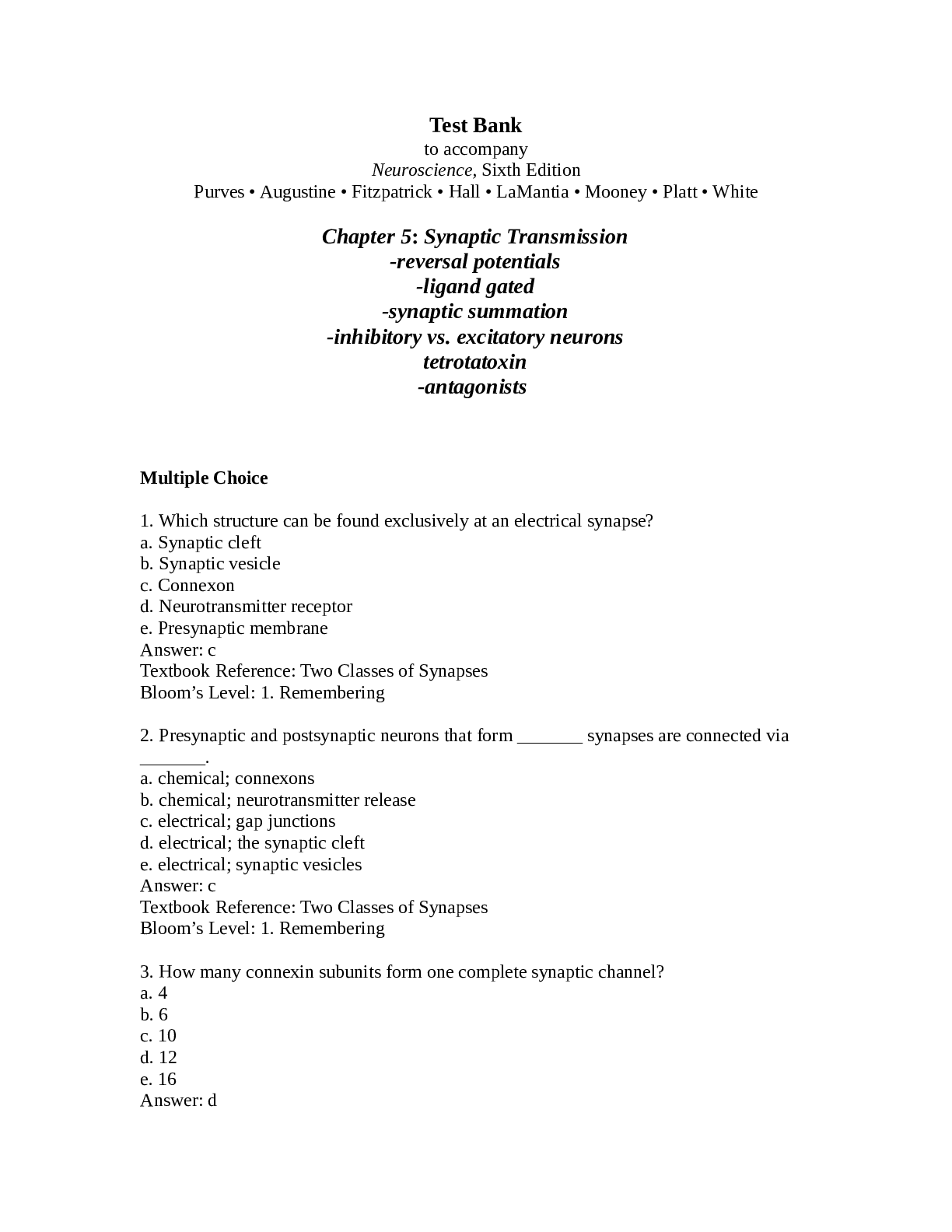
Test Bank
to accompany
Neuroscience, Sixth Edition
Purves • Augustine • Fitzpatrick • Hall • LaMantia • Mooney • Platt • White
Chapter 5: Synaptic Transmission
-reversal potentials
-ligand gated
-synaptic summation
-inhibitory vs. excitatory neurons
tetrotatoxin
-antagonists
Multiple Choice
1. Which structure can be found exclusively at an electrical synapse?
a. Synaptic cleft
b. Synaptic vesicle
c. Connexon
d. Neurotransmitter receptor
e. Presynaptic membrane
Answer: c
Textbook Reference: Two Classes of Synapses
Bloom’s Level: 1. Remembering
2. Presynaptic and postsynaptic neurons that form _______ synapses are connected via
_______.
a. chemical; connexons
b. chemical; neurotransmitter release
c. electrical; gap junctions
d. electrical; the synaptic cleft
e. electrical; synaptic vesicles
Answer: c
Textbook Reference: Two Classes of Synapses
Bloom’s Level: 1. Remembering
3. How many connexin subunits form one complete synaptic channel?
a. 4
b. 6
c. 10
d. 12
e. 16
Answer: d
Textbook Reference: Signaling Transmission at Electrical Synapses
Bloom’s Level: 2. Understanding
4. Which substances diffuse through connexon channels between pre- and postsynaptic
neurons?
a. Ions
b. Second messengers
c. Small proteins
d. ATP
e. All of the above
Answer: e
Textbook Reference: Signaling Transmission at Electrical Synapses
Bloom’s Level: 1. Remembering
5. Which feature of an electrical synapse allows synchronizing the electrical activity of
multiple neurons?
a. Fast speed of transmission
b. Ability of neurons to form gap junctions with glial cells
c. Bidirectional transmission of electrical signals
d. Slow transmission of signals
e. Bidirectional transmission of chemical signals
Answer: c
Textbook Reference: Signaling Transmission at Electrical Synapses
Bloom’s Level: 2. Understanding
6. What is the action of the neurotransmitter at a chemical synapse?
a. It acts on receptors in the postsynaptic membrane.
b. It electrically activates the presynaptic neuron.
c. It crosses the postsynaptic membrane and then activates ion channels in the
postsynaptic neuron.
d. It depolarizes the postsynaptic membrane by delivering an electrical charge.
e. It transfers an action potential from the presynaptic neuron to the postsynaptic neuron.
Answer: a
Textbook Reference: Signaling Transmission at Chemical Synapses
Bloom’s Level: 2. Understanding
7. Which event is the first in the series of events that take place during chemical synaptic
transmission?
a. Neurotransmitter binds to its receptors.
b. Influx of Ca2+ in the presynaptic terminal.
c. Voltage-gated Ca2+ channels open.
d. Neurotransmitter is released into the synaptic cleft.
e. Synaptic vesicles fuse with the presynaptic membrane.
Answer: c
Textbook Reference: Signaling Transmission at Chemical Synapses
Bloom’s Level: 3. Applying
8. At which point during signal transmission at a chemical synapse is exocytosis
occurring?
a. As neurotransmitter binds to its receptors
b. While Ca2+ enters the presynaptic terminal
c. As voltage-gated Ca2+ channels are opening
d. During neurotransmitter release into the synaptic cleft
e. During reuptake, as synaptic vesicles are reformed from the plasma membrane
Answer: d
Textbook Reference: Signaling Transmission at Chemical Synapses
Bloom’s Level: 1. Remembering
9. Refer to the figure.
The figure shows an electron micrograph of a chemical synapse in the cerebral cortex.
Which statement about this synapse is accurate?
a. Inside the postsynaptic neuron are synaptic vesicles, which fuse with the membrane in
the postsynaptic density.
b. Inside the presynaptic neuron are synaptic vesicles, which fuse with the membrane in
the active zone.
c. Inside the presynaptic neuron are synaptic vesicles, which fuse with the membrane in
the postsynaptic density.
d. A gap junction connects the two neurons via connexons that span the pre- and
postsynaptic membranes.
e. None of the above
Answer: b
Textbook Reference: Signaling Transmission at Chemical Synapses
Bloom’s Level: 4. Analyzing
10. In the sequence of events in neurotransmission, which event occurs just after the
action potential arrives at the presynaptic terminal?
a. Packaging of the neurotransmitter
b. Delivery of the neurotransmitter to the presynaptic terminal
c. Fusion of the synaptic vesicles with the presynaptic membrane
d. Influx of Ca2+ into the presynaptic terminal
e. Release of the neurotransmitter
Answer: d
Textbook Reference: Signaling Transmission at Chemical Synapses
[Show More]


.png)