1
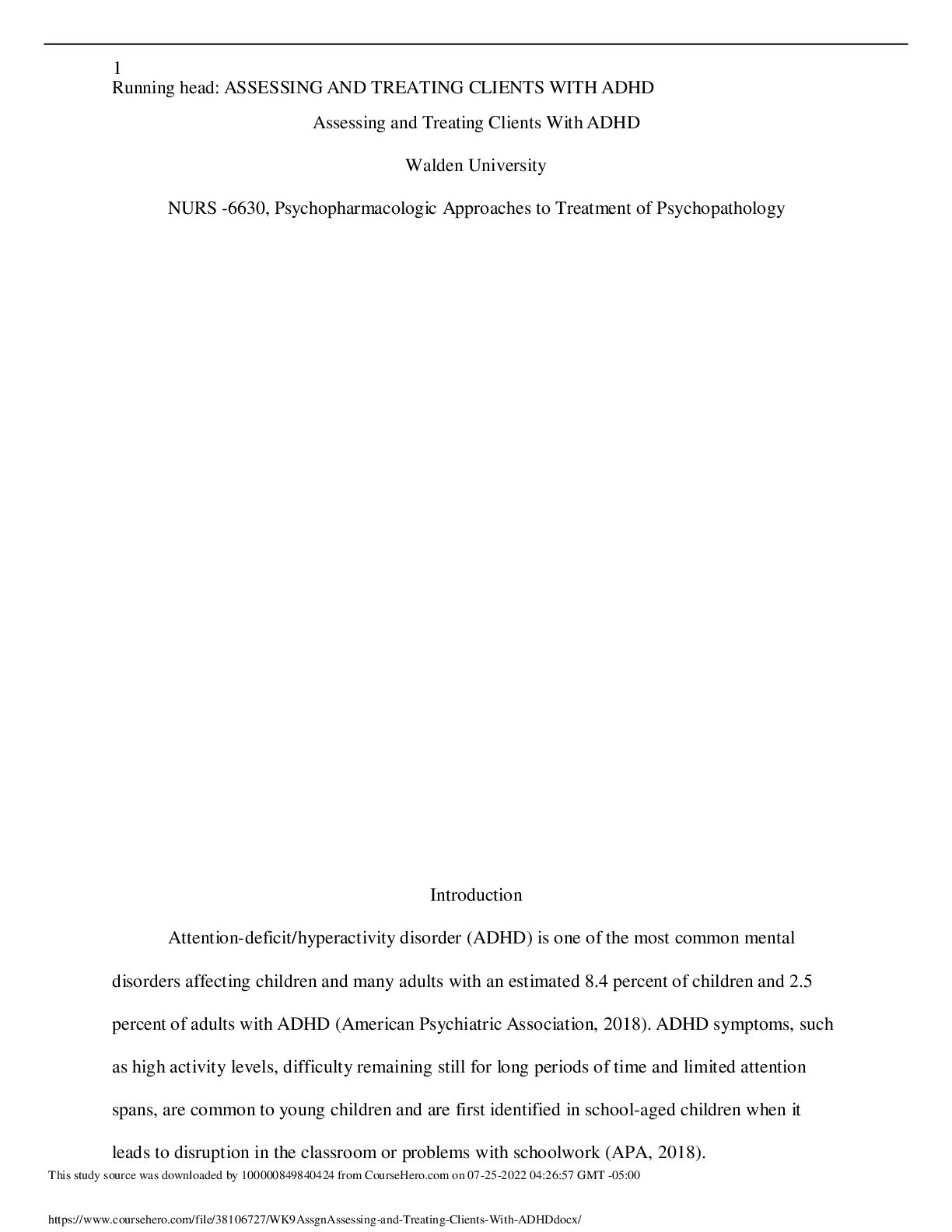
Running head: ASSESSING AND TREATING CLIENTS WITH ADHD
Assessing and Treating Clients With ADHD
Walden University
NURS -6630, Psychopharmacologic Approaches to Treatment of Psychopathology
January , 2019
Introduc
...
1
Running head: ASSESSING AND TREATING CLIENTS WITH ADHD
Assessing and Treating Clients With ADHD
Walden University
NURS -6630, Psychopharmacologic Approaches to Treatment of Psychopathology
January , 2019
Introduction
Attention-deficit/hyperactivity disorder (ADHD) is one of the most common mental
disorders affecting children and many adults with an estimated 8.4 percent of children and 2.5
percent of adults with ADHD (American Psychiatric Association, 2018). ADHD symptoms, such
as high activity levels, difficulty remaining still for long periods of time and limited attention
spans, are common to young children and are first identified in school-aged children when it
leads to disruption in the classroom or problems with schoolwork (APA, 2018).
As a provider, to diagnose ADHD, start by asking about a child's health, behavior, and
activity; talk with parents and kids about the things they have noticed, ask parents to complete
checklists about their child's behavior, and also ask parents to give the child's teacher a checklist
too (Hasan, 2017). After all information has been gathered, the provider may diagnose ADHD if
This study source was downloaded by 100000831988016 from CourseHero.com on 04-05-2022 14:51:21 GMT -05:00
https://www.coursehero.com/file/38106727/WK9AssgnAssessing-and-Treating-Clients-With-ADHDdocx/
2
ASSESSING AND TREATING CLIENTS WITH ADHD
the child's distractibility, hyperactivity, or impulsivity go beyond what's usual for their age, the
behaviors have been going on since the child was young, distractibility, hyperactivity, and
impulsivity affect the child at school and at home, and a health check shows that another health
or learning issue isn't causing the problems (Hasan, 2017). The aim of ADHD treatment is to
improve symptoms, optimize functional performance, and remove behavioral obstacles;
therefore, therapy should start with medications in children six years and older including
behavioral treatments which are particularly helpful if medication response is poor or associated
with adverse effects (Felt, Biermann, Christner, Kochhar, & Van Harrison, 2014).
The case study for this assignment is on a eight year old Caucasian female who is brought
to the office by her mother and father referred by their primary care provider to be evaluated by
psychiatry to determine whether or not the client has ADHD after the teacher filled the “Conner’s
Teacher Rating Scale-Revised” which the score shows client is inattentive, easily distracted,
forgets things she already learned, is poor in spelling, reading, and arithmetic. The parents seems
to be in denial of the client having ADHD. The purpose of this paper is to show how to assess
and develop personalized therapy plans for children with ADHD based on the decision
concerning the medication to prescribe to the client, the influence of pharmacokinetic and
pharmacodynamic, and including ethical and legal implications related to prescribing therapy for
children with ADHD.
Decision One
The first decision choice is to start the client on Ritalin (methylphenidate) chewable
tablets 10 mg orally in the morning. Methylphenidate is the most effective and safest short term
drug treatment and should be the preferred first choice medicine for children with ADHD
(Iacobucci, 2018). According to a study by Storebo et al. (2018), findings suggest that
This study source was downloaded by 100000831988016 from CourseHero.com on 04-05-2022 14:51:21 GMT -05:00
https://www.coursehero.com/file/38106727/WK9AssgnAssessing-and-Treating-Clients-With-ADHDdocx/
3
ASSESSING AND TREATING CLIENTS WITH ADHD
methylphenidate might improve some of the core symptoms of ADHD by reducing hyperactivity
and impulsivity, and helping children to concentrate; therefore, might also help to improve the
general behavior and quality of life of children with ADHD. Ritalin works by Increasing
norepinephrine and especially dopamine action
[Show More]