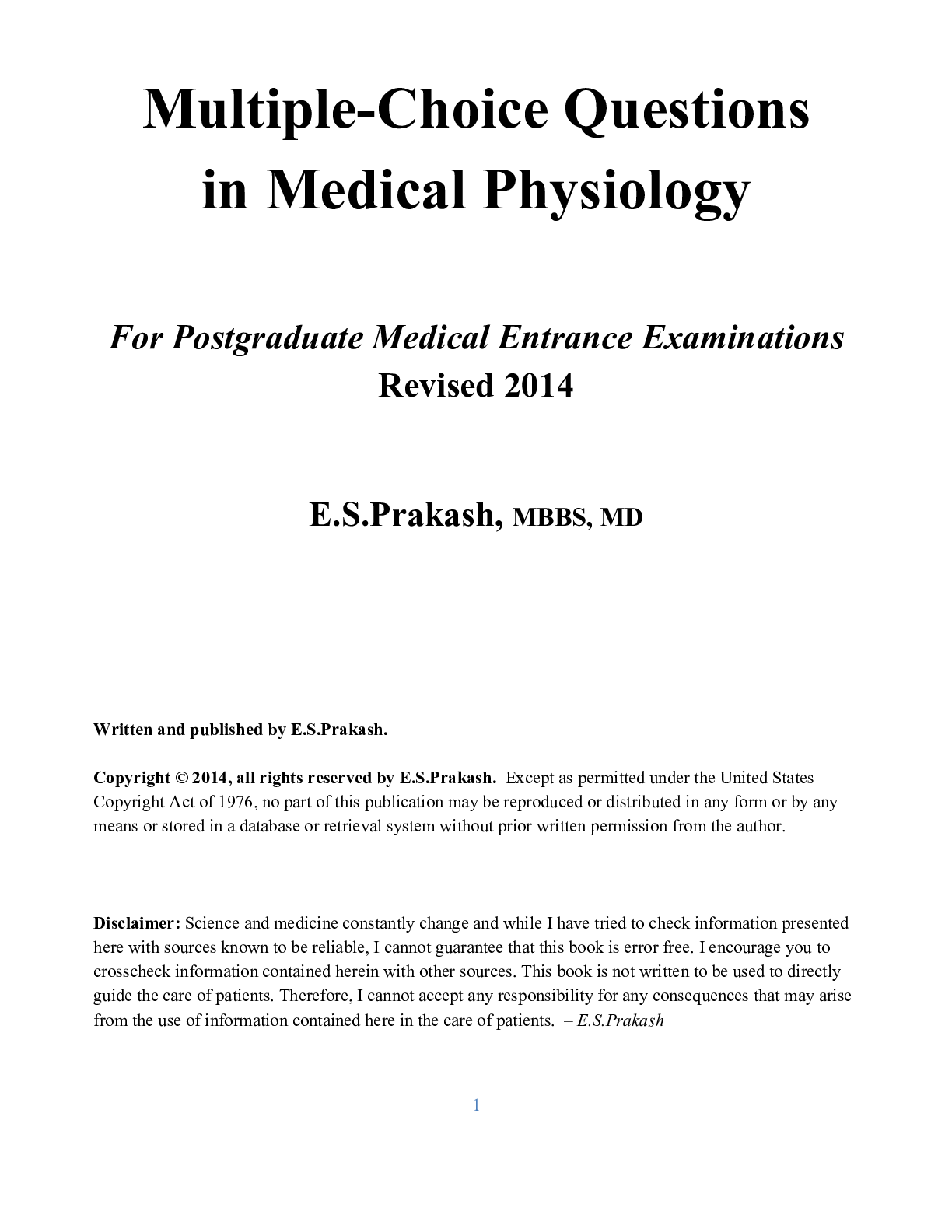
Multiple-Choice Questions in Medical Physiology:
Table of Contents
Chapter
Frequently used abbreviations
2 minutes please
General Physiology
Nerve, Muscle, Synaptic Physiology and Neurotransmission
Central Nervo
...
Multiple-Choice Questions in Medical Physiology:
Table of Contents
Chapter
Frequently used abbreviations
2 minutes please
General Physiology
Nerve, Muscle, Synaptic Physiology and Neurotransmission
Central Nervous System
Endocrinology and Reproduction
Gastrointestinal Physiology
Blood and Cardiovascular Physiology
Pulmonary Physiology
Renal and Acid-Base Physiology
Frequently used abbreviations
aka – also known as
BP – blood pressure
CSF – cerebrospinal fluid
ECF – extracellular fluid
Hb – hemoglobin
Hct – hematocrit
ICF – intracellular fluid
ISF – interstitial fluid
MAP – mean systemic arterial pressure
MCQ – multiple-choice question
PCV – packed cell volume
RBC – red blood cell
SVR – systemic vascular resistance
T/F – True or false
TPR – total peripheral resistance (aka. Systemic vascular resistance)
WBC – white blood cell
WNL – within normal limits
2 minutes please
Think of this book as a tool to help you assess how well you have learnt medical physiology. It has been
written primarily for use in revision courses for doctors who are preparing for competitive postgraduate
medical entrance examinations in India, but undergraduate medical students and postgraduate physiology
students, may also find this helpful. The intent here is to use multiple-choice questions (MCQ) as a means
to help the reader revise key facts, test understanding of concepts and the ability to apply them.
Many questions that I have seen appear on entrance examinations test conceptual understanding and
meaningful learning. However, depending on the exam, some test knowledge of facts that are not of
significance to a practicing primary care physician, and an undesirable backwash effect of this is it tends to
encourage rote learning over indepth learning of important concepts. In writing this book, I have focused on
the immediate ‘learning needs’ of the target audience, which is to be successful on these exams.
I’ve frequently included questions solely for learning and systematic revision of certain topics. Thus, not all
questions are written to be equivalent in standard to questions commonly appearing in entrance
examinations. That being said, the difficulty level of questions varies from one exam to another with some
predominantly testing recall of facts whereas others test knowledge and understanding and the ability to
apply concepts and solve problems. Just to be clear, no attempt is made here to be comprehensive.
Summaries of certain topics can be found at the start of each section. I’d suggest giving the summaries a
quick read before doing questions and explanations (for questions) that may be found in summaries upfront
are not repeated.
As MCQs with multiple correct answers enable more material to be revised with fewer questions, I have
also frequently used such questions; this helps us get into and sustain the important habit of carefully
reading all options in a question. Furthermore, some entrance exams use the multiple true-false type of
MCQ, so some practice with this type of question is needed.
[Show More]