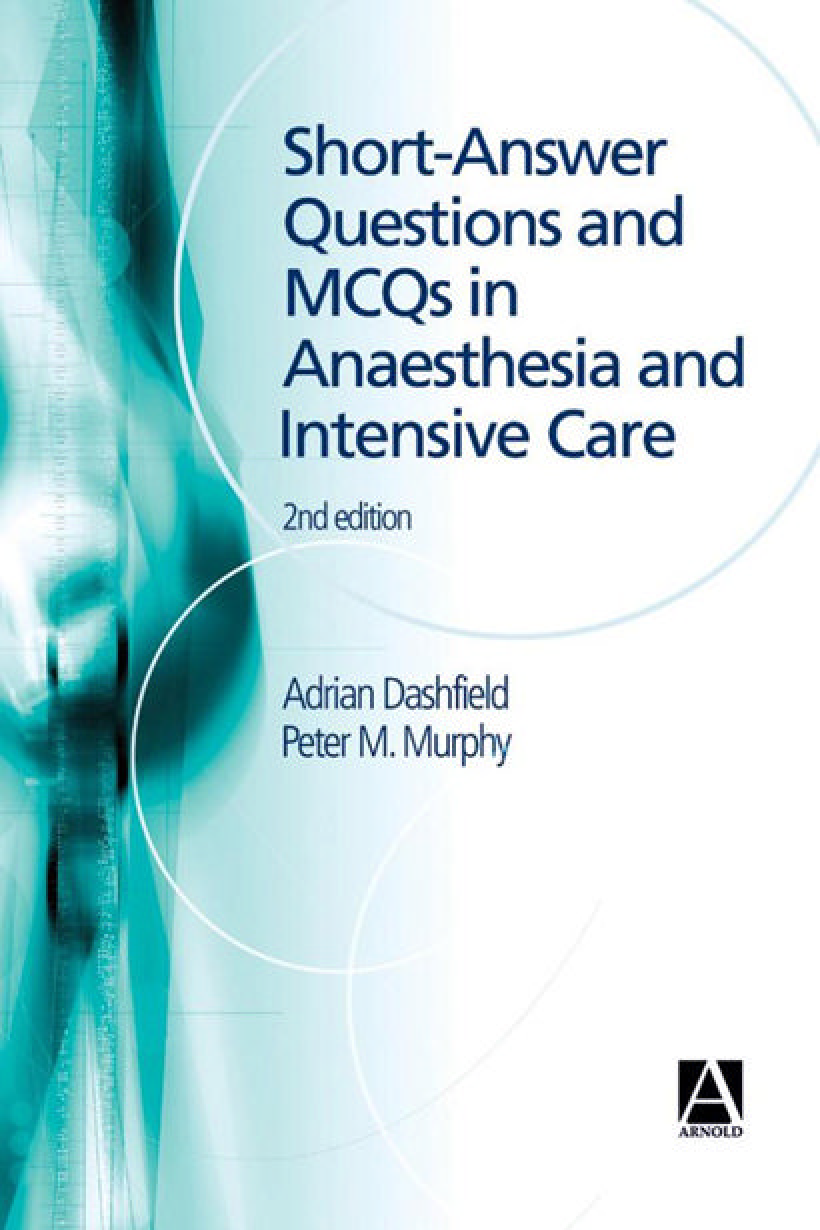
Short Answer Questions and MCQs in Anesthesia and Intensive Care :
Contents
Preface
Section 1 – Action plans
1. Air embolism
2. Alarming cyanosis
3. Bloody epidural
4. Dural tap
5. Malignant hyperpyrexia
6. Pu
...
Short Answer Questions and MCQs in Anesthesia and Intensive Care :
Contents
Preface
Section 1 – Action plans
1. Air embolism
2. Alarming cyanosis
3. Bloody epidural
4. Dural tap
5. Malignant hyperpyrexia
6. Pulmonary aspiration
7. Severe drug reactions
8. Systemic toxicity of local anaesthetics
9. Tricyclic overdose
10. Wheezing
Multiple-choice questions
Answers to multiple-choice questions
ix
1
2
5
8
9
11
14
16
18
20
21
23
27
Section 2 – Anatomy 29
1. First rib
2. Anterior spinal artery
3. Blood supply of the heart
4. Femoral nerve
5. Internal jugular veins
6. Oesophagus
7. Subclavian vein
8. Diaphragm
9. Pleura
10. Arterial supply of brain
11. Brachial plexus
12. Innervation of the eye
13. Intercostal space
14. The axilla
15. The sympathetic trunk
16. The trachea
Multiple-choice questions
Answers to multiple-choice questions 30
33
35
37
41
43
45
46
48
50
53
57
61
63
67
70
72
75vi
CONTENTS
Section 3 – Cardiothoracic anaesthesia
1. Coronary artery bypass surgery
2. Problems in 24-hour period after CABG
3. Management in 24-hour period after CABG
4. Oesophagectomy
5. Physiology of one-lung ventilation (OLV)
6. One-lung ventilation: indications
7. One-lung ventilation: technique
8. One-lung ventilation: problems
9. Post-thoracotomy pain
Multiple-choice questions
Answers to multiple-choice questions
77
78
83
85
89
93
96
97
100
102
107
111
Section 4 – The intensive care unit (ICU) 113
1. Cardiac output
2. Cardiopulmonary resuscitation
3. Central venous catheter infections
4. Complications of total parenteral nutrition (TPN)
5. Enteral versus parenteral feeding
6. Assessment of nutritional status
7. Hypothermia
8. Trauma to chest
9. Transfer between hospitals
10. Metabolic requirements
11. Nitric oxide use
12. Positive end-expiratory pressure (PEEP)
13. Pulmonary oedema
14. Ventilatory support
15. Burns
Multiple-choice questions
Answers to multiple-choice questions 114
118
121
124
127
129
132
135
139
142
144
147
150
152
157
160
165
Section 5 – Neuroanaesthesia
1. Head injury
2. Intracranial pressure (ICP) measurement
3. Indications for referral of head injury
4. Spinal cord injury
Multiple-choice questions
Answers to multiple-choice questions 167
168
171
174
177
179
183
Section 6 – Obstetrics 185
186
188
190
192
1.
2.
3.
4.
Caesarean section in pre-eclampsia
Control of blood pressure in pre-eclampsia
Control of pre-eclamptic convulsions
Repeat caesarean sectionvii
Contents
5. Prophylaxis for deep vein thrombosis (DVT)
6. Postdural puncture headache
Multiple-choice questions
Answers to multiple-choice questions
193
194
196
199
Section 7 – Paediatric anaesthesia 201
1. Latex allergy
2. Investigation of latex allergy
3. Paediatric pain
4. Premedicant drugs
5. Sevoflurane versus propofol
6. Tracheo-oesophageal fistula repair
Multiple-choice questions
Answers to multiple-choice questions 202
204
206
208
210
212
215
218
Section 8 – Pain management 219
1. Measurement of pain
2. Patient-controlled analgesia (PCA)
3. Safety of PCA
4. NSAIDs
5. Complex regional pain syndrome
6. Neurogenic pain
7. Stellate ganglion block
8. Postoperative pain
9. The postanaesthetic visit
Multiple-choice questions
Answers to multiple-choice questions 220
223
225
228
232
234
237
239
241
244
246
Section 9 – Physics 247
1. Serum oxygen measurement
2. Pulse oximetry
3. Carbon dioxide measurement
4. Invasive blood pressure measurement
5. Temperature measurement
6. Perioperative heat loss
7. Low-flow anaesthesia
8. Swan–Ganz catheter
Multiple-choice questions
Answers to multiple-choice questions 248
251
253
256
258
261
263
266
270
275
Section 10 – Special clinical problems 277
1.
2.
3.
4. 278
281
284
285
Non-cardiac surgery after heart transplant
Septoplasty
Monitoring in magnetic resonance imaging (MRI)
Subtotal thyroidectomyviii
CONTENTS
5. Dental anaesthesia
6. Day-case anaesthesia
7. Thromboembolism prophylaxis
8. Patient with pacemaker
9. Infection risk
10. Atrial fibrillation
Multiple-choice questions
Answers to multiple-choice questions 291
293
294
296
298
300
301
306
Section 11 – Study design and statistics
1. Meta-analysis
2. Patient information sheet
3. Evidence-based medicine
4. Study design for new antiemetic drug
5. Data interpretation
Multiple-choice questions
Answers to multiple-choice questions 307
308
310
312
313
315
316
318
Section 12 – Applied pharmacology 319
1. Propofol versus thiopentone
2. Therapeutic uses of magnesium
3. Use of nitrous oxide (N 2 0)
4. Anaesthetic implications of substance-abusing patients
5. Drugs used to induce hypotension
6. Postoperative nausea and vomiting (PONV)
Multiple-choice questions
Answers to multiple-choice questions 320
322
323
324
326
328
330
333
[Show More]