Everything in red and yellow is on the final exam! You’re welcome!
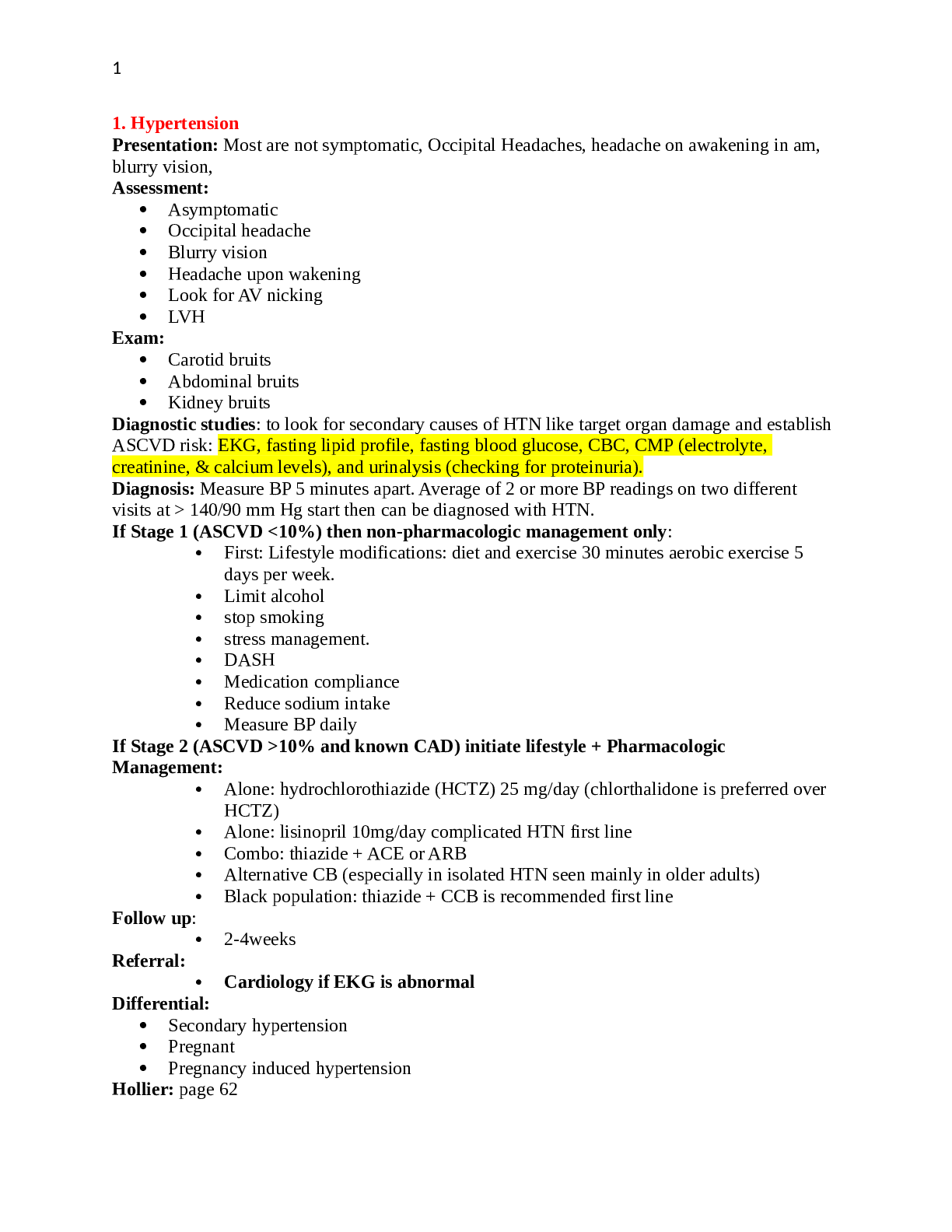
● Ethical decision making
○ When making choices about ethical issues based on the standards of right vs wrong.
○ It requires a systematic framework fo
...
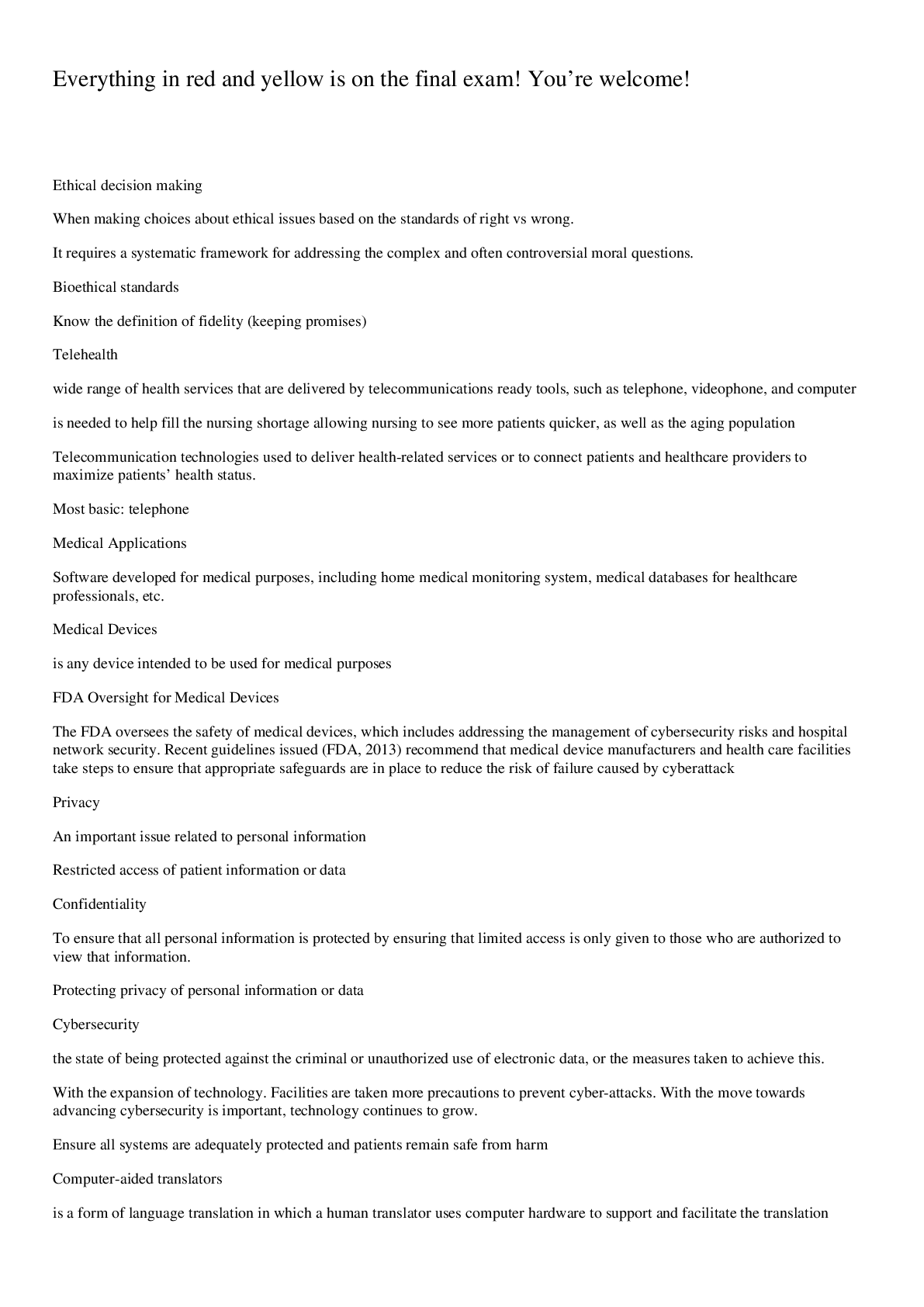
Everything in red and yellow is on the final exam! You’re welcome!
● Ethical decision making
○ When making choices about ethical issues based on the standards of right vs wrong.
○ It requires a systematic framework for addressing the complex and often controversial
moral questions.
● Bioethical standards
○ Know the definition of fidelity (keeping promises)
● Telehealth
○ wide range of health services that are delivered by telecommunications ready tools,
such as telephone, videophone, and computer
○ is needed to help fill the nursing shortage allowing nursing to see more patients quicker,
as well as the aging population
○ Telecommunication technologies used to deliver health-related services or to connect
patients and healthcare providers to maximize patients’ health status.
○ Most basic: telephone
● Medical Applications
○ Software developed for medical purposes, including home medical
monitoring system, medical databases for healthcare professionals, etc.
● Medical Devices
○ is any device intended to be used for medical purposes
● FDA Oversight for Medical Devices
○ The FDA oversees the safety of medical devices, which includes addressing the
management of cybersecurity risks and hospital network security. Recent guidelines
issued (FDA, 2013) recommend that medical device manufacturers and health care
facilities take steps to ensure that appropriate safeguards are in place to reduce the risk
of failure caused by cyberattack
● Privacy
○ An important issue related to personal information
○ Restricted access of patient information or data
● Confidentiality
○ To ensure that all personal information is protected by ensuring that limited access is
only given to those who are authorized to view that information.
■ Protecting privacy of personal information or data
● Cybersecurity
○ the state of being protected against the criminal or unauthorized use of electronic data,
or the measures taken to achieve this.
○ With the expansion of technology. Facilities are taken more precautions to prevent
cyber-attacks. With the move towards advancing cybersecurity is important, technology
continues to grow.
○ Ensure all systems are adequately protected and patients remain safe from harm
● Computer-aided translators
○ is a form of language translation in which a human translator uses computer hardware
to support and facilitate the translation process.
This study source was downloaded by 100000831988016 from CourseHero.com on 04-25-2022 01:43:31 GMT -05:00
https://www.coursehero.com/file/68015827/NR-599-final-exam-study-guide-HIGHLIGHTED-1docx/
● HIPAA
○ was established in the U.S. in 1996 to protect an individual's personal health
care information.
○ Signed by Pres. Bill Clinton
○ Healthcare institutions are required to meet all standards and comply with
the appropriate security measures in order to safeguard patient data.
○ Four parts to HIPAA's Administrative Simplification
■ Electronic transactions and code sets standards requirements.
■ Privacy requirements.
■ Security requirements.
■ National identifier requirements.
● ICD-10 Coding
○ An alphanumeric code used by doctors, health insurance companies, and
public health agencies across the world to represent diagnoses.
○ The system offers accurate and up-to-date procedure codes to improve
health care cost and ensure fair reimbursement policies
○ The current codes specifically help healthcare providers to identify patients
in need of immediate disease management and to tailor effective disease
management programs.
■ Similarly, ICD and CPT coding go together
● Is a medical code set that is used to report medical, surgical, and
diagnostic procedures and services to entities such as
physicians, health insurance companies and accreditation
organizations.
● Evaluation and Management Coding
○ Is a medical coding process in support of medical billing
○ Practicing health care providers in the United States must use E/M coding to be
reimbursed by Medicare, Medicaid programs, or private insurance for patient
encounters.
○ 3 key components: history, physical, medical decision making
● Clinical Support Tools
○ are designed to help sift through enormous amounts of digital data to
suggest next steps for treatments, alert providers to available information
they may not have seen, or catch potential problems, such as dangerous
medication interactions
○ Such as CDS clinical decision support, a program used by providers.
○ Or various applications use by healthcare professionals to allow for
communicate between provider to provider and provider to patient
○ The tools are all used to benefit patient outcome
● Workflow analysis
○ Not an optional part of clinical implementations, but rather a necessity for safe patient
care fostered by technology.
○ The ultimate goal of workflow analysis is not to “pave the cow path,” but rather to create
a future-state solution that maximizes the use of technology and eliminates non–valueadded activities.
This study source was downloaded by 100000831988016 from CourseHero.com on 04-25-2022 01:43:31 GMT -05:00
https://www.coursehero.com/file/68015827/NR-599-final-exam-study-guide-HIGHLIGHTED-1docx/
○ Although many tools and methods can be used to accomplish workflow redesign, the
best method is the one that complements the organization and supports the work of
clinicians.
○ needs to be done as well as working in optimization (moving conditions past their
current state into a more effective method of performing.
WEEK FIVE READING/ KEY POINTS
Key points from the lessons and modules
● Clinical Decision Support (CDS)
○ Generate patient specific interventions, assessments and recommendations
○ CDS tools existed prior to development of EHRs
○ The primary goal of implementing a CDS tool is to leverage data and the scientific
evidence to help guide appropriate decision making
● CDS improving healthcare
○ Reducing clinical variation and duplicative testing
○ Ensuring patient safety
○ Avoiding complications that may result in readmissions
○ Create alerts about drug-drug interactions
○ Drug allergy contraindications
● CDS challenging healthcare
○ Alarm fatigue
○ Clinical burnout
○ Occur with poorly implemented CDS features
○ Financial burden
● Chapter 19 Clinical Decision Support System
○ CDS: provides clinicians, staff, patients, or other individuals with knowledge and personspecific information, intelligently filtered or presented at appropriate times to enhance
healthcare
○ Successful implementation is done using leadership, executive support, and
interprofessional teams representing stakeholders most impacted by changes to
workflow
○ Qualitative evaluation strategy after implementing CDS program may include focus
groups or surveys-- Quantitative measures include flow charts and may be used to
report back to leadership
○ CDS teams must design and deploy CDSS’s so they are most helpful for their purposes
as EHR directly from the vendor do not automatically capture certain information to find
trends and suggest interventions
■ Finding common ground terminology is important as what one thing means to IT
staff is something totally different from a doctor or even different to the nurse
■ The team must work together, as clinicians can have unrealistic expectation for
the capability of technology/computer, and the informatics team needs to know
what is important to the front-line staff
This study source was downloaded by 100000831988016 from CourseHero.com on 04-25-2022 01:43:31 GMT -05:00
https://www.coursehero.com/file/68015827/NR-599-final-exam-study-guide-HIGHLIGHTED-1docx/
WEEK SIX READING/ KEY POINTS
● McGonigle Chapter 18 Telenursing and remote access telehealth
○ Telehealth: wide range of health services that are delivered by telecommunications
ready tools, such as telephone, videophone, and computer
○ Allow easier and faster access to patient’s conditions ex. Pt’s response to medications
in hours rather than in days
○ Telehealth is needed to help fill the nursing shortage allowing nursing to see more
patients quicker, as well as the aging population ( 50+ years old live with at least one ⅘
chronic disease or condition). The amount of chronic conditions and number of people
affected by chronic conditions is expected to continue rising-- of people of all ages ⅓
have limited ability to go to school or live independently due to chronic conditions
○ Telemedicine: use of medical information exchanged from one site to another via
electronic communications to improve patient’s health status. Telehealth is similar but is
a broader definition that does not always involve clinical services
○ Telehealth: use of technology to deliver healthcare, health information, or health
education at a distance
● McBride Chapter 7 EHR and POC technology
○ Adoption
■ refers to how well the staff and users actually use and embrace the system as
part of their routine daily activities
■ Adoption of the EHR by stakeholders, including leadership, clinicians, support
staff, and patients, aligns with more mature stages in accordance with the
diffusion of an innovation theoretical framework
■ Today, the adoption of EHRs has become routine, given that most organizations
and providers have an EHR
○ Electronic health record
■ Is the systematized collection of patient and population electronicallystored health information in a digital format
■ These records can be shared across different health care settings
■ EHRs are real-time, patient-centered records that make information
available instantly and securely to authorized users
○ Evaluation
■ An evaluation of how effective the adoption of an EHR has been be measured
through qualitative studies, such as surveys, questionnaires, focus groups or
ethnographic observational methods, staff interviews, and workflow analysis
before and after the implementation of the system.
■ An evaluation of the implementation should be done by all members of the
project team, as well as by the staff using the system
○ Point-of-care (POC) technology
■ Encompasses the devices and systems that support health-care
professionals in their daily activities of monitoring patients, caring for
them, and documenting their health progress
● McGonigle Chapter 5 Ethical Applications of Informatics
This study source was downloaded by 100000831988016 from CourseHero.com on 04-25-2022 01:43:31 GMT -05:00
https://www.coursehero.com/file/68015827/NR-599-final-exam-study-guide-HIGHLIGHTED-1docx/
○ Casuist approach
■ An approach to ethical decision making that grew out of the concern for methods
of examining ethical dilemmas
■ Casuistry is a specific ethical reasoning method that analyzes the facts of a case
in a sound, logical, and ordered or structured manner.
○ Confidentiality
■ To ensure that all personal information is protected by ensuring that limited
access is only given to those who are authorized to view that information.
○ Ethical decision making
■ When making choices about ethical issues based on the standards of right vs
wrong.
■ It requires a systematic framework for addressing the complex and often
controversial moral questions.
○ Ethical dilemma
■ A difficult issue that requires the use of standards to solve issues. Ethically
challenged.
○ Fidelity
■ Keeping a promise
○ Principlism
■ A foundation for ethical decision making by rational individuals and beliefs
○ Health disparities
■ The health status differences between different groups of people, especially
minorities and non-minorities.
■ The gap between the different people is an ongoing problem even with the
advances in technology and healthcare practices
○ Protected health information
■ Any and all information about a person’s health that is tied to any type of
personal identification.
■ This exception ended in January 2011 for providers that recently implemented
electronic health record (EHR) systems.
■ For those providers with EHR systems that were implemented before passage of
the HITECH Act, the TPO exception ended in January 2014.
■ It is easy to understand why this exception ended: Because all providers must
implement comprehensive EHR systems, it will be very easy to generate an
electronic record with an accounting of anyone who accessed a patient’s record.
○ Firewall
■ A tool commonly used by organizations to protect their corporate networks when
they are attached to the Internet.
■ A firewall can be either hardware or software, or a combination of the two. It
examines all incoming messages or traffic to the network.
■ The firewall can be set up to allow only messages from known senders into the
corporate network; it can also be set up to look at outgoing information from the
corporate network.
○ Malware
This study source was downloaded by 100000831988016 from CourseHero.com on 04-25-2022 01:43:31 GMT -05:00
https://www.coursehero.com/file/68015827/NR-599-final-exam-study-guide-HIGHLIGHTED-1docx/
■ A malicious program or software that infects a device and is intended to steal
information, take control or destroy data, information, or the device.
○ American Recovery and Reinvestment Act of 2009 (ARRA)
■ An economic stimulus package enacted in February 2009 that was intended to
create jobs and promote investment and consumer spending during the
recession.
■ Also referred to as the Stimulus or Recovery Act
○ Health Information Technology for Economic and Clinical Health Act of 2009 (HITECH)
■ Under this act, healthcare organizations can qualify for financial incentives
based on the level of meaningful use achieved
■ the HITECH Act specifically incentivizes health organizations and providers to
become “meaningful users.”
[Show More]



- Test Bank.png)