PHI 103 week 4 quiz
Question 1
1 / 1 pts
Which of the following is not true about inductive reasoning versus deductive reasoning?
Deductive reasoning aims for an absolute connection between the premises and conclusi
...
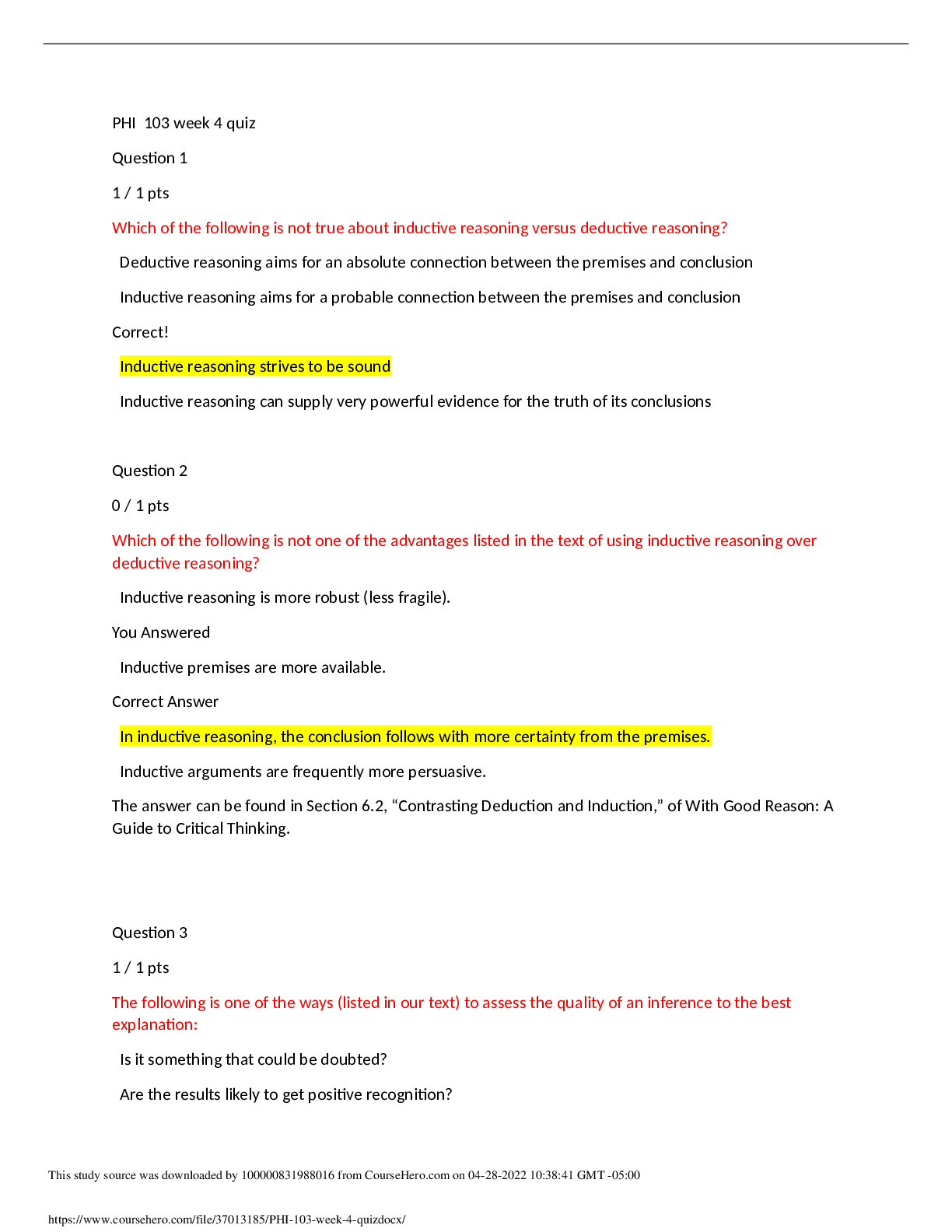
PHI 103 week 4 quiz
Question 1
1 / 1 pts
Which of the following is not true about inductive reasoning versus deductive reasoning?
Deductive reasoning aims for an absolute connection between the premises and conclusion
Inductive reasoning aims for a probable connection between the premises and conclusion
Correct!
Inductive reasoning strives to be sound
Inductive reasoning can supply very powerful evidence for the truth of its conclusions
Question 2
0 / 1 pts
Which of the following is not one of the advantages listed in the text of using inductive reasoning over
deductive reasoning?
Inductive reasoning is more robust (less fragile).
You Answered
Inductive premises are more available.
Correct Answer
In inductive reasoning, the conclusion follows with more certainty from the premises.
Inductive arguments are frequently more persuasive.
The answer can be found in Section 6.2, “Contrasting Deduction and Induction,” of With Good Reason: A
Guide to Critical Thinking.
Question 3
1 / 1 pts
The following is one of the ways (listed in our text) to assess the quality of an inference to the best
explanation:
Is it something that could be doubted?
Are the results likely to get positive recognition?
This study source was downloaded by 100000831988016 from CourseHero.com on 04-28-2022 10:38:41 GMT -05:00
https://www.coursehero.com/file/37013185/PHI-103-week-4-quizdocx/
Is it likely to be praised by the scientific community?
Correct!
Is it testable?
Question 4
0 / 1 pts
This form of inductive argument moves from the general to the specific:
You Answered
inductive generalization
Correct Answer
statistical syllogism
argument from authority
deductive argument
The answer can be found in Section 6.1, “Contrasting Deduction and Induction,” of With Good Reason: A
Guide to Critical Thinking.
Question 5
1 / 1 pts
Which of the following is true of the distinction between induction and deduction?
Inductive reasoning means going from the specific to the general; while deductive reasoning is the
reverse.
Inductive reasoning means going from the general to the specific, while deductive reasoning is the
reverse.
Correct!
Some forms of inductive reasoning go from the specific to the general, while others go from the general
to the specific.
Deductive reasoning never has a general conclusion.
Question 6
This study source was downloaded by 100000831988016 from CourseHero.com on 04-28-2022 10:38:41 GMT -05:00
https://www.coursehero.com/file/37013185/PHI-103-week-4-quizdocx/
1 / 1 pts
Which of the following is not true about adding new premises to inductive arguments?
Adding premises to an inductive argument can make it go from strong to weak
Adding new premises to an inductive argument can make it go from weak to strong
One can keep adding premises to inductive arguments to make them go from strong to weak, then back
to strong again, etc.
Correct!
Once one has a strong inductive argument, there is no possible new information that will make it weak
again
Question 7
1 / 1 pts
Which of these is one of the steps of the hypothetico-deductive method?
Interview other scholars first
Avoid things that would refute your theory
Determine whether the results are likely to be profitable
Correct!
Test to find out if a predicted consequence occurs
Question 8
1 / 1 pts
The concept of persuasiveness, when applied to inductive arguments (in Chapter 6) means what?
Correct!
Sometimes deductively valid arguments are less persuasive than inductive arguments because one is
not likely to accept their strong premi
[Show More]