HOW TO APPLY ADVANCED PRACTICE NURSING COMPETENCIES TO CLINICAL SETTINGS
With the growth in Advanced Practice Roles such as the Clinical Nurse Specialist and Nurse Practitioner
titles there is more recognition and inte
...
HOW TO APPLY ADVANCED PRACTICE NURSING COMPETENCIES TO CLINICAL SETTINGS
With the growth in Advanced Practice Roles such as the Clinical Nurse Specialist and Nurse Practitioner
titles there is more recognition and interest in the potential benefits that APNs may bring to the care of
patients. Numerous studies have shown the value of using advanced practice nurses in the clinical setting
yielding significant contributions and examples of outcome measures for APNs. APNs are effective in
improving the outcomes such as patient satisfaction, readmissions, cost, health status, and complications.
The interprofessional educational efforts should instill the core competencies by following guiding
principles of being patient centered; having a community or population focus; emphasizing relationships
and processes; containing developmentally appropriate activities and assessments; and being outcome
driven.
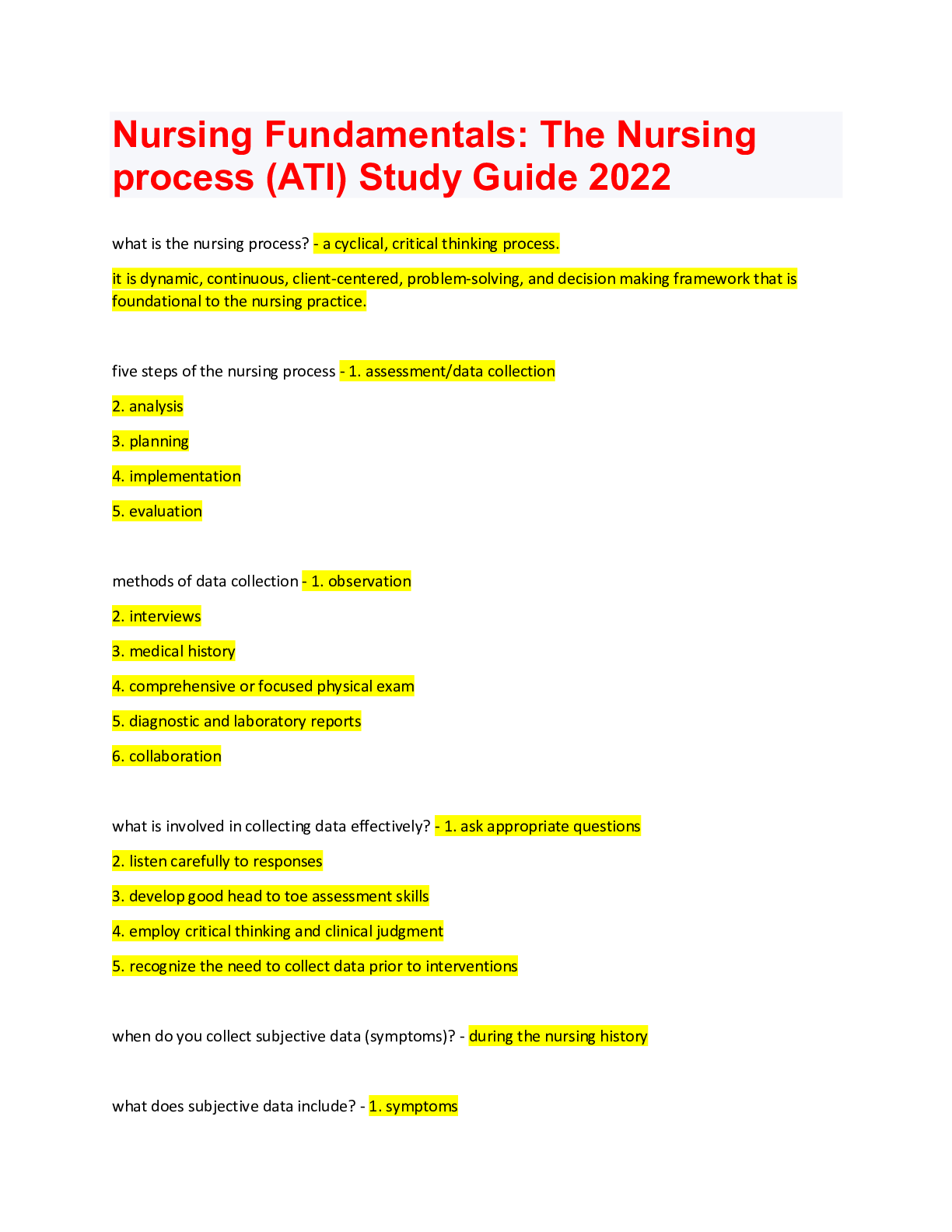
The American Nurses Association (ANA) 20 issued a competency document outlining essential genomic
competencies for graduate nurses. The document was established by an expert consensus panel in
genetics and genomics. The document contains 38 competencies under seven major categories that
include risk assessment and interpretation; genetic education, counseling, testing, and results
interpretation; clinical management; ethical, legal, and social implications; professional role; leadership;
and research. In professional practice, the essential competencies of the ANA document require nurses
with graduate level education to be competent in risk assessment and interpretation; genetic education,
counseling, testing, and results interpretation; clinical management; and ethical, legal, and social
implications as they relate to genetics and genomics.
Theories in nursing practice (See the last page-split among many members-most have not submitted)
SOAP NOTE –
S – Looking for Subjective Evidence
Interview the patient and/or family member about the history of the present illness.
Ask about the presentation of the illness (timing, signs and symptoms, etc.)
Ask whether the patient is on any medication, inquire about past medical history, diet, etc.
Be alert for the historical findings because they provide important clues that help point to the correct
diagnosis (or differential diagnosis).
O - Looking for Objective Evidence
Perform physical exam (general or targeted to the present complaints).
If applicable, perform a physical maneuver (Tinel’s, Kernig’s, drawer, etc.)
Order laboratory/other tests to “rule in” (or “rule out”) the differential diagnosis
If the laboratory test result is abnormal, you may be asked about the next step (such as a follow up lab
test that is more sensitive or specific).
A-Assessment
The medical diagnoses for the medical visit on the given date of a note written. An assessment is the
diagnosis or condition the patient has. In some instances, there may be one clear diagnosis. In other
cases, a patient may have several things wrong. There may also be other times where a definitive
diagnosis is not yet made, and more than one possible diagnosis is included in the assessment.
P-Plan
This describes what the health care provider will do to treat the patient - ordering labs, referrals,
procedures performed, medications prescribed, etc. How you are going to address the patient’s problem.
It may involve ordering additional tests to rule out or confirm a diagnosis. It may also include treatment
that is prescribed, such as medication or surgery. The plan may also include information for self-care and
deposition including bed rest and days off work.
CODING AND BILLING PRACTICES FOR NP’S.
For reimbursement of services the first thing that has to happen is the NP needs to obtain a National
Provider Identifier (NPI) number. This application is online. You also will need to apply/enroll as a
Medicare and Medicaid provider (separate applications) using that NPI number.
Billing: When you have all your appropriate billing numbers you can submit for reimbursement.
NPs can bill under their own numbers and reimbursement will be at 85% of the physician fee schedule for
outpatient and inpatient services.
“Incident to services” is a billing term specific to Medicare for the office/outpatient setting. When NPs bill
“incident to”, they are reimbursed at 100% of the physician fee. These instances have specific
requirements. #1 The services must in rendered in the physician’s office under “Physician’s direct personal
supervision”. This means that the physician must be available on site to provide assistance if needed. It
does NOT mean that the physician has to see the patient on that visit or that they must “sign off” on that
patient’s visit. The physician DOES have to do the initial visit and see the patient on a frequency that
supports that he/she is involved in the patient’s plan of care. “Incident to” does not apply in the hospital
setting.
Split/Shared E/M Services applies to hospital inpatient/hospital outpatient or emergency department.
This is used when BOTH the NP and physician have BOTH had a face to face visit with the patient. The key
here is Face to Face. Doctor must physically lay eyes on the patient, not just review documentation.
Other third party payers vary on reimbursement from 85-100%.
Coding: is based on the complexity of the visit. E/M Coding represents the health care provider’s
cognitive skills and includes office or clinic visits, consultations, preventative medical examinations, and
critical care services. Make sure codes are accurate for diagnoses as Over AND Under coding both
constitute Medicare fraud. Medicare fraud can result in fines, criminal prosecution, loss of provider status
and license.
Other key points I found:
“collaborative” does not mean “supervisory”.
In Home Health services, physicians must complete medical necessity eval.
NP’s cannot bill for Medicare under Medicare A “Delegation from a physician”. Under part B, NP’s can bill
provided services are “physician services” i.e. Dx, Tx, consult, care plan management.
NP’s can be reimbursed for all care “evaluation and management codes” and diagnostic tests if in
collaboration with MD.
INTEGUMENTARY DISORDERS
MELANOMA
Differential diagnoses
a. actinic keratosis
b. seborrheic keratosis
c. dysplastic nevi
d. basal or squamous cell carcinoma
Various treatment options
a. surgical biopsy or removal
b. lymph node excision
c. chemotherapy/immunotherapy
Pattern recognition
a. usual age for diagnosis is early 40s
b. abcde (asymmetry, border irregularity, color variation, diameter >6mm, elevation above level of skin)
c. hypo or hyperpigmentation, bleeding, scaling, or size change of existing mole or lesion
d. common in caucasians on back, anterior lower leg
e. common in african-americans on nails, hands, and feet
Comments/suggestions/additional information: Accounts for over 65% of skin cancer deaths;
metastasizes to any organ.
ACTINIC KERATOSIS
Differential diagnoses
a. seborrheic keratosis
b. warty lesions
c. solar lentigo
d. malignant melanoma
e. basal cell or squamous cell carcinoma
Various treatment options
a. liquid nitrogen by a freeze-thaw technique to obtain a 1-to-3mm rim of freeze, allowing slow thawing
during 20 to 40 seconds
b. topical fluorouracil cream
c. topical imiquimod 5% cream
d. photodynamic therapy (using topical & light therapy)
e. tca peels
f. tretinoin 0.02-0.1% or salicylic acid 6% in addition to topical imiquimod cream can enhance treatment
Pattern recognition
a. round, oval shaped scaly lesions
b. flesh colored, red, pink, brown, or black
c. may be papules or plaques and are rough when palpated
d. size varies from 0.25-2.0cm; usually <1cm
BASAL CELL CARCINOMA
Differential diagnoses
a. actinic keratosis
b. seborrheic keratosis
c. dysplastic nevi
d. melanoma or squamous cell
Various treatment options
a. electrodesiccation & currettage
b. surgical biopsy &/or removal
Pattern recognition
a. common in 40-60 year olds but increasing incidence in younger age groups
b. males more common than females
c. most common sites are head and neck (80% of cases… 20% on lower extremeties)
d. common appearance is pearly domed nodule with overlying telangiectatic vessels; may vary from flesh
colored to slightly pigmented lesion
e. may be plaque, papule, or may see central ulceration and crusting later on
Comments/Suggestions/Additional Information: an annual skin examination is recommended for those
diagnosed with basal cell carcinoma; a physician or dermatologist can do this exam.
SQUAMOUS CELL CARCINOMA
Differential diagnoses
A. Actinic keratosis
B. basal cell carcinoma
C. common warts
D. prurigo nodularis
Various treatment options
A. Cryotherapy (liquid nitrogen applied to the tumor either via spray gun or direct contact.
B. electrodessication/curretage
C. photodynamic therapy (a topical photosensitize therapy such as 5-aminoleculinic acid)
Pattern recognition
A. actinic keratosis: precursor lesions to SCC- physical assessment shows scaly growth caused by
damage from exposure to ultraviolet (UV) radiation- The rough, scaly skin patch enlarges slowly and
usually causes no other signs or symptoms.
B. SCC in situ (Bowens disease): slowly enlarging, erythematous, well-demarcated scaly patch or plaque
and confined to outer layer of skin
C. Invasive SCC: spread into deeper layers of skin
D. Metastatic SCC: spread to other parts of body
Comments/Suggestions/Additional Information: primary options for treatment include: flurouracil
topical: 5% apply to the affected area for 3-6 weeks and imiquimod topical: 5 % apply to the affected area
once daily 2-3 times weekly for 3-6 weeks, doing a biopsy is a must for each case you are uncertain of.
[Show More]