Nursing Process
Definition & Elements
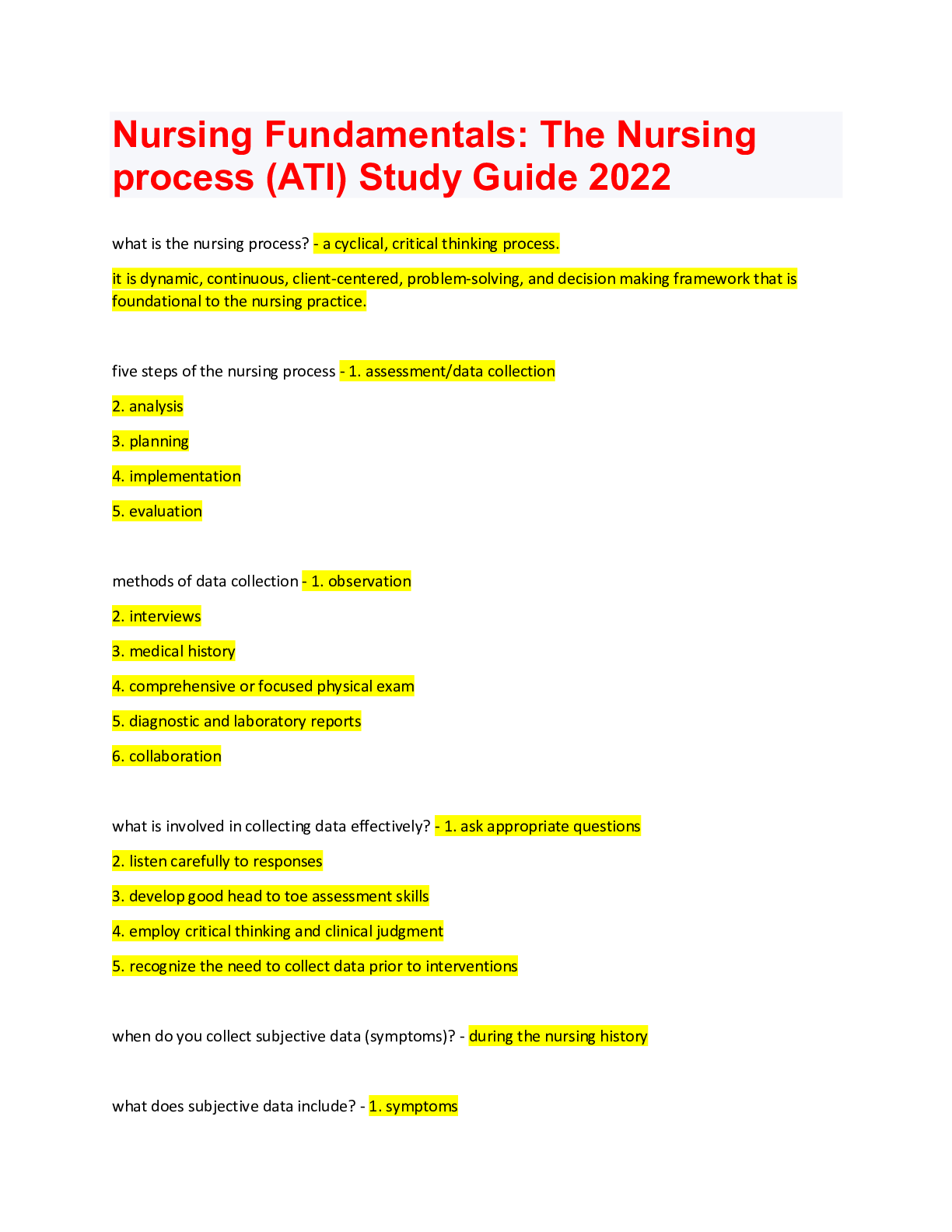
5 step critical thinking process that is goal directed to achieve optimal patient outcome
Why?
To provide optimal patient care
A.D.P.I.E. – assessment, diagnosis, planning, impl
...
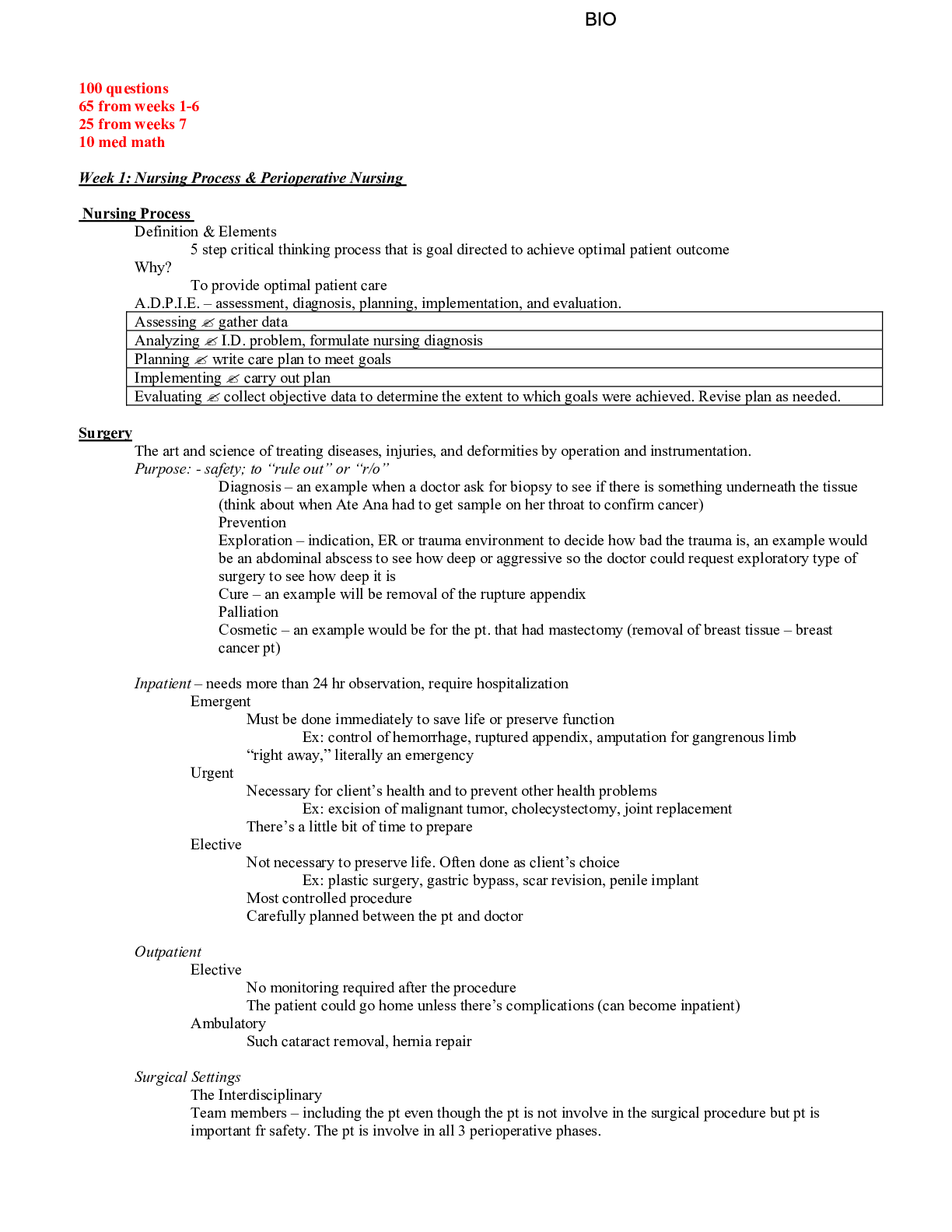
Nursing Process
Definition & Elements
5 step critical thinking process that is goal directed to achieve optimal patient outcome
Why?
To provide optimal patient care
A.D.P.I.E. – assessment, diagnosis, planning, implementation, and evaluation.
Assessing ? gather data
Analyzing ? I.D. problem, formulate nursing diagnosis
Planning ? write care plan to meet goals
Implementing ? carry out plan
Evaluating ? collect objective data to determine the extent to which goals were achieved. Revise plan as needed.
Surgery
The art and science of treating diseases, injuries, and deformities by operation and instrumentation.
Purpose: - safety; to “rule out” or “r/o”
Diagnosis – an example when a doctor ask for biopsy to see if there is something underneath the tissue
(think about when Ate Ana had to get sample on her throat to confirm cancer)
Prevention
Exploration – indication, ER or trauma environment to decide how bad the trauma is, an example would
be an abdominal abscess to see how deep or aggressive so the doctor could request exploratory type of
surgery to see how deep it is
Cure – an example will be removal of the rupture appendix
Palliation
Cosmetic – an example would be for the pt. that had mastectomy (removal of breast tissue – breast
cancer pt)
Inpatient – needs more than 24 hr observation, require hospitalization
Emergent
Must be done immediately to save life or preserve function
Ex: control of hemorrhage, ruptured appendix, amputation for gangrenous limb
“right away,” literally an emergency
Urgent
Necessary for client’s health and to prevent other health problems
Ex: excision of malignant tumor, cholecystectomy, joint replacement
There’s a little bit of time to prepare
Elective
Not necessary to preserve life. Often done as client’s choice
Ex: plastic surgery, gastric bypass, scar revision, penile implant
Most controlled procedure
Carefully planned between the pt and doctor
Outpatient
Elective
No monitoring required after the procedure
The patient could go home unless there’s complications (can become inpatient)
Ambulatory
Such cataract removal, hernia repair
Surgical Settings
The Interdisciplinary
Team members – including the pt even though the pt is not involve in the surgical procedure but pt is
important fr safety. The pt is involve in all 3 perioperative phases.
BIO
Perioperative phases – is the entire operative process which includes:
1 nurse in each phase per ATI
Preoperative – before surgery
Begins at time of determination of surgical need. Can be minutes to weeks.
Assessment, teaching, preparation, consent, diagnostics, preop checklist, medications
Intraoperative – during surgery
Identification, reducing anxiety, protection, positioning, monitoring, maintain surgical asepsis,
documentation
Postoperative – after/following surgery
Assessment (ABCs) recovery, reinforcement of teaching, prevention of complications
Preoperative Nursing
Patient Interview & Nursing Assessment
Happens any time before the surgery
Does it have to happen in surgery center? No, it could happen in doctor’s office
Safety ? eliminate or r/o, reduce or prevent chances/risk of complications
Managing anxiety and fear! ? SOLER (sit facing pt, open posture, lean towards pt, intermittent eye
contact, relax)
Purpose of preoperative is to: SAFETY
Assess risk factors & prepare to initiate a plan of care to ensure safety
Establish baseline data for comparison
Baseline = pts “normal”
Head-to-toe assessment, vital signs, and oxygen saturations
Determine psychologic status
Emotions = anxiety/fear/hope
Anxiety usually due to lack of knowledge of the procedure
Fear of death or permanently disability, allow the patient to express their fear, explore their feelings
Hope is a positive factor for surgery when patient anticipated for positive outcome from the procedure
Our ultimate goal is to assess these 3 emotions
Anxiety level = regarding the procedure, support systems, and coping mechanisms
Determine physiologic factors of procedure contributing to risks
We have to take into consideration in their family history, or any medical history or current problems
and reason for surgery
It gives an idea if the patient could have an adverse reaction such as malignant hyperthermia, bleeding
Assess medications, herbs, OTC
Aspirin
Garlic & gingko biloba ? bleeding complications
Ginseng ? BP to increase
Kava/valerian ? sedative, promote sleep
It is NOT in our scope of practice to STOP the patient from taking their herbs/meds that they
have been taking, only MD could
Obtain detailed medical and surgical history
Detail on family history ? malignant hyperthermia
Subjective date & Objective data
Assess allergies
Allergies to banana, avocado or kiwi can indicate the client is at risk for a reaction to latex
Allergy to eggs or soybean oil is a contraindication to the use of propofol for anesthesia
Allergies to shellfish can result in a reaction to povidone-iodine – use for contrast
Review of Systems: Subjective & Objective Data Continued
Assessment of different body systems alert the nurse of areas to closely monitor during preoperative physical
assessment = head-to-toe assessment
Cardiovascular system – listening to the heart sound is normal, quality of the sound is efficient
Respiratory system – airway, breathing, how effective is their breathing, are there any sputum or cough, respiratory
rate or rhythm
Neurologic system – A&O level
Genitourinary system – I&Os
Hepatic system – I&Os
Integumentary system – pressure ulcer
Musculoskeletal system – ROM, gait, any weakness or deficit
Immune system – infection
Endocrine system – diabetic patient, delayed healing, infection
Fluid & Electrolyte status & Nutritional status – basic metabolic panel = looks at BUN, creat…
GI system – we want to make sure our patient is able to pass gas, getting back their bowel movement
Diagnostic Studies
Diagnostic Studies/Test Rationale
Urinalysis Renal failure, r/o infection
Blood type & cross match Transfusion readiness
CBC Fluid status, anemia, infection/immune status
Pregnancy test Fetal risk of anesthesia
Clotting studies PT, INR, aPTT, platelet count
Electrolyte levels Evaluate imbalances
Serum creatinine & BUN Renal status
ABGs Oxygenation status
Chest x-ray Heart and lung status
12 lead ECG Baseline heart rhythm, abnormalities
Nursing Management: PREOPERATIVE
Preoperative Teaching
General surgery information
Ambulatory surgery information
Legal Preparation for Surgery
Informed consent
Blood transfusions
Advance directives
Power of attorney
Day of Surgery Preparation
Final preoperative teachings
Reassessment and verification of pertinent findings
Verified that informed consent is signed
Administer preoperative
Administer preoperative medications as ordered
Transportation to the Operating room (OR)
Handoff using SBAR – think safety!
Information for family and caregivers
Special considerations for our geriatrics!
Preop Nursing Management
1st: Preoperative Teaching
General Surgery
All pt will receive regardless
whether inpatient or outpatient
Teaching patient how to avoid
complications after surgery
Ambulatory Surgery
Usually applies to those outpatients
or same-day operation
TCDB – turn, cough, deep breath = to help open up their
lungs
Must have a “DD” (designated driver)
IS - incentive spirometer Usually, this would brief questionnaire
SCD - sequential compression devices = to prevent DVT Proper clothing
(the device that goes onto the calf area)
Ambulation Bring medication or whatever they have been taking
Both categories of preoperative teaching
need NPO = 2 hrs liquid & 6 hrs solid – to avoid aspiration
Could occur at home, through the phone, at the doctor’s office, preadmission
2nd: Day of Preparation The “Check In”
Patient’s belonging
“DD” making sure they have one
Inform consent
Inform family member where should wait and possible outcome
3rd: Transportation to OR
Hand off occur where preop nurse repeat to the intraop nurse
Usually focusing on the abnormalities
[Show More]