Health Care  >  STUDY GUIDE  >  PEDIATRIC-NURSING STUDY GUIDE LATEST 100% UPGRADED (All)

PEDIATRIC-NURSING STUDY GUIDE LATEST 100% UPGRADED

Document Content and Description Below

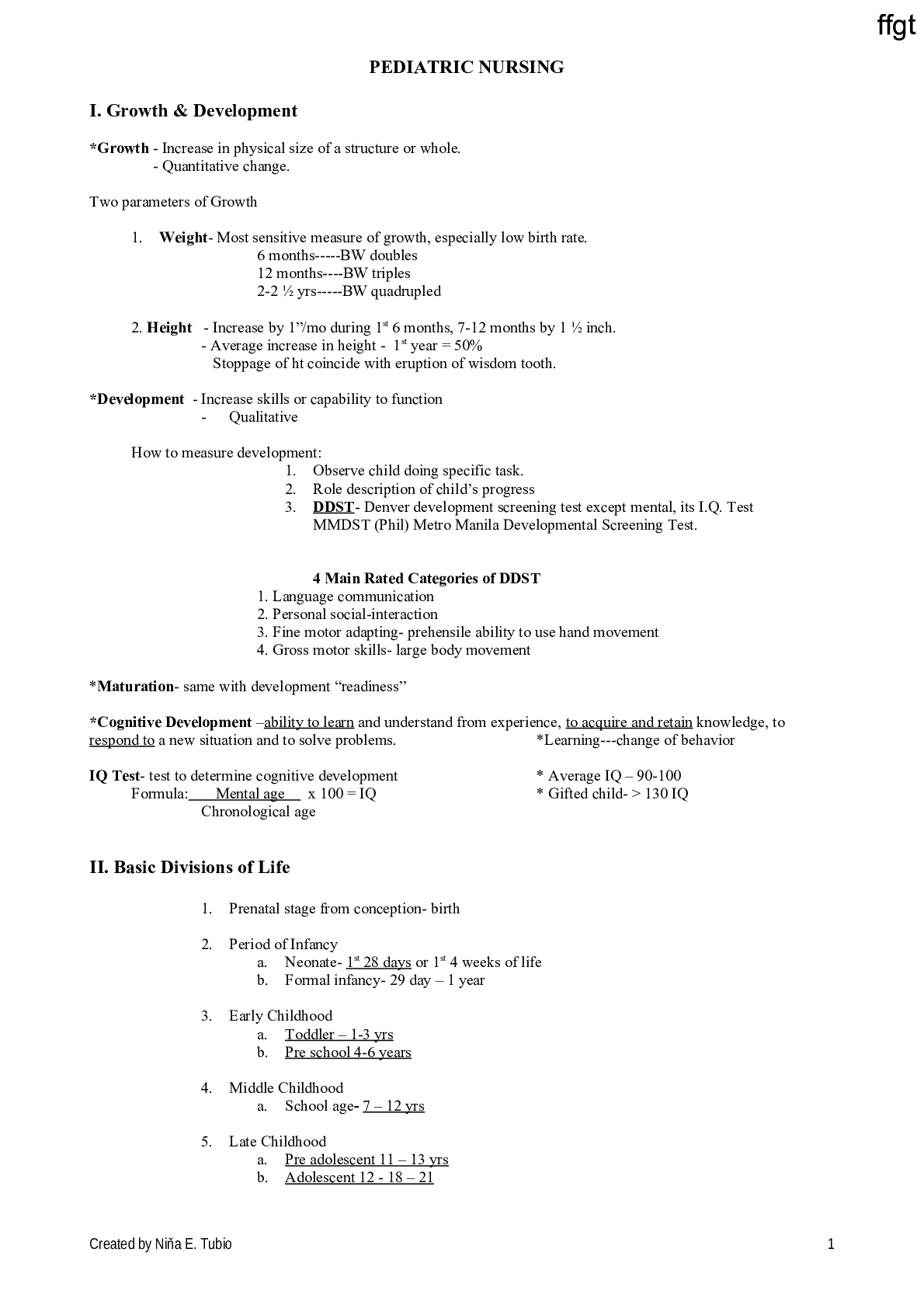
Growth & Development *Growth - Increase in physical size of a structure or whole. - Quantitative change. Two parameters of Growth 1. Weight- Most sensitive measure of growth, especially low birth ... rate. 6 months-----BW doubles 12 months----BW triples 2-2 ½ yrs-----BW quadrupled 2. Height - Increase by 1”/mo during 1st 6 months, 7-12 months by 1 ½ inch. - Average increase in height - 1st year = 50% Stoppage of ht coincide with eruption of wisdom tooth. *Development - Increase skills or capability to function - Qualitative How to measure development: 1. Observe child doing specific task. 2. Role description of child’s progress 3. DDST- Denver development screening test except mental, its I.Q. Test MMDST (Phil) Metro Manila Developmental Screening Test. 4 Main Rated Categories of DDST 1. Language communication 2. Personal social-interaction 3. Fine motor adapting- prehensile ability to use hand movement 4. Gross motor skills- large body movement *Maturation- same with development “readiness” *Cognitive Development –ability to learn and understand from experience, to acquire and retain knowledge, to respond to a new situation and to solve problems. *Learning---change of behavior IQ Test- test to determine cognitive development * Average IQ – 90-100 Formula: Mental age x 100 = IQ * Gifted child- > 130 IQ Chronological age II. Basic Divisions of Life 1. Prenatal stage from conception- birth 2. Period of Infancy a. Neonate- 1 st 28 days or 1st 4 weeks of life b. Formal infancy- 29 day – 1 year 3. Early Childhood a. Toddler – 1-3 yrs b. Pre school 4-6 years 4. Middle Childhood a. School age- 7 – 12 yrs 5. Late Childhood a. Pre adolescent 11 – 13 yrs b. Adolescent 12 - 18 – 21 Created by Niňa E. Tubio 1 III. Principles of G & D 1. G&D is a continuous process that begins from conception- ends in death--“ Womb to Tomb principle” 2. Not all parts of the body grow at the same time or at same rate.-------------“Asynchronous Growth principle” Patterns of G&D: a. Renal, GIT, musculoskeletal, circulatory----grows rapidly during childhood b. Neuromuscular tissue (CNS, brain, S. cord)---grow rapidly 1-2 years of life • Brain achieved its adult proportion by 5 years. • 1-2 y/o- very important yrs---if with severe malnutrition--mild mental retardation c. Lymphatic system- lymph nodes, spleen, tonsils---grows rapidly- infancy and childhood -protection against infection • tonsil adult proportion by 5 years d. Reproductive system- grows rapidly at puberty Rates of G&D: a. Fetal and Infancy – period of most rapid G&D -----*prone to develop anemia b. Adolescent- period of rapid G&D Toddler- slow growth period c. Toddler and preschool- alternating rapid and slow d. School age- slower growth 3. Each child is unique 2 Primary Factors Affecting G&D : A. Heredity: R – race F- born less in length than M by 1 inch. I – intelligence F- born less in wt. than M by 1 lb. S – sex N - nationality B. Environment: Q – quality of nutrition S – socio eco. status H – health O – ordinal position in family Eldest- ability in comm. & social skills P – parent child relationship youngest- more toilet trained 4. G&D occurs in a regular direction reflecting a definitive & predictable patterns or trends. A. Directional Trends- occur in a regular direction reflecting the development of neuromuscular function. These apply to physical, mental, social and emotional development and includes. 1. Cephalo-caudal--- “head to toe” • Occurs along body’s long axis in w/c control over head, mouth & eye movements & precedes control over upper body torso and legs. 2. Proximo- distal---- “Centro distal” • From center of body to extremities. 3. Symmetrical----side of body develop on same direction at same time at same rate. 4. Mass Specific “Differentiation” - Learns simple operations before complex function, from broad general pattern of behavior to a refined pattern. B. Sequential- involves a predictable sequence of G&D to w/c the child normally passes. 1. Locomotion- creep, crawls, sit then stand. 2. Socio & Language skills- solitary games, parallel games C. Secular- worldwide trend of maturing earlier & growing larger as compared to succeeding generations. 5.Behavior--most compressive indicator of developmental status. *1st cry--oha 6. Universal language of child- play 2 nd sound-cooing 7. Great deal of skill and behavior is learned by practice. Practice makes perfect. 3 rd sound-ahh(bowel) 9. Neonatal reflexes must be lost 1st before dev’t can proceed. *1st play-solitary -Plantar reflex shld. disappear before baby can walk Created by Niňa E. Tubio 2 -Moro reflex shld. disappear before baby can roll *Persistent primitive infantile reflexes- case of cerebral palsy [Show More]

Last updated: 3 years ago

Preview 1 out of 55 pages

Buy Now

Instant download

We Accept:

Payment methods accepted on Scholarfriends (We Accept)
Preview image of PEDIATRIC-NURSING STUDY GUIDE LATEST 100% UPGRADED document

Buy this document to get the full access instantly

Instant Download Access after purchase

Buy Now

Instant download

We Accept:

Payment methods accepted on Scholarfriends (We Accept)

Reviews( 0 )

$7.00

Buy Now

We Accept:

Payment methods accepted on Scholarfriends (We Accept)

Instant download

Can't find what you want? Try our AI powered Search

114
0

Document information


Connected school, study & course


About the document


Uploaded On

May 22, 2022

Number of pages

55

Written in

All

Seller


Profile illustration for APLUSMASTER
APLUSMASTER

Member since 4 years

7 Documents Sold

Reviews Received
2
0
0
0
1
Additional information

This document has been written for:

Uploaded

May 22, 2022

Downloads

 0

Views

 114

Document Keyword Tags

Recommended For You

Get more on STUDY GUIDE »

$7.00
What is Scholarfriends

Scholarfriends.com Online Platform by Browsegrades Inc. 651N South Broad St, Middletown DE. United States.

We are here to help

We're available through e-mail, Twitter, Facebook, and live chat.
 FAQ
 Questions? Leave a message!

Follow us on
 Twitter

Copyright © Scholarfriends · High quality services·