NASM Personal Trainer 2021 Questions
and Answers Already Passed
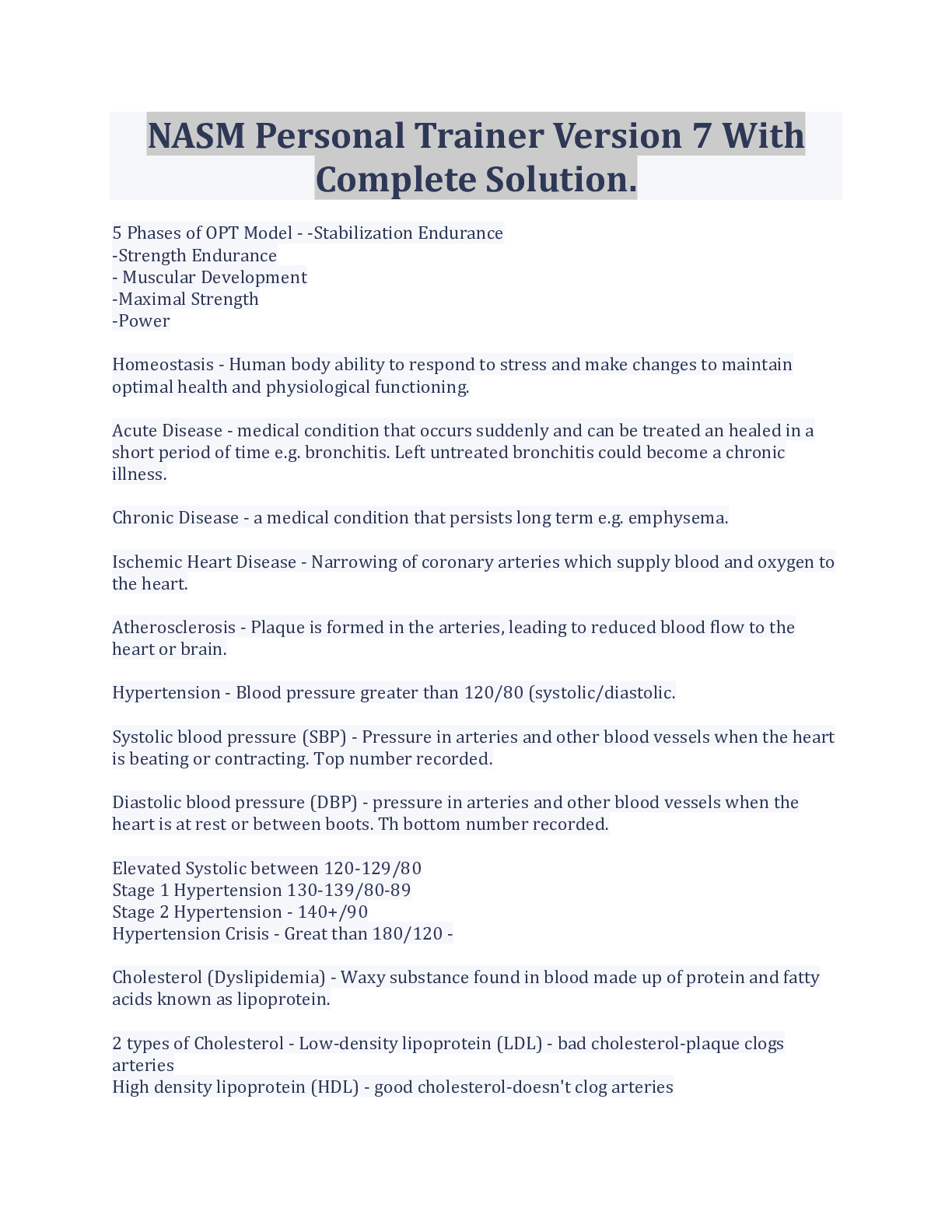
5 Phases of OPT Model Correct Answer--Stabilization Endurance
-Strength Endurance
- Muscular Development
-Maximal Strength
-Power
Homeostasis Correct
...
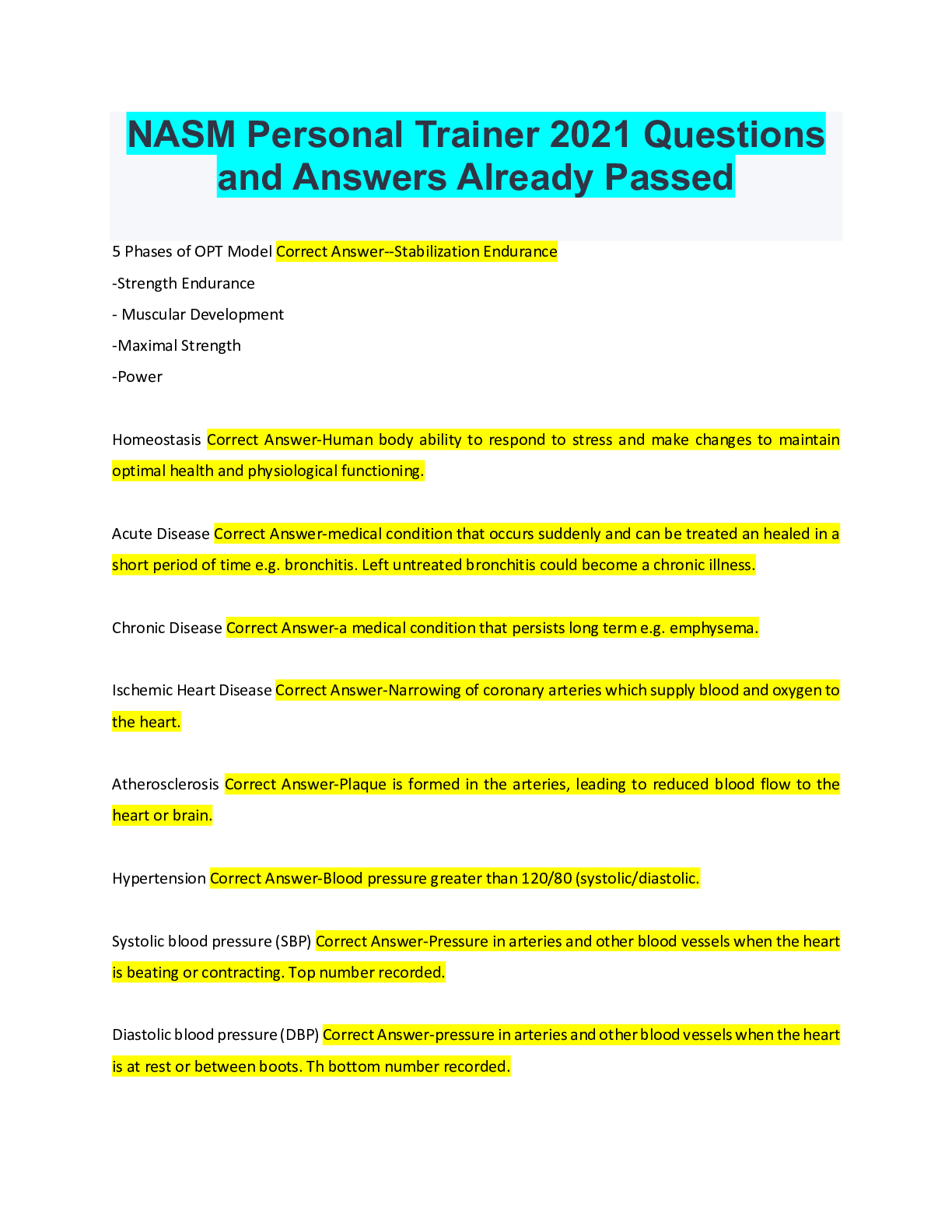
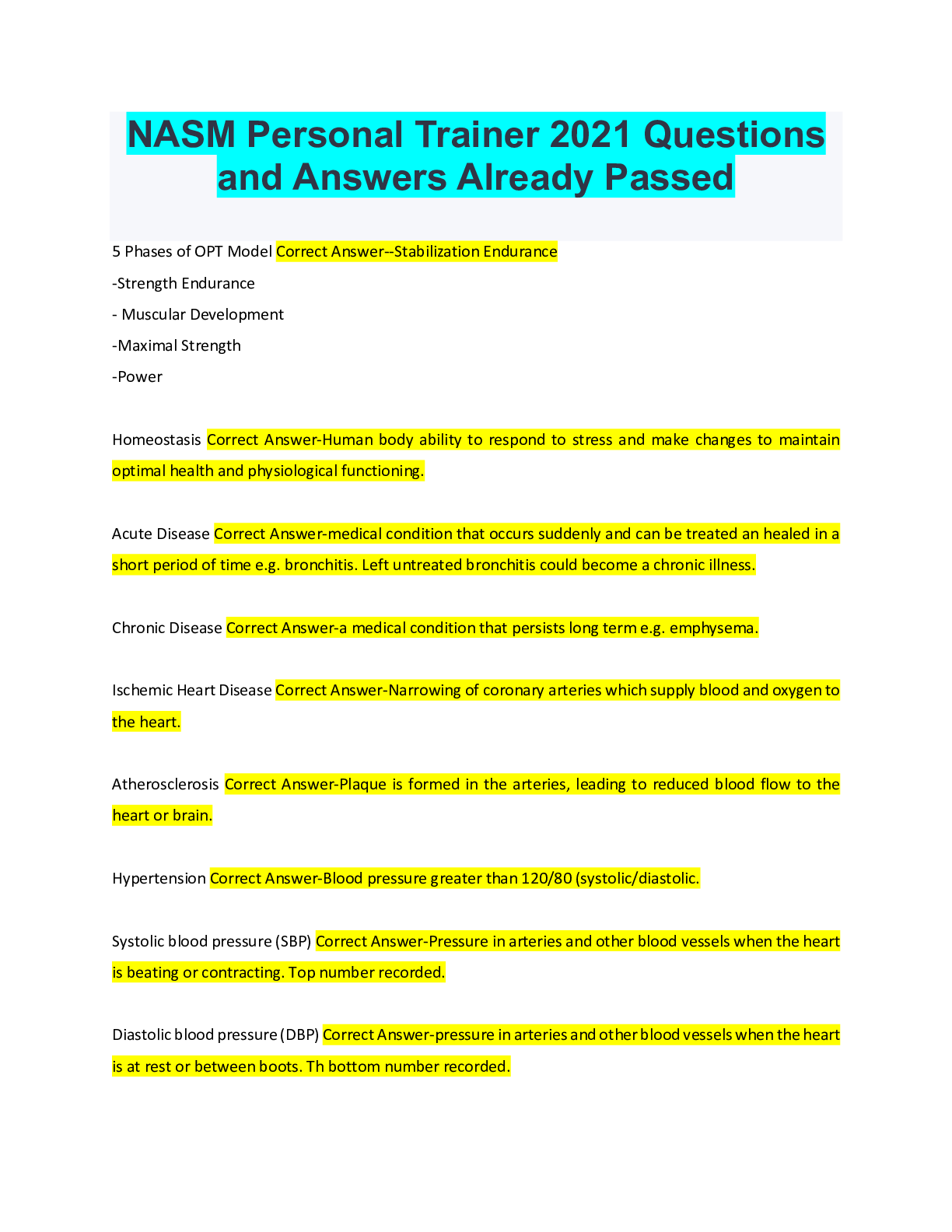
NASM Personal Trainer 2021 Questions
and Answers Already Passed
5 Phases of OPT Model Correct Answer--Stabilization Endurance
-Strength Endurance
- Muscular Development
-Maximal Strength
-Power
Homeostasis Correct Answer-Human body ability to respond to stress and make changes to maintain
optimal health and physiological functioning.
Acute Disease Correct Answer-medical condition that occurs suddenly and can be treated an healed in a
short period of time e.g. bronchitis. Left untreated bronchitis could become a chronic illness.
Chronic Disease Correct Answer-a medical condition that persists long term e.g. emphysema.
Ischemic Heart Disease Correct Answer-Narrowing of coronary arteries which supply blood and oxygen to
the heart.
Atherosclerosis Correct Answer-Plaque is formed in the arteries, leading to reduced blood flow to the
heart or brain.
Hypertension Correct Answer-Blood pressure greater than 120/80 (systolic/diastolic.
Systolic blood pressure (SBP) Correct Answer-Pressure in arteries and other blood vessels when the heart
is beating or contracting. Top number recorded.
Diastolic blood pressure (DBP) Correct Answer-pressure in arteries and other blood vessels when the heart
is at rest or between boots. Th bottom number recorded.
Elevated Systolic between 120-129/80
Stage 1 Hypertension 130-139/80-89
Stage 2 Hypertension - 140+/90
Hypertension Crisis - Great than 180/120 Correct AnswerCholesterol (Dyslipidemia) Correct Answer-Waxy substance found in blood made up of protein and fatty
acids known as lipoprotein.
2 types of Cholesterol Correct Answer-Low-density lipoprotein (LDL) - bad cholesterol-plaque clogs
arteries
High density lipoprotein (HDL) - good cholesterol-doesn't clog arteries
Diabetes Correct Answer-Disease that impacts the body's ability to properly metabolize carbohydrates,
specifically glucose.
Two types of Diabetes Correct Answer-Type 1 - genetic can't be prevented. Exercise helps.
Type 2-body produces insulin, but not used properly by the cells.
Insulin resistance (type 2 diabetes) Correct Answer-The inability of the cells to respond to insulin.
Cancer Correct Answer-Abnormal cell growth in the body.
Chronic Obstructive Pulmonary Disease (COPD) Correct Answer-Respiratory dysfunctions that include
breathlessness, airflow limitation, and decline of lung function.
Patellar tendonitis Correct Answer-Inflammation of the tendon that connects the patella (knee cap) to the
tibia (shin bone).
Anterior cruciate ligament (ACL) tear Correct Answer-Stretch, partial or complete tear of the ligament of
the knee.
Medial cruciate ligament (MCL) tear Correct Answer-Stretch, partial or complete tear of the medial
collateral ligament of the knee.
Shoulder impingement Correct Answer-Shoulder pain caused by rotator cuff tissues rubbing against the
acromion bone of the shoulder.
SWOT analysis Correct Answer-As a CPT you need to identify your personal strengths, weakness and
opportunities for growth and potential threats to success.
Four P's of Marketing Correct Answer-product, price, promotion, place
Unique Selling Product (USP) Correct Answer-A set of specific skills or traits that are highlighted during a
sales presentation (marketing to an older population or stay at home moms, etc.)
Amotivation Correct Answer-Not being engaged in an activity or behavior (not wanting to exercise).
Extrinsic motivation Correct Answer-Doing an activity for some form of recognition (win an award). Short
term exercise as once reward is given person loses focus.
Intrinsic motivation Correct Answer-Pursuing activities that are of interest or meaningful to that person
(long term exercise).
Outcome goals Correct Answer-Focused on the end result (place in top 10 in a 10K race).
Process goals Correct Answer-Process of pursuing a goal (walking 1 hour a day @ 11am Monday-Sunday).
4 types of social support Correct Answer-Instrumental (driving one to the gym, watching their kids so they
have time to workout);
Emotional (encouraging showing empathy);
Informational (providing education about fitness and health); and
Companionship (accompanying friend to the gym)
4 Components of Leadership Correct Answer-Leader's qualities (being optimistic, empathetic, and
knowledgeable.;
Leadership styles (encourages feedback and input from students);
Situational Factors (factors such as large or small class); and
Follower's qualities (age group, gender, and exercise level).
10 Benefits of group exercise Correct Answer-Accountability,
Comparison
Competition
Comradery
Consistency
Energy
Intensity
Mindless (know what to expect
Motivation; and
Sociability (warm and inviting)
Third space Correct Answer-A special communal space that is separate from work or home. A where one
can build relationships with others e.g. the gym.
SMART goals Correct Answer-Specific, Measurable, Attainable, Realistic & Timely.
Determinants of Behavior Correct Answer-Psychological, social or environmental factors that influence
behavior.
Autonomous Motivation Correct Answer-When client values the outcome and is motivated to exercise.
Affective Judgment Correct Answer-Expected pleasure or enjoyment.
Subjective Norms Correct Answer-Belief that an important person or group will approve and support a
behavior e.g. resistance training.
Stages of Change Model a/k/a Transtheoretical Model of Behavior Change. Correct AnswerPrecontemplation- individual doesn't exercise and is not planning to within the next 6 months.
Contemplation-individual does not currently exercise, but plans to in the next 6 months.
Preparation-Planning to begin exercise soon and maybe be sporadically exercising already.
Action-Been exercising for at least 6 months.
Maintenance-has been exercising consistently for 6 months or more.
Decisional Balance Correct Answer-Weighing the pros and cons of changing a behavior.
Reflective Listening Correct Answer-Understanding the meaning of the speaker's words and relaying back
to the speaker of what that understood was correct.
Active Listening Correct Answer-Taking a genuine interest in what the speaker is saying and looking them
in the eye while speaking.
Closed Ended Questions Correct Answer-Directive questions that can be answered with a one word
answer yes or no.
Open Ended Questions Correct Answer-Non-directive questions that can't be answered by a simple yes or
no. Require critical thinking before responding.
Motivational Interviewing Correct Answer-Instills feelings of being ready, willing, and able for the client
to make a change in their behavior.
Self-Discrepancy Correct Answer-Internal conflict between what someone thinks their ideal self should be
and what the actual self is.
Sustain talk Correct Answer-Keeping things the way they are and not wanting to make a change e.g. not
wanting to make time to exercise by looking for excuses.
Implementation intentions Correct Answer-Connecting the exercise routine to a specific event (exercising
during lunch break).
Coping intentions Correct Answer-Anticipating barriers and creating alternative plans to exercise.
Reverse listing Correct Answer-Replacing
[Show More]
.png)


.png)




.png)
.png)