Quiz Submissions - Module 5 Quiz
Anjiu Huang (username: ahuang4)
Attempt 1
Written: Dec 2, 2020 6:34 PM - Dec 2, 2020 7:20 PM
Submission View
Your quiz has been submitted successfully.
Question 1 2 / 2 points
T
...
Quiz Submissions - Module 5 Quiz
Anjiu Huang (username: ahuang4)
Attempt 1
Written: Dec 2, 2020 6:34 PM - Dec 2, 2020 7:20 PM
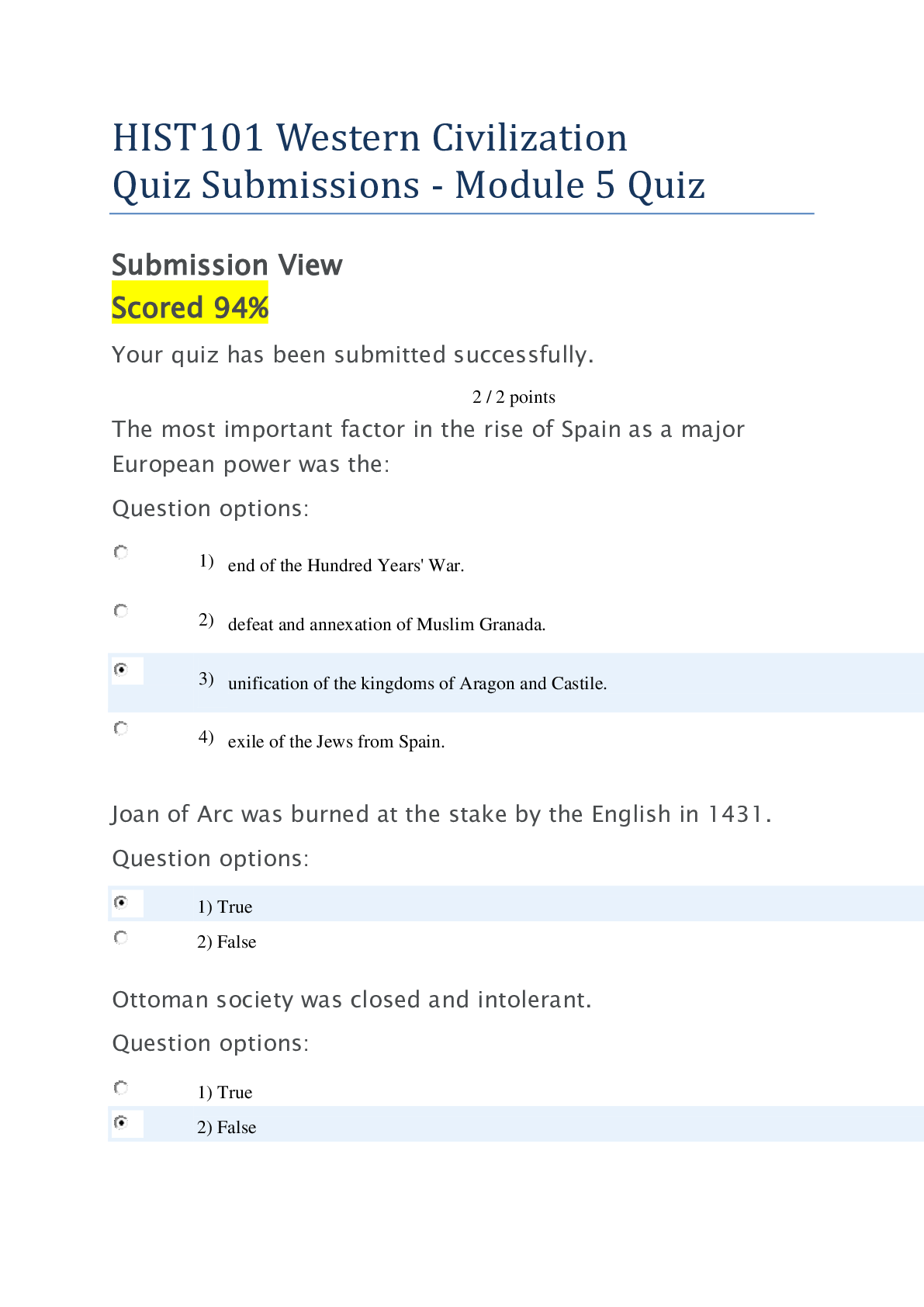
Submission View
Your quiz has been submitted successfully.
Question 1 2 / 2 points
The most important factor in the rise of Spain as a major European power was the:
Question options:
1)
end of the Hundred Years' War.
2)
defeat and annexation of Muslim Granada.
3)
unification of the kingdoms of Aragon and Castile.
4)
exile of the Jews from Spain.
Question 2 2 / 2 points
Joan of Arc was burned at the stake by the English in 1431.
Question options:
1) True
2) False
Question 3 2 / 2 points
Ottoman society was closed and intolerant.
Question options:
1) True
2) False
Question 4 2 / 2 points
During the Hundred Years' War, the English won an astounding victory at Agincourt in 1415. What helped them achieve this victory?
Question options:
1)
the Black Death, which first decimated the French troops
2)
the support of the German emperor
3)
the English longbow
4)
Gunpowder
Question 5 2 / 2 points
The social mobility of the fourteenth century was made possible largely due to the:
Question options:
1)
English Peasants' Revolt.
2)
beginning of the Hundred Years' War.
3)
Crusades.
4)
Black Death.
Question 6 2 / 2 points
The bacterial strain that causes the plague is:
Question options:
1)
Pasteurella gallinarum
2)
Haemophilus ducreyi
3)
Derxia gummosa
4)
Yersinia pestis
Question 7 0 / 2 points
In the Late Middle Ages, the ability to defend castles was severely undermined by:
Question options:
1)
the longbow.
2)
Greek Fire.
3)
the rifle.
4)
the canon.
Question 8 2 / 2 points
Unlike most contemporary European rulers, Mongol khans were:
Question options:
1)
tolerant of other religions.
2)
deeply religious.
3)
highly educated.
4)
monogamous.
Question 9 2 / 2 points
Historians today generally use the term Renaissance to refer to:
Question options:
1)
a period in economic history when trade was reborn.
2)
a period of intellectual rebirth after the Dark Ages, when learning had been extinguished.
3)
a period in European history when the northern countries dominated the culture of the Continent.
4)
a period in intellectual and cultural history, marked by a new interest in the study of classical learning.
Question 10 2 / 2 points
From the Arab world, Italian merchants learned about and ultimately adopted a number of commercial practices and techniques that helped them stay at the forefront of the European economy.
Question options:
1) True
2) False
Question 11 2 / 2 points
Florence was a republic, however, by 1434 real power was in the hand of the _________ family.
Question options:
1)
Petrarch
2)
Medici
3)
Lorenzo
4)
Romanov
Question 12 2 / 2 points
The Renaissance was chronologically distinct from the late Middle Ages.
Question options:
1) True
2) False
Question 13 2 / 2 points
Benefiting from the fragmentation of the Church during the era of the Babylonian Captivity and the Great Western Schism, Italian bankers came to charge interest on loans, becoming the first Christians to defy the church's ban on:
Question options:
1)
usury.
2)
profit.
3)
trade.
4)
manufacturing.
Question 14 2 / 2 points
The Medici made their fortune in:
Question options:
1)
the arts.
2)
banking.
3)
the silk trade.
4)
government.
Question 15 2 / 2 points
Among Italian rulers, support for Renaissance artists was often:
Question options:
1)
a means of promoting Italian universities.
2)
a way for ruling families to develop their own artistic skills.
3)
a way of beautifying the homes of wealthy Italians.
4)
a means of competition for political rivals.
Question 16 2 / 2 points
Much of the prosperity of northern Italy was based on the trade ties Italy maintained with:
Question options:
1)
South America.
2)
the Middle East.
3)
Russia.
4)
North America.
Question 17 2 / 2 points
Petrarch believed that the "Dark Ages" were not the pagan past, but the Middle Ages, the time that separated him from:
Question options:
1)
the Trojan War.
2)
the Greek and Roman ages.
3)
the time of Jesus.
4)
the time of the Church Fathers.
Question 18 2 / 2 points
Aside from his work on Biblical translations, ____________ also edited, translated, and published ancient pagan texts, like Cicero's, and the works of many pivotal religious authors, especially Saint Jerome. One of his most famous works was In Praise of Folly, a scathing critique of the Church.
Question options:
1)
Desiderius Erasmus
2)
Petrarch
3)
Martin Luther
4)
Livy
Question 19 2 / 2 points
Dante's Divine Comedy represents:
Question options:
1)
the pinnacle of Latin prose.
2)
a clear adoption of Christian principles and a rejection of classical learning.
3)
a fusion of classical and Christian cultures.
4)
the nadir of Italian vernacular writing.
Question 20 2 / 2 points
Leonardo da Vinci considered artists to be skilled craftsmen.
Question options:
1) True
2) False
Question 21 2 / 2 points
Italian artists of the Renaissance experimented with all of the following techniques EXCEPT:
Question options:
1)
brass rubbing.
2)
portraiture.
3)
realistic portrayals of the human body.
4)
vanishing point perspective.
Question 22 2 / 2 points
The "Prince of the Humanists" was:
Question options:
1)
Constantine.
2)
Petrarch.
3)
Martin Luther
4)
Desiderius Erasmus
Question 23 2 / 2 points
Niccolò Machiavelli's work suggests that he was more of a political theorist than a political realist.
Question options:
1) True
2) False
Question 24 2 / 2 points
Many of the Spanish conquistadors who invaded South and Central America had acquired their military experience from the wars against the Muslim inhabitants of the Iberian peninsula.
Question options:
1) True
2) False
Question 25 2 / 2 points
What event prompted the Portuguese and others to find a new avenue for trade?
Question options:
1)
After the Ottomans conquered Constantinople in 1453, they took over the established trade routes.
2)
The collapse of Indonesia in 1433 sparked a rush to enter the spice market.
3)
The Venetians ended their exclusive trade treaty with the Ottoman Turks in 1445.
4)
The invention of sailing ships in the late fifteenth century encouraged more trade.
Question 26 2 / 2 points
In 1488, Bartolomeu Dias:
Question options:
1)
discovered Haiti.
2)
sailed through the Straights of Gibralter.
3)
rounded the southern tip of Africa.
4)
sailed across the Atlantic to Florida.
Question 27 2 / 2 points
Few if any people believed the world was flat when Columbus began his voyage.
Question options:
1) True
2) False
Question 28 2 / 2 points
Historians refer to the enormous exchange of plant and animal species, as well as bacteria and viruses, between the Old and New Worlds as the:
Question options:
1)
The Magellan Effect.
2)
Marco Polo Phenomenon.
3)
The Great Dying.
4)
Columbian Exchange.
Question 29 2 / 2 points
As much as ____% of the native people of the Americas died within a few generations of Columbus's arrival.
Question options:
1)
90
2)
60
3)
20
4)
50
Question 30 0 / 2 points
By the mid-15th century, Portuguese explorers were venturing southward along the Atlantic coast of Africa in search of:
Question options:
1)
spices, salt and opium.
2)
meat, iron-ore and olive oil.
3)
food, gold and slaves.
4)
elephants, lapis-lazuli and silk.
Attempt Score:
56 / 60 - 93.33 %
Overall Grade (highest attempt):
56 / 60 - 93.33 %
[Show More]

 (1).png)


.png)