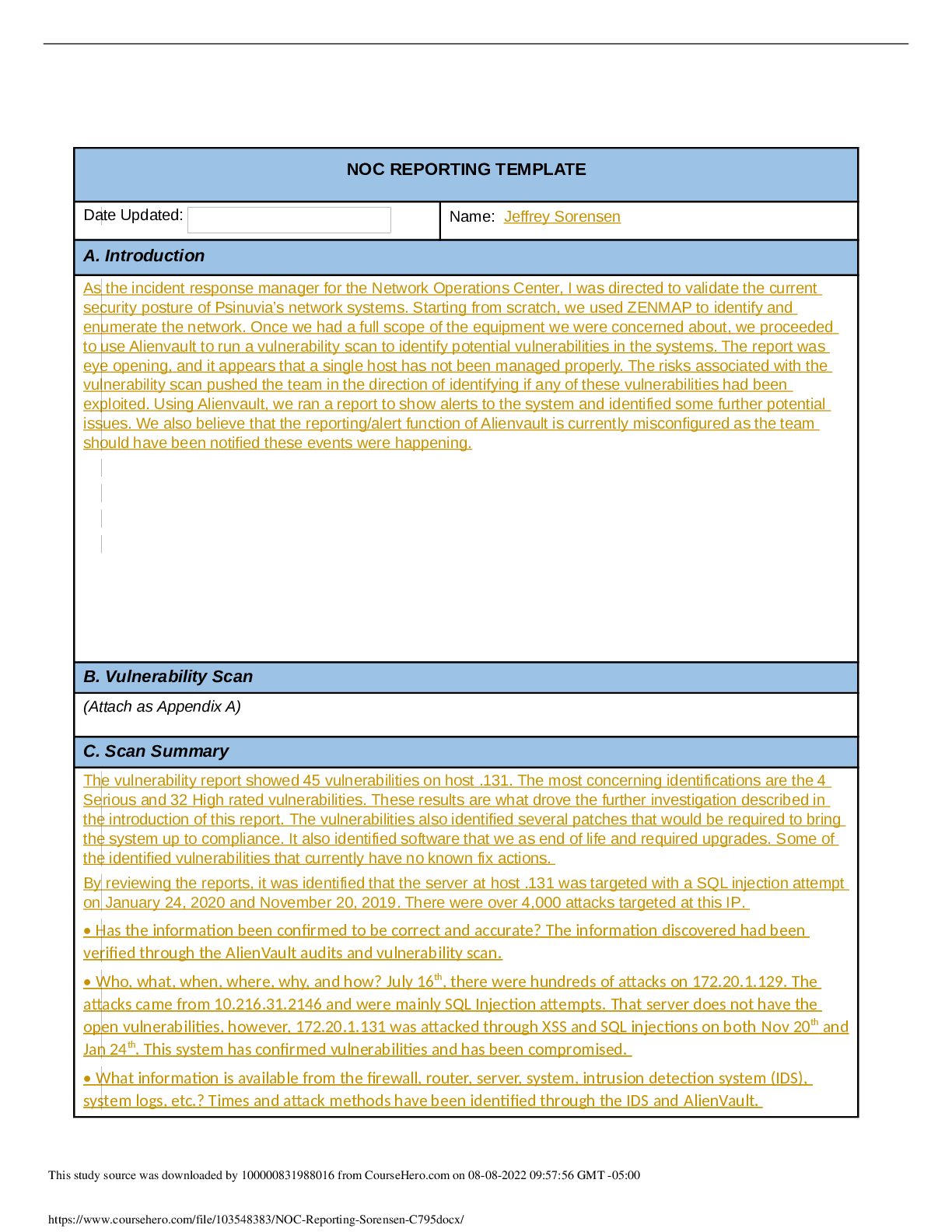
NOC REPORTING TEMPLATE
Date Updated: Name: Jeffrey Sorensen
A. Introduction
As the incident response manager for the Network Operations Center, I was directed to validate the current
security posture of Psinuvia’s ne
...
NOC REPORTING TEMPLATE
Date Updated: Name: Jeffrey Sorensen
A. Introduction
As the incident response manager for the Network Operations Center, I was directed to validate the current
security posture of Psinuvia’s network systems. Starting from scratch, we used ZENMAP to identify and
enumerate the network. Once we had a full scope of the equipment we were concerned about, we proceeded
to use Alienvault to run a vulnerability scan to identify potential vulnerabilities in the systems. The report was
eye opening, and it appears that a single host has not been managed properly. The risks associated with the
vulnerability scan pushed the team in the direction of identifying if any of these vulnerabilities had been
exploited. Using Alienvault, we ran a report to show alerts to the system and identified some further potential
issues. We also believe that the reporting/alert function of Alienvault is currently misconfigured as the team
should have been notified these events were happening.
B. Vulnerability Scan
(Attach as Appendix A)
C. Scan Summary
The vulnerability report showed 45 vulnerabilities on host .131. The most concerning identifications are the 4
Serious and 32 High rated vulnerabilities. These results are what drove the further investigation described in
the introduction of this report. The vulnerabilities also identified several patches that would be required to bring
the system up to compliance. It also identified software that we as end of life and required upgrades. Some of
the identified vulnerabilities that currently have no known fix actions.
By reviewing the reports, it was identified that the server at host .131 was targeted with a SQL injection attempt
on January 24, 2020 and November 20, 2019. There were over 4,000 attacks targeted at this IP.
• Has the information been confirmed to be correct and accurate? The information discovered had been
verified through the AlienVault audits and vulnerability scan.
• Who, what, when, where, why, and how? July 16th
, there were hundreds of attacks on 172.20.1.129. The
attacks came from 10.216.31.2146 and were mainly SQL Injection attempts. That server does not have the
open vulnerabilities, however, 172.20.1.131 was attacked through XSS and SQL injections on both Nov 20th
and
Jan 24th
. This system has confirmed vulnerabilities and has been compromised.
• What information is available from the firewall, router, server, system, intrusion detection system (IDS),
system logs, etc.? Times and attack methods have been identified through the IDS and AlienVault.
This study source was downloaded by 100000831988016 from CourseHero.com on 08-08-2022 09:57:56 GMT -05:00
https://www.coursehero.com/file/103548383/NOC-Reporting-Sorensen-C795docx/
• What type of data is involved, and what is its classification? All data involved is unclassified. However, it is
possible that there is both medical data and PII that could only be disclosed under the proper reasoning and
procedures.
• Are there obscenities, child pornography, or confrontational data? There is no obscene or vulgar data
involved.
• Is there criminal activity? At the current time, criminal activity is not suspected.
• Is the data protected by an encryption solution? Data is protected by encryption.
• What is the magnitude of the systems being impacted? Magnitude of the system is high. The data being
tracked is significantly impacting overall health of patients.
• Is the event still in progress? Yes
• Has preliminary containment been performed (i.e., disable account, reset password, remove remote access,
isolate device in segregated segment)? System has been disabled and removed from the network.
• What is the estimated value of the impacted data and systems? Data is valued at ~$200M (~1/3 of yearly
sales) and the system is ~$10K
D. Detailed Analysis
Reviewing the SIEM identified several different attacks that happened from July to January. Starting with the
earlier attacks, alarms were reviewed and monitored to identify which systems were being attacked and if they
were vulnerable to those attacks. In July, the attacks were targeted at system 129. These attacks mainly
consisted of SQL injection attempts with a few XSS and brute force attacks. But as identified in the Vulnerability
report, this system is secure.
This study source was downloaded by 100000831988016 from CourseHero.com on 08-08-2022 09:57:56 GMT -05:00
https://www.coursehero.com/file/103548383/NOC-Reporting-Sorensen-C795docx/
Then next step was to review the alarms that were triggered in November. Systems 129 and 131 were both
targeted during this attack. Again system 129 is secure according to the vulnerability scan, but most attacks
were targeting 131. Resources were targeted to identifying the capabilities of the system and if it had been
exploited. Per the vulnerability scan, this system is missing multiple updates and has several issues as
identified in section C of this document. The images below show both the summary of alarms per host and
some of the specific events that triggered the alarms.
This study source was downloaded by 100000831988016 from CourseHero.com on 08-08-2022 09:57:56 GMT -05:00
https://www.coursehero.com/file/103548383/NOC-Reporting-Sorensen-C795docx/
The final step was to look at the events of January 24th
. There is a persistent threat to the network as this is the
third example of similar attack patterns. Again, system 131 was the primary target and it had not been patched
since the events of November. The images below show both the summary of alarms per host and some of the
specific events that triggered the alarms.
This study source was downloaded by 100000831988016 from CourseHero.com on 08-08-2022 09:57:56 GMT -05:00
[Show More]


.png)



.png)
.png)
.png)
.png)
.png)
.png)
.png)
.png)
.png)
.png)
.png)
.png)
.png)