WGU - C236 Questions and Answers
with Complete Solutions
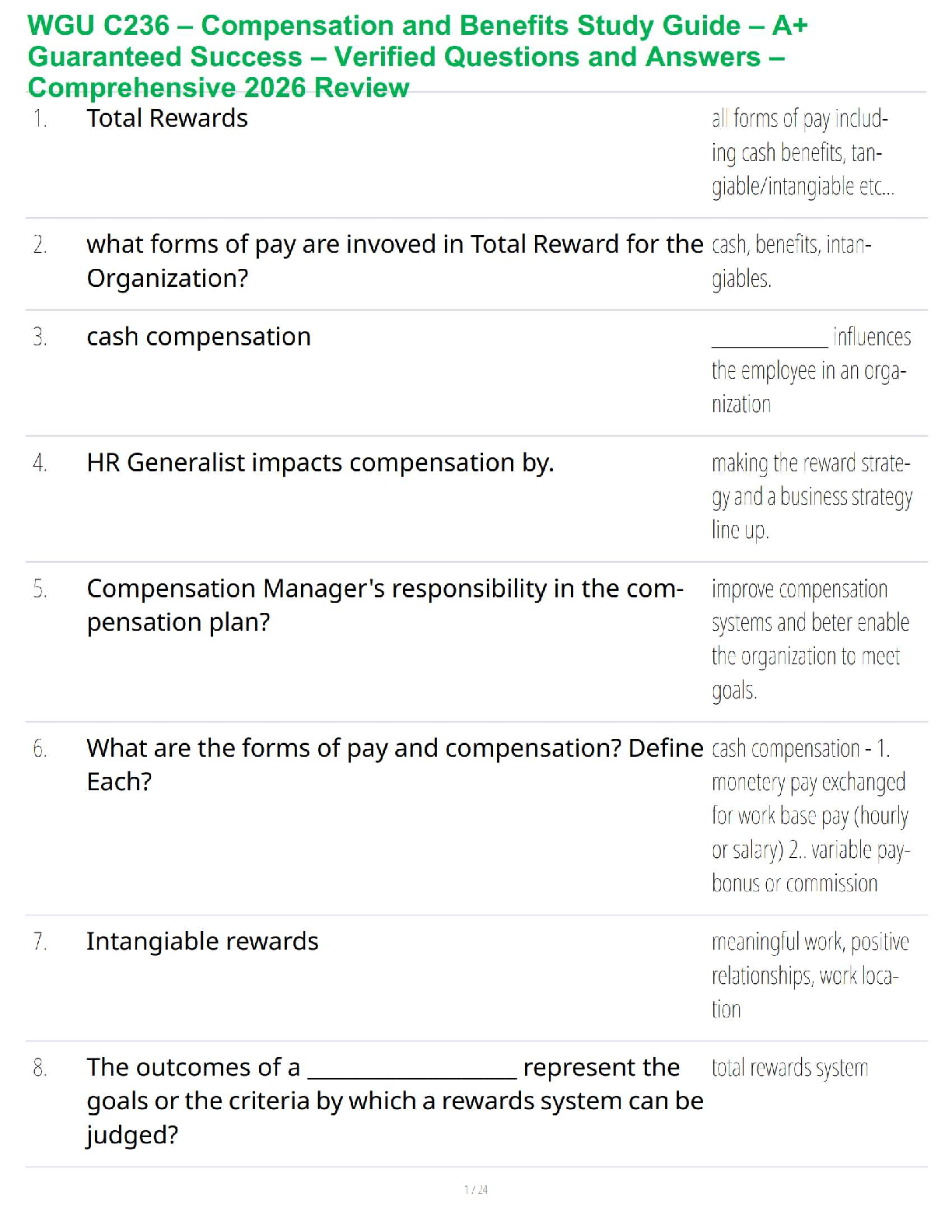
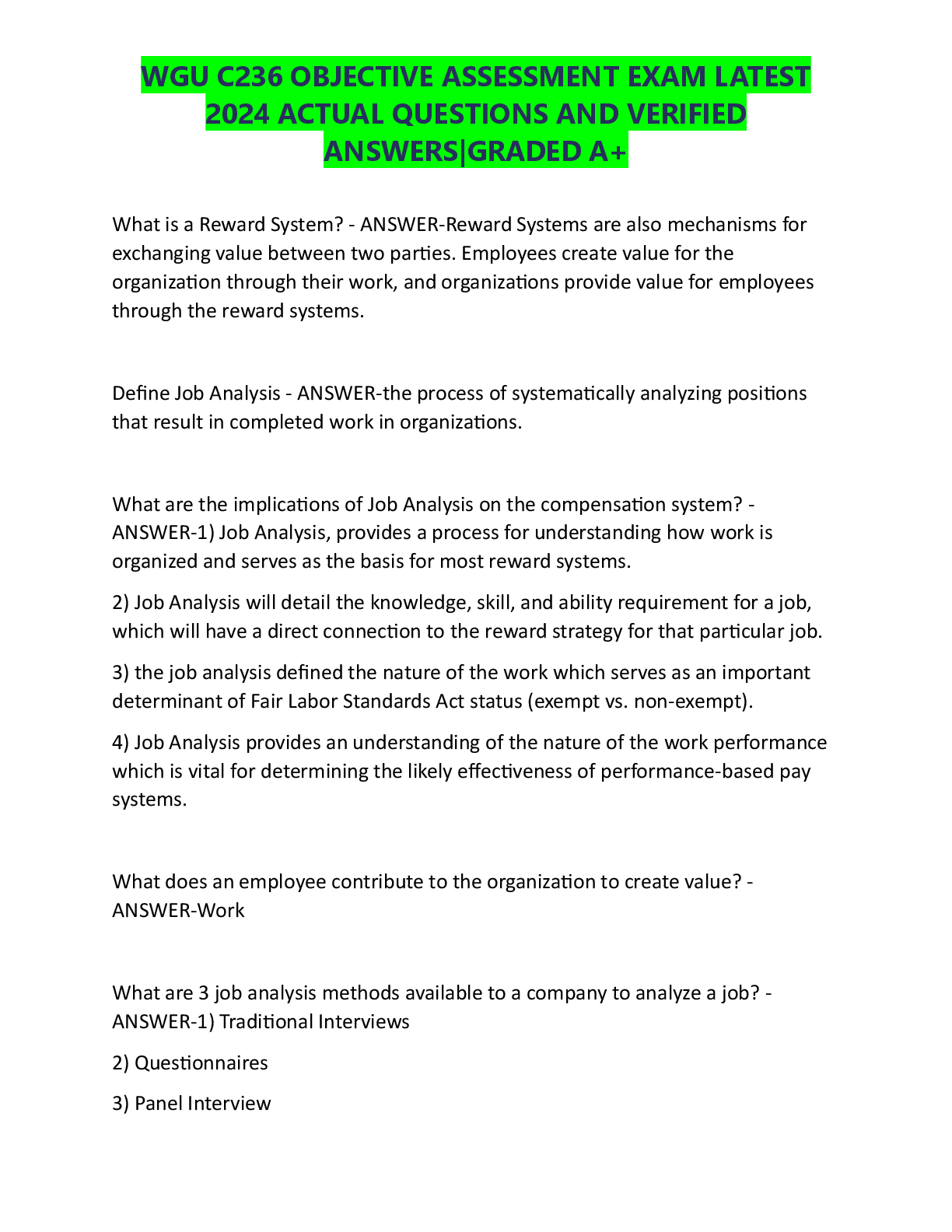
What is a Reward System? ✔✔Reward Systems are also mechanisms for exchanging value
between two parties. Employees create value for the organization through thei
...
WGU - C236 Questions and Answers
with Complete Solutions
What is a Reward System? ✔✔Reward Systems are also mechanisms for exchanging value
between two parties. Employees create value for the organization through their work, and
organizations provide value for employees through the reward systems.
Define Job Analysis ✔✔the process of systematically analyzing positions that result in completed
work in organizations.
What are the implications of Job Analysis on the compensation system? ✔✔1) Job Analysis,
provides a process for understanding how work is organized and serves as the basis for most reward
systems.
2) Job Analysis will detail the knowledge, skill, and ability requirement for a job, which will have
a direct connection to the reward strategy for that particular job.
3) the job analysis defined the nature of the work which serves as an important determinant of Fair
Labor Standards Act status (exempt vs. non-exempt).
4) Job Analysis provides an understanding of the nature of the work performance which is vital
for determining the likely effectiveness of performance-based pay systems.
What does an employee contribute to the organization to create value? ✔✔Work
What are 3 job analysis methods available to a company to analyze a job? ✔✔1) Traditional
Interviews
2) Questionnaires
3) Panel Interview
What is involved in the traditional interview? ✔✔The job analyst asks the job incumbent preset
questions about the content, skills needed, and time spent on activities in the job.
How is the panel interview used to analyze a job? ✔✔Multiple job incumbents (and sometimes
multiple job analysts) all meet together to analyze the job. In panel interviews, the job incumbents
themselves explore the agreement and contradictions in their responses.
What analysis method does an organization use to overcome some of the limitations of interview
methods? ✔✔Questionares
When creating a job analysis who should you speak with for input? ✔✔In small organizations, the
information may be gathered from every incumbent of a given job. As the number of job
incumbents per job increases, organizations typically try to make the process more efficient by
choosing a subset of the job incumbents to be involved in the process.
Why is it necessary to gain buy in for a job analysis to create a value-added analysis? ✔✔It is
important to involve people from all levels in the organization, not only to increase the quality of
the information, but also to obtain buy-in from those who will be using it for reward decisions.
What is the goal of a job analysis? ✔✔Understand the work involved and how it creates value
(The goal is not to evaluate the performance of any particular employee in performing that work)
Define job design and state what is its purpose? ✔✔The process of systematically constructing
jobs to make them functional, efficient, and motivational
Job Title ✔✔Name by which the job is known within the company
Job Specification ✔✔Translates the TDRs into the Knowledge, Skills, Abilities, and Other
(KSAOs) that an employee needs to perform the job at a satisfactory level
What is included in the bulk of the job description? ✔✔Written documents that serve as the
primary source of information about jobs for many uses within the organization, and these
descriptions play a key role in the design and implementation of total reward systems.
Job Family ✔✔Grouping of jobs that have similar functions or content
What does the Fair Labor Standards Act require of organizations? ✔✔Organizations determine
the "employee status" of each job
What does an Independent Contractor have the ability to do? ✔✔Have the ability to set their own
hours and work processes, and they work and are paid on a project basis with the opportunity for
profit or loss
Salary Level Test ✔✔Any employee paid less than $35,568 per year (or $684 per week) is nonexempt and covered by the FLSA for purposes of paying overtime
Salary Basis Test ✔✔Any employee whose pay is reduced based on the hours worked is nonexempt
Primary Duties Test ✔✔If an employee has significant discretion and exercises independent
judgment, that employee is classified as exempt from FLSA provisions. The tests of duties are
broken into exemption criteria for Executives, Learned Professionals, Creative Professionals,
Administrative, Computer, Outside Sales, and High Compensated.
How does FSLA require a company to cover compensatory time? ✔✔Any employee working
above 40 hours per week must be paid time and a half for those extra hours.
(In the public sector, employers are allowed to grant paid time off instead of overtime pay, referred
to as Compensatory Time)
How does FSLA monitor Child Labor? ✔✔FSLA defines the type of work appropriate for children
and the ages at which children can work
Internal rewards alignment ✔✔The extent to which an organization's Total Rewards System aligns
each employee's rewards with those received by others in the organization
What potential problems can happen if there are flaws in a compensation system? ✔✔Morale,
Turnover, & Information Sharing
Job-based Approach ✔✔Assumes that organizations provide rewards based upon the job that a
person holds.
Individual-based Approach ✔✔Assumes that rewards should be based upon the characteristics of
the person holding a job.
Performance-based Approach ✔✔Assumes that rewards should be based upon the performance or
results produced by an employee.
In a Job-Based System, what is the fundamental unit for designing the rewards system? ✔✔The
job itself
When do pay changes occur in the Job-Based system? ✔✔In companies using job-based systems,
pay changes occur when an employee changes jobs, not when the employee gains additional skills.
Using Job Analysis what is all work organized into? ✔✔Jobs
External Reward Positioning ✔✔How an organization's Rewards compare to the Rewards offered
for comparable work in other organizations
External equity ✔✔Employee perceptions regarding the worth of their work conditions and
rewards compared to the work conditions and rewards of individuals outside the company
Labor-driven Job Market ✔✔When the demand for a particular set of KSAs (knowledge, skills,
and abilities) is high and the supply of these KSAs is low
Labor Markets ✔✔Individuals are the sellers and organizations are the buyers. Prospective
employees are offering to sell their time, knowledge, skills, influence, and other ways of creating
value. Organizations are looking to buy the time
[Show More]
.png)
.png)

.png)
.png)



.png)
.png)