AP World History Modern Unit 1 Terms
2019-2020 Already Passed
Confucianism ✔✔The system of ethics, education, and statesmanship taught by Confucius and his
disciples, stressing love for humanity, ancestor worship, rev
...
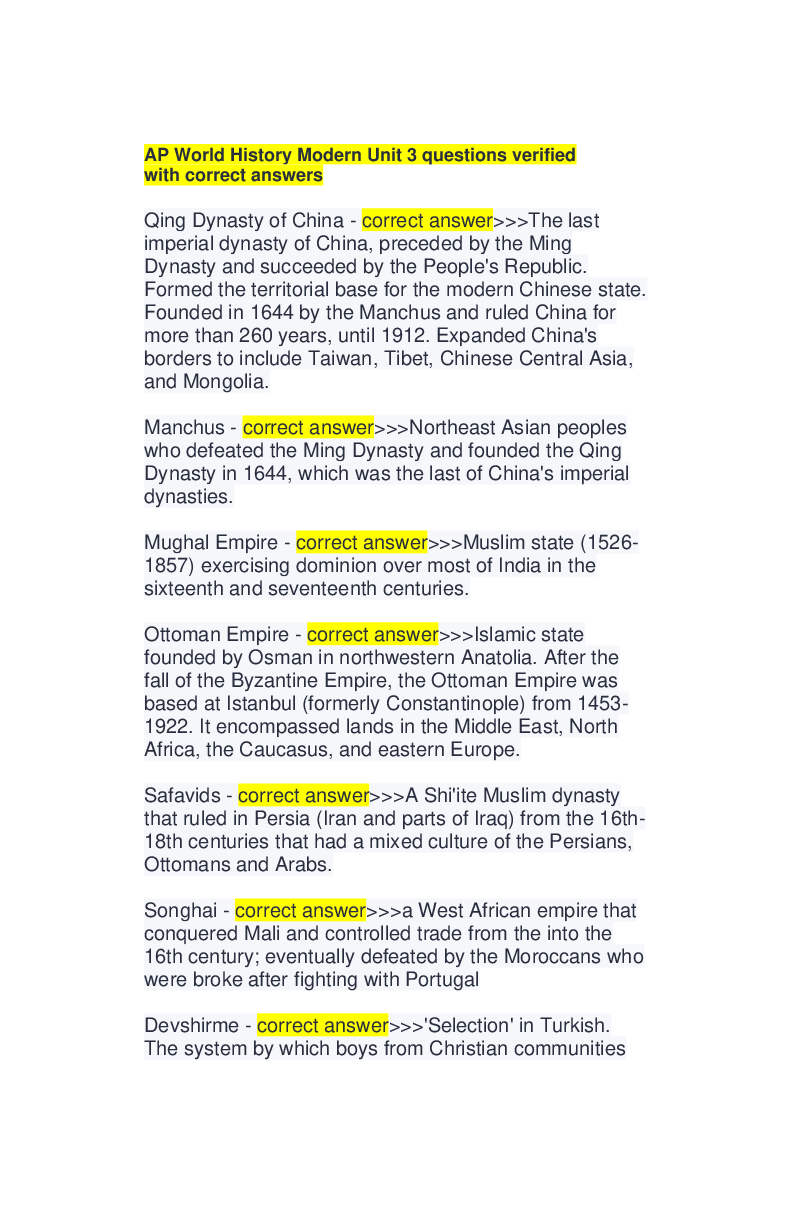
AP World History Modern Unit 1 Terms
2019-2020 Already Passed
Confucianism ✔✔The system of ethics, education, and statesmanship taught by Confucius and his
disciples, stressing love for humanity, ancestor worship, reverence for parents, and harmony in
thought and conduct. Made to restore traditional values and develop a caste system.
Filial Piety ✔✔In Confucian thought, one of the virtues to be cultivated, a love and respect for
one's parents and ancestors.
Neo-Confucianism ✔✔Term to describe the resurgence of Confucianism and the influence of
Confucian scholars during the T'ang Dynasty; a unification of Daoist or Buddhist metaphysics
with Confucian ideas.
Confucian respect and deference for women. ✔✔Believed women were capable of loyalty,
courage, and devotion, but also intrigue, manipulation, and selfishness. Women were supposed to
remain in their place in the caste system.
Theravada ✔✔Teaching of the elders; oldest serving branch of Buddhism; more conservative.
Mahayana ✔✔The name of the more mystical and larger of the two main Buddhist sects.
Originated in India in the 400s CE and gradually found its way north to the Silk road and into
Central and East Asia. Focus on more spiritual relations.
Tibetan Buddhism ✔✔The religion of Tibet; a form of Mahayana Buddhism. Combines values of
Buddhism and other indigenous religion.
Champa Rice ✔✔Quick-maturing rice that can allow two harvests in one growing season.
Originally introduced into Champa from India, it was later sent to China as a tribute gift by the
Champa state (now known as Vietnam) during the Song dynasty. Increased China's population
greatly.
Grand Canal Expansion ✔✔Built in 7th century during reign of Yangdi during Sui dynasty;
designed to link the original centers of Chinese civilization on the north China plain with the
Yangtze river basin to the south; nearly 1200 miles long. Built to ship grain from rich farmland in
south China to Beijing.
Song Dynasty ✔✔(960-1279 CE) The Chinese dynasty that placed much more emphasis on civil
administration, industry, education, and arts other than military. Used a monarch government
system, later taken over by the Mongols. Comparable to the renaissance of Europe of the 14th
century.
Effects of the innovations of the Chinese economy in Song, China. ✔✔Products such as textiles,
porcelain, steel, and iron lead to urbanization and made China richer.
Effects of Intellectual Innovation in Dar al Islam. ✔✔Dar al Islam translates to "The House of
Islam" or "The House of Peace." This was a place where Muslims could practice their religion.
Expanded dramatically in medieval times. Arab elements were incorporated to philosophy.
Innovation from these new philosophies are partial to inventions we still use today, such as
toothbrushes, marching bands, and algebra.
Abbasid Caliphate ✔✔Third of the Islamic Caliphates of the Islamic Empire. The rulers who built
their capital in Baghdad after overthrowing the Umayyad caliphs. (Caliphs are leaders.) In started
in 750 CE. It flourished for two centuries, but slowly went into decline with the rise to power of
the Turkish army it had created, the Mamluks. In the 13th century the Mongols displaced them.
Seljuk Empire ✔✔An empire formed by Turkish and Persian Sunnis, lasting from 1037 to 1194
A.D. Monarch government.
Mamluk Sulante of Egypt ✔✔Medieval realm spanning Egypt, the Levant, and Hejaz. Lasted the
overthrow of the Ayyubid dynasty until Ottoman conquest in Egypt in 1517. Largely a military
based dynasty. Soldiers were called mamlucks, their status just above slaves.
Delhi Sultanates ✔✔For about 320 years beginning in 1206, five dynasties ruled over the city of
Delhi in India. This kingdom has been coined the Delhi Sultanate. A former slave named Qutbud-din Aibak began the dynasty, spreading Delhi's territory and influence across northern India.
He also spread the influence of the Islamic religion throughout the region. After years of conquest,
the Sultanate conquered and incorporated that majority of the Indian subcontinent. This resulted
in a sort of unification process between the diverse peoples of the region, but also led to a split in
Indian culture, as Hindus increasingly fought against the Sultanate in the 16th century, leading to
its demise.
Nasir al-Din al-Tusi ✔✔Persian mathematician and cosmologist whose academy near Tabriz
provided the model for the movement of the planets that helped to inspire the Copernican model
of the solar system. Also thought to have created trigonometry.
A'ishah al-Ba'uniyyah ✔✔Female Sufi master and poet, taught by her father and said to have
memorized the Quran when she was eight. One of few Islamic women to record her views in
writing. It was likely that she wrote more works than any women prior to the 20th century, but
most of her works have been lost.
Islam Advances in Medicine ✔✔Contributions of the two major Muslim philosophers and
physicians, Al-Razi and Ibn Sina, made a lasting impact on Muslim medicine. Wrote their
compilation of knowledge in medical books, giving a major influence on the education of medical
knowledge.
House of Wisdom in Baghdad ✔✔Large Islamic-based Library and learning center. Focus of
conversion of Greek and Roman classics and Indian learning into Arabic. Preserved knowledge.
Often described as a school or university and place to exchange ideas and wisdom.
Scholarly and cultural transfers in Muslim and Christian Spain. ✔✔Medieval people, whether
Christians, Muslims, or Jews, perceived ethnicity largely in terms of religious affiliation. In
religiously heterogeneous societies, religious minorities were perceived as ethnically differentiated
units, no matter what the level of their general acculturati
[Show More]
.png)

.png)
.png)
.png)