Unit 2 Session 1-8 & LETRS Unit 2 FInal Assessment, Question with answers. 100% verified. 2022/2023 latest update.
Unit 2 Session 1
T/F A student with general phonological awareness can learn to read fluently, even
...
Unit 2 Session 1-8 & LETRS Unit 2 FInal Assessment, Question with answers. 100% verified. 2022/2023 latest update.
Unit 2 Session 1
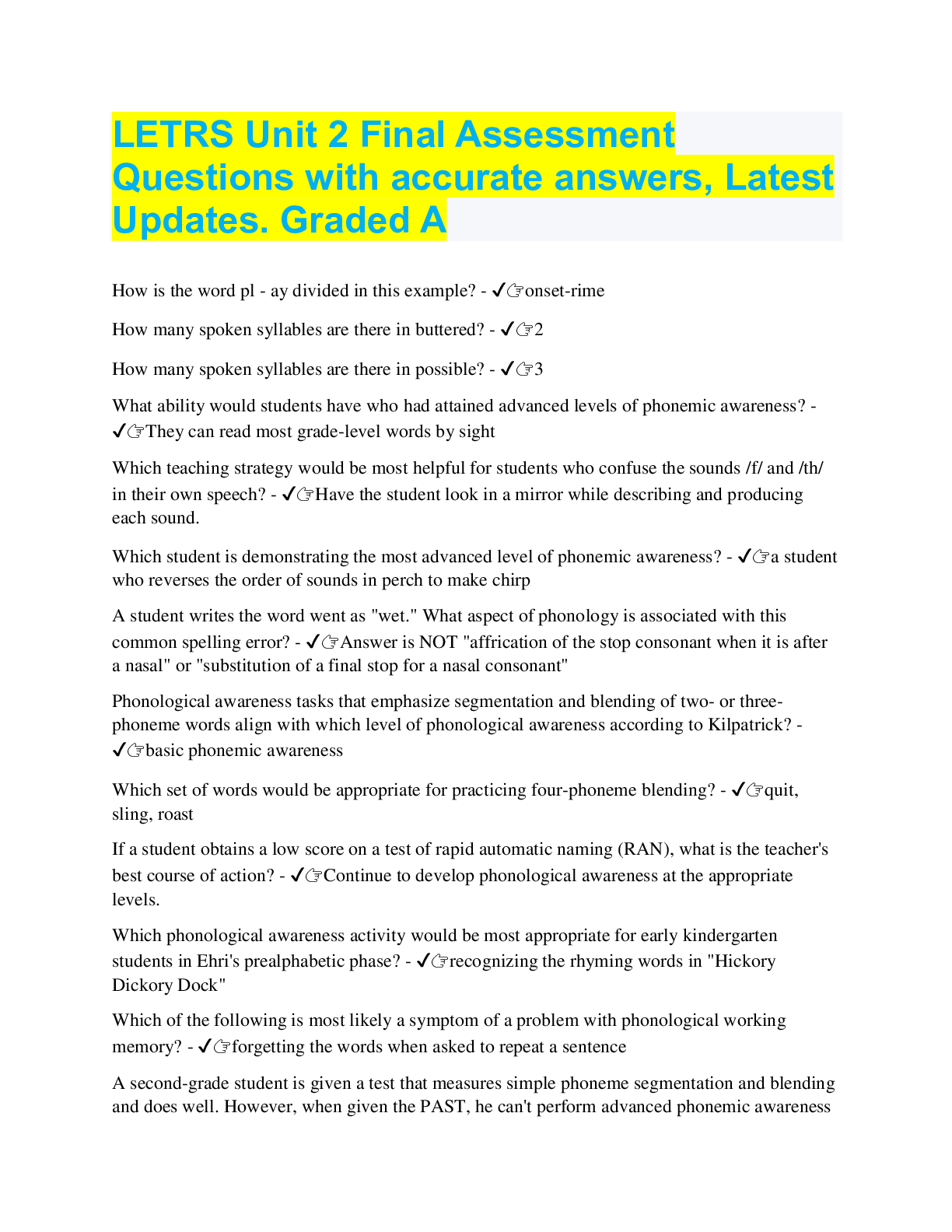
T/F A student with general phonological awareness can learn to read fluently, even if the student has not yet developed awareness of speech sounds at the phoneme level. - ✔✔False
T/F If a student analyzes the sounds and syllables in a word, it is easier for the student to store the word in semantic memory. - ✔✔True
Read the following list of classroom activities. Select the one that targets phonological awareness only, without attempting to address other language skills.
a. Ms. Jones says a word, has students repeat it, and then asks students when or where they have heard it before and what they think it means.
b. Ms. Chang says a word and has students repeat it, clap for each syllable, and count the syllables.
c. Mr. Garcia has students look at a word, identify the letters used to spell it, and sound out the word to read it aloud.
d. Mrs. Moretti says a word, has students segment the sounds and blend them to say the word again, and asks students to use the word in a sentence. - ✔✔b. Ms. Chang says a word and has students repeat it, clap for each syllable, and count the syllables.
Which of these skills should not be a direct focus of classroom instruction? (Select all that apply.)
a. phonological working memory (PWM)
b. phonics
c. rapid automatic naming (RAN)
d. speech production - ✔✔A& C. a. phonological working memory (PWM) & rapid automatic naming (RAN)
The term coarticulation means the ability to:
a. perceive all of the individual phonemes in a word during listening.
b. associate phonemes with the letters or letter groups (graphemes) that represent each sound.
c. "match" the sound of a spoken word to the corresponding definition in one's mental lexicon.
d. say the phonemes within a syllable so that all of the segments are seamlessly joined. - ✔✔d. say the phonemes within a syllable so that all of the segments are seamlessly joined.
LETRS Unit 2 Session 1 Mini-Quiz
Which of the following words best completes the sentence when inserted into blank 1?
phonological processing
phonological awareness
phoneme
phonemic awareness
phonology
phonetics - ✔✔phonology
Which of the following words best completes the sentence when inserted into blank 2?
phonological processing
phonological awareness
phoneme
phonemic awareness
phonology
phonetics - ✔✔phonological awareness
Which of the following words best completes the sentence when inserted into blank 3?
phonological processing
phonological awareness
phoneme
phonemic awareness
phonology
phonetics - ✔✔phonemic awareness
Which of the following words best completes the sentence when inserted into blank 4?
phonological processing
phonological awareness
phoneme
phonemic awareness
phonology
phonetics - ✔✔phonetics
Which of the following words best completes the sentence when inserted into blank 5?
phonological processing
phonological awareness
phoneme
phonemic awareness
phonology
phonetics - ✔✔phoneme
Which of the following words best completes the sentence when inserted into blank 6?
phonological processing
phonological awareness
phoneme
phonemic awareness
phonology
phonetics - ✔✔phonological processing
LETRS Unit 2 Session 1 - Mini Quiz - Teaching Reading IS Rocket Science
The phonological processor allows us to do which of the following? Select all that apply.
a. perceive sounds
b. remember sounds
c. interpret sounds
d. produce speech - ✔✔Select All Choices
The written representation of a speech sound is known as a grapheme.
true
false - ✔✔true
Providing direct, detailed phonemic awareness instruction is only necessary for students who struggle with reading.
true
false - ✔✔False
Which of the following is a necessary prerequsite to being able to read words? Select all that apply.
a. perceive individual speech sounds
b. produce individual speech sounds
c. manipulate individual speech sounds
d. none of these - ✔✔a. perceive individual speech sounds
b. produce individual speech sounds
c. manipulate individual speech sounds
It is necessary that students know how speech sounds look and feel when produced as well as how they sound.
true
false - ✔✔true
Unit 2 - Session 2 Questions with answers, rated A
Several kinds of _______ __________ predict the ability to read, spell and write between Kindergarten and Second Grade. - ✔✔phonological tasks
_____________ _____________, especially segmenting and blending individual sounds in simple spoken words, predicts future reading problems in kindergarten and beginning first grade better than other phonological tasks such as rhyming, allieteration,word repetition, or syllable counting. - ✔✔Phonemic awareness
__________ __________ is comprised of three levels; early, basic and advanced. - ✔✔Phonological awareness
__________ ________ _________ usually develops in preschoolers, with appropriate experiences, and include rhyming, alliteration, syllable segmentatio and first-sound matching in words that are found in alliterative phrases. These skills facilitate early matching of printed letters to letter names and letter sounds. - ✔✔Early Phonological Awareness
________ __________ _________ typically develops in Kindergarten and First Grade. Skills are usually tested in universal screening measures (DIBELS Next, AIMSweb, and easyCBM. They include phoneme segmentation and blending of single-syllable words without consonant blends. - ✔✔Basic Phonological Awareness
_______ ________ _________ skills continue to develop through fourth grade and include the ability to substitute sounds for one another in a spoken word, reverse the order of sounds, and insert or delete sounds to make new words. Needed for efficient sight vocabulary development. - ✔✔Advanced Phonological Awareness
Problems with _______ _________ awareness may go undetected by teachers once students are past the first grade. - ✔✔advanced phonemic
Any student who is less than _________ in reading and spelling, no matter what age, should have his or her phonological skills tested with a screener that includes advanced phoneme manipulations and that accounts for the automaticity of student response. - ✔✔proficient
At age 4, Early Phonological Awareness skills include; responsiveness to rhyme and alliteration during word play are addressed by enjoying and reciting _______ words or __________ phrases in familiar storybooks or nursery rhymes. - ✔✔rhyming; alliterative
At age 5, Early Phonological Awareness skills include; rhyme recognition, clapping, __________ syllables, matching words with the same first sound by using the following tasks; Which two words rhyme? stair, steel, chair. Hickory dickory dock, the mouse went up the _____? - ✔✔counting
At age 5.5, Basic Phonemic Awareness skills include distinguishing and remembering separate phonemes in a series, _________ onset and rime, segementing and pronouncing the initial sound of a word by using the following tasks; showing sequences of single phonemes with colored blocks, What word? th-umb and say the first sound in shoelace (/sh/). - ✔✔blending
At age 6, Basic Phonemic Awareness skills include syllable deletion, deleting part of a compound, onset-rime blending, beginning phoneme blending, phoneme segmentation, simple syllables with _____________ (no blends) by using the following tasks; Say parsnip. Say it again but don't say par. /sh/ - op (shop), say each sound in the word as you move a chip for each sound: /sh/ - /e/, /m/-/a/-/n/. - ✔✔2-3 phonemes
At age 6.5, Basic Phonemic Awareness includes, phoneme segmentation up to ____________________ including blends, Phoneme substitution to build new words- simple syllables with NO blends, extracting and pronouncing beginning, final, and media phonemes from one-syllable words by using the following tasks; say phonemes while tapping sounds, change /j/ in cage to /n/, change to /a/ in cane to /o/. Say last sound in milk. Say the vowel sound in rope. - ✔✔3-4 phonemes
At age 7, Advanced Phonemic Awareness includes; sound deletion, initial and final position, sound substitution in words with _____________ by using the following tasks; Say meat, Say it again without the /m/. Listen. What sound have I changed? Shrink, shrank, square, squire. - ✔✔5-6 phonemes
At age 8, Advanced Phonemic Awareness skills include sound deletion, intial position, including ________ by using the following tasks; say prank. Now say in again without the /p/. - ✔✔blends
At age 9, Advanced Phonemic Awareness skills include; sound deletion, medial and final blend position, phoneme reversal and phoneme chaining by using the following tasks; Say safe. Say the last sound first and the first sound last (face), in a series of words that change only one sound at a time, use colored blocks to show addition, deletion, substitution, and resequencing of sounds from one word to the _______. - ✔✔next
Unit 2 - Session 3 Questions with accurate answers
Phonemic Awareness is ________ for learning to read and write in any alphabetic writing system. - ✔✔critical
_____________ tests given to Kindergarten and First grade students have the best predictive validity if they include measures of phoneme segmentation, phoneme manipulation, or phoneme representation in phonetic spelling - ✔✔Screening
Screening measures are quite _________ at identifying students at risk if they combine phonemic awareness with letter-name knowledge, letter-sound association, and vocabulary. - ✔✔accurate
Measures of advanced phonemic awareness are better ________ of reading difficulties from second grade onward. - ✔✔predictors
Whole class instruction that includes phonemic awareness training for a few minutes per day, several days per week, is one of the best ________ for future reading failure. However, instruction must be linked to explicit phonics instruction (letter-sound correspondences) to benefit young learners. - ✔✔antiodotes
Most at risk students will benefit from _____________ teaching of phonological skills. - ✔✔explicit
The _____________ principle is the concept that English uses graphemes to represent phonemes. - ✔✔alphabetic
________________ refers both to the sytstem of correspondenc between print and sound AND the approach to reading and spelling instruction. - ✔✔Phonics
After age _______, learning the phonology of a new language becomes more challenging as brain circuitry for the production of sounds in a known language is already established. - ✔✔five
LETRS Unit 2 Session 4 Questions and answers
T/F In many instances, two different consonant phonemes in English are formed the same way in the mouth, but one is voiced and the other is unvoiced. - ✔✔True
T/F Adults often miscount the number of phonemes in a word because they tend to recall how a word looks in print and count the letters, not the sounds. - ✔✔True
Which of the following sounds is an affricate, meaning it combines features of fricatives and stops?
a. /k/
b. /ng/
c. /ch/
[Show More]