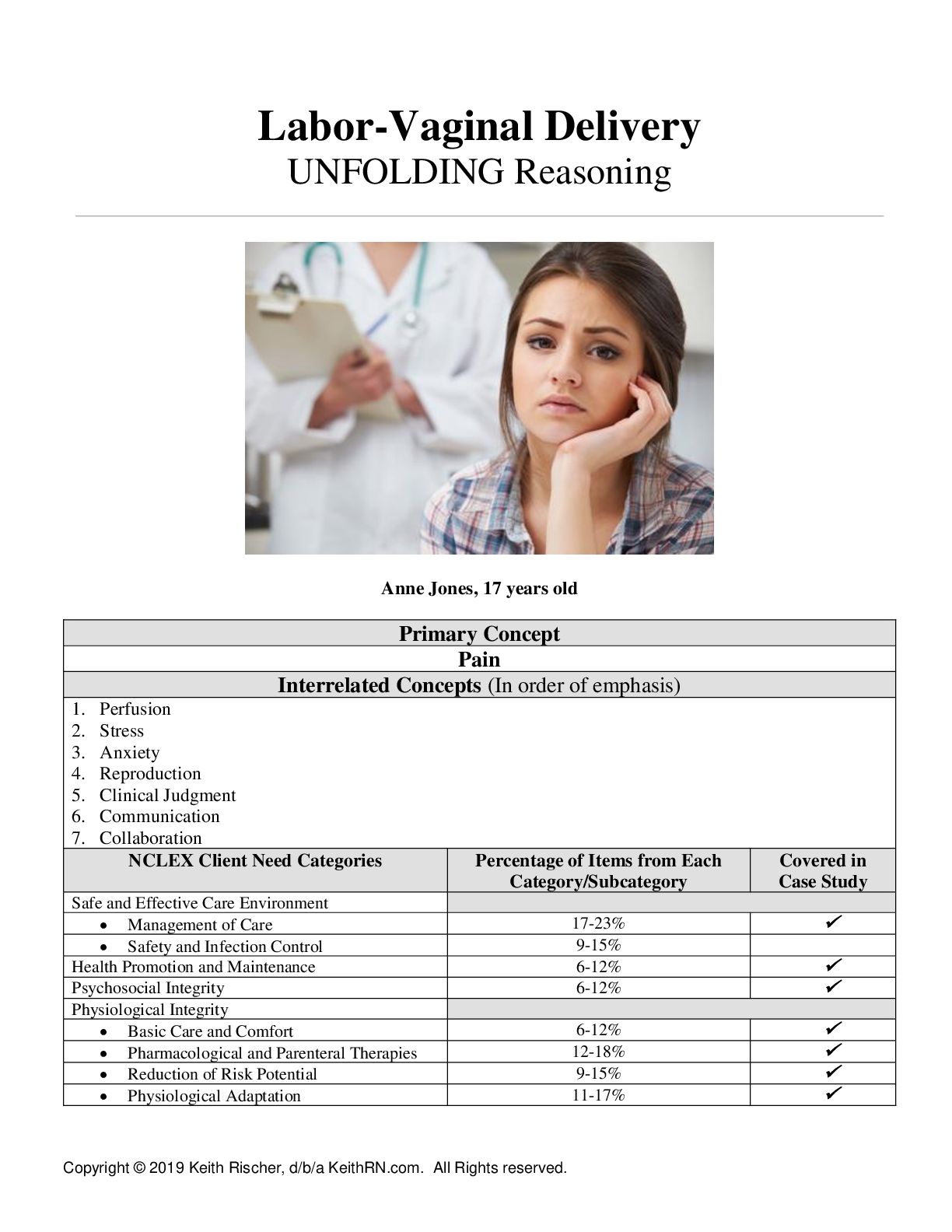
Labor-Vaginal Delivery UNFOLDING Reasoning Anne Jones, 17 years old
Copyright © 2019 Keith Rischer, d/b/a KeithRN.com. All Rights reserved.
Labor-Vaginal Delivery
UNFOLDING Reasoning
Anne Jones, 17 years old
Prima
...
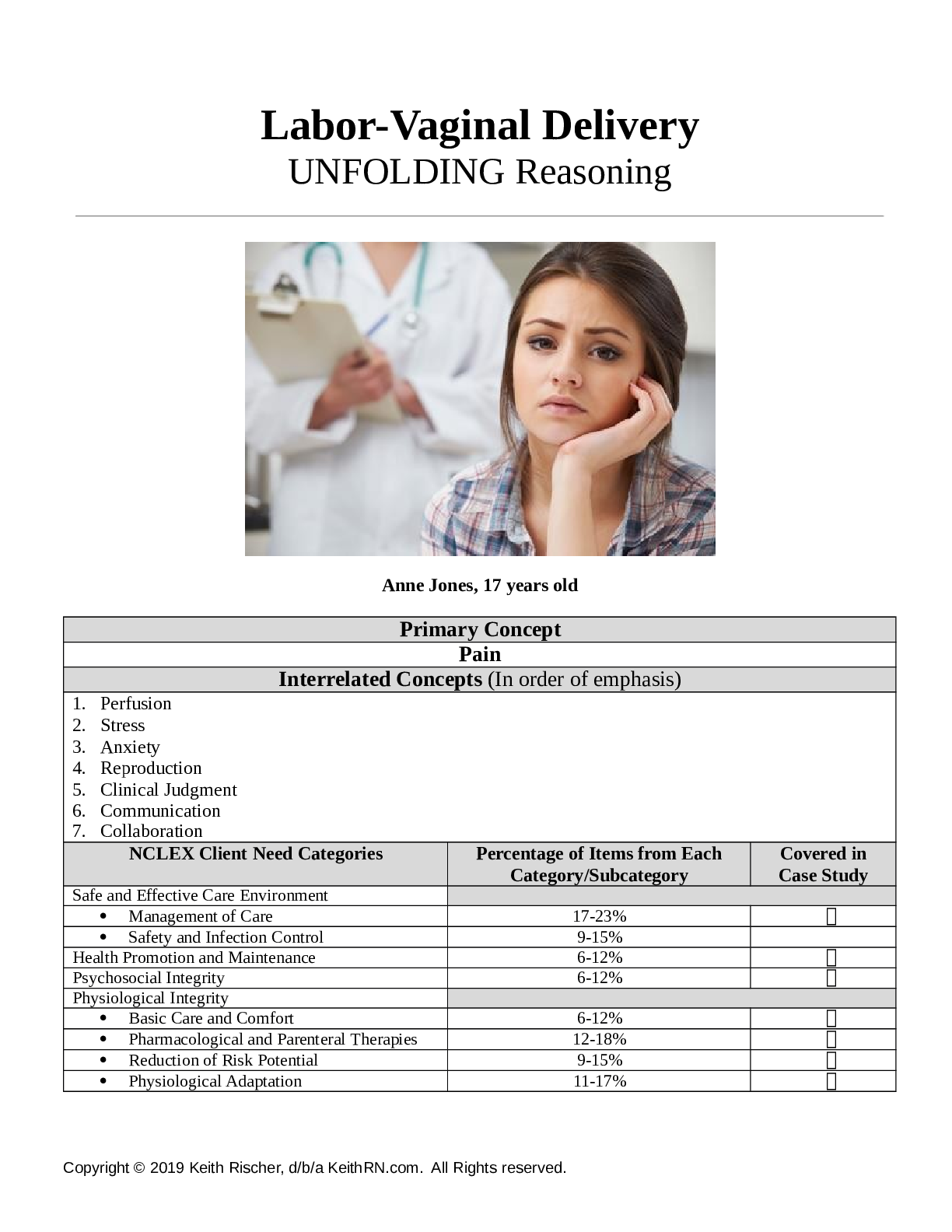
Labor-Vaginal Delivery UNFOLDING Reasoning Anne Jones, 17 years old
Copyright © 2019 Keith Rischer, d/b/a KeithRN.com. All Rights reserved.
Labor-Vaginal Delivery
UNFOLDING Reasoning
Anne Jones, 17 years old
Primary Concept
Pain
Interrelated Concepts (In order of emphasis)
1. Perfusion
2. Stress
3. Anxiety
4. Reproduction
5. Clinical Judgment
6. Communication
7. Collaboration
NCLEX Client Need Categories Percentage of Items from Each
Category/Subcategory
Covered in
Case Study
Safe and Effective Care Environment
• Management of Care 17-23% ✓
• Safety and Infection Control 9-15%
Health Promotion and Maintenance 6-12% ✓
Psychosocial Integrity 6-12% ✓
Physiological Integrity
• Basic Care and Comfort 6-12% ✓
• Pharmacological and Parenteral Therapies 12-18% ✓
• Reduction of Risk Potential 9-15% ✓
• Physiological Adaptation 11-17% ✓Copyright © 2019 Keith Rischer, d/b/a KeithRN.com. All Rights reserved.
History of Present Problem:
Anne is a 17-year-old, gravida 1 para 0 who is 39 weeks gestation and admitted to the labor room for
observation at 1200. She began having contractions three hours ago at 8 to 10-minute intervals with each
contraction lasting 30 seconds. She states her pain is 3/10. Her membranes are intact. On admission, a vaginal
exam indicates cervical dilation is 1 cm, 80% effacement, and 0 station.
After two hours of observation, her cervix is 2-3 cm/ 80% effacement/0 station and contractions are now 4-
5 minutes apart, lasting 60-70 seconds and pain remains 3/10. Fetal lie is longitudinal with a cephalic
presentation. You have her prenatal records from her visits to the office. She is Group Beta Strep (GBS)
positive and received antibiotics at 36 weeks. Her blood type is B-.
Personal/Social History:
Anne’s mother is with her. Anne is not married and the father of the baby is not involved. She appears to be
relaxed although she states she is a bit nervous. She wants a natural non-medicated birth and her mother will
help coach her. She plans on breastfeeding for “awhile”. She attended childbirth preparation classes with her
mother.
What data from the histories are RELEVANT and must be interpreted as clinically significant by the nurse?
(Reduction of Risk Potential)
RELEVANT Data from Present Problem: Clinical Significance:
RELEVANT Data from Social History: Clinical Significance:
Anne is placed on a fetal monitor and
the nurse collects the following strip:Copyright © 2019 Keith Rischer, d/b/a KeithRN.com. All Rights reserved.
Fetal Heart Rate Strip Assessment:
Fetal Monitoring Strip:
Interpretation:
Clinical Significance:
Patient Care Begins:
What VS data are RELEVANT and must be interpreted as clinically significant by the nurse?
(Reduction of Risk Potential/Health Promotion and Maintenance)
RELEVANT VS Data: Clinical Significance:
Current VS: P-Q-R-S-T Pain Assessment:
T: 98.6 F/37.0 C (oral) Provoking/Palliative: Began 3 hours ago
P: 76 (regular) Quality: Cramping that comes and goes, lasting 40 sec after 1 hour 60-
70 sec.
R: 18 (regular) Region/Radiation: Uterus
BP: 125/80 Severity: 3/10
O2 sat: 98 Timing: 8-10 min then 4-5 minsCopyright © 2019 Keith Rischer, d/b/a KeithRN.com. All Rights reserved.
What assessment data are RELEVANT and must be interpreted as clinically significant by the nurse?
(Reduction of Risk Potential/Health Promotion and Maintenance)
RELEVANT Assessment Data: Clinical Significance:
Clinical Reasoning Begins…
1. Interpreting relevant clinical data, what is the primary concern? What primary health-related concepts does this
primary problem represent? (Management of Care/Physiologic Adaptation)
Problem: Pathophysiology of Problem in OWN Words: Primary Concept:
Collaborative Care: Medical Management (Pharmacologic and Parenteral Therapies)
Care Provider Orders: Rationale: Expected Outcome:
Admit to Labor and Delivery
Intermittent fetal heart
monitoring ambulating as
tolerated
Ampicillin 2 g IVPB when
in active labor and 1 g every
4 hours while in labor
Current Assessment:
General
Appearance:
Calm, body relaxed, no grimacing, appears to be slightly anxious.
Respiratory: Breath sounds clear with equal aeration bilaterally ant/post, non-labored respiratory effort
Cardiac: Pink, warm & dry, slight ankle edema, heart sounds regular with no abnormal beats, pulses
strong, equal with palpation at radial, brisk cap refill
Neuro: Alert and oriented to person, place, time, and situation (x4)
HEENT: Normal cephalic
Chest: Breasts tender on palpation, areola darkened and occasional veins present
Abdomen: Soft; no masses, uterus palpable above umbilicus, mild indenting with palpation, fetus is in
LOA position by palpation
Extremities: Mild spider varicose veins on medial aspect of left leg, deep tendon reflexes 2+
Vaginal Exam: Small amount clear mucous, 1cm/80%/0, membranes intactCopyright © 2019 Keith Rischer, d/b/a KeithRN.com. All Rights reserved.
Vital Signs every hour
Limit vaginal exams.
May ambulate as tolerated
PRIORITY Setting: Which Orders Do You Implement First and Why? (Management of Care)
Care Provider Orders: Order of Priority: Rationale:
• Establish peripheral IV
• Ampicillin 2 g IVPB
now x1 and 1 g every 4
hours while in labor
• Intermittent fetal heart
monitoring ambulating
as tolerated
Collaborative Care: Nursing
2. What body system(s) will you assess most thoroughly based on the primary/priority concern?
(Reduction of Risk Potential/Physiologic Adaptation)
PRIORITY Body System: PRIORITY Nursing Assessments:
3. What nursing priority (ies) will guide your plan of care? (Management of Care)
Nursing PRIORITY:
PRIORITY Nursing Interventions: Rationale: Expected Outcome:Copyright © 2019 Keith Rischer, d/b/a KeithRN.com. All Rights reserved.
4. What psychosocial/holistic care PRIORITIES need to be addressed for this patient?
(Psychosocial Integrity/Basic Care and Comfort)
Psychosocial PRIORITIES:
PRIORITY Nursing Interventions: Rationale: Expected Outcome:
CARE/COMFORT:
Caring/compassion as a nurse
Physical comfort measures
EMOTIONAL (How to develop a
therapeutic relationship):
Discuss the following principles needed
as conditions essential for a therapeutic
relationship:
• Rapport
• Trust
• Respect
• Genuineness
• Empathy
Four hours later… (1600)
Anne is breathing through the contractions and her mother is at her side. She has put on
the call light because she thinks her water broke. You as the nurse, go in and assess.
Her contractions are now every three minutes and moderate in intensity with palpation.
You perform a vaginal exam and note clear fluid that has no odor, she is 6 cm dilated,
90% effacement, and +1 station. Vertex presentation and fetal position is LOA with
good flexion of the head. You notice the following FHR on the strip.Copyright © 2019 Keith Rischer, d/b/a KeithRN.com. All Rights reserved.
Fetal Monitoring Strip:
Interpretation:
Clinical Significance:
1. What data is RELEVANT and must be interpreted as clinically significant by the nurse?
(Reduction of Risk Potential/Health Promotion and Maintenance)
RELEVANT VS Data: Clinical Significance:
RELEVANT Assessment Data: Clinical Significance:
Current VS: Most Recent: Current PQRST:
T: 98.8 F/37.1 C (oral) T: 98.6 F/37.0 C (oral) Provoking/Palliative:
P: 86 (regular) P: 76 (regular) Quality: “Squeezing, tightening”
R: 22 (regular) R: 18 (regular) Region/Radiation: abdomen
BP: 130/80 BP: 125/80 Severity: 6/10
O2 sat: 98% room air O2 sat: 98% room air Timing: Every 3-4 minsCopyright © 2019 Keith Rischer, d/b/a KeithRN.com. All Rights reserved.
2. Has the status improved or not as expected to this point? Does your nursing priority or plan of care need to be
modified in any way after this evaluation assessment? (Management of Care, Physiological Adaptation)
Evaluation of Current Status: Modifications to Current Plan of Care:
3. Based on your current evaluation, what are your CURRENT nursing priorities and plan of care?
(Management of Care)
CURRENT Nursing PRIORITY:
PRIORITY Nursing Interventions: Rationale: Expected Outcome:
Four hours later… (2000)
Anne puts on her call light and you answer it. She states she feels pressure “down
there”. You perform a vaginal exam. She is now 10 cm/100%/2+. She has the urge
to push.Copyright © 2019 Keith Rischer, d/b/a KeithRN.com. All Rights reserved.
Fetal Monitoring Strip:
Interpretation:
Clinical Significance:
Half an hour later (2030)…
RELEVANT Assessment Data: Clinical Significance:
Anne delivers a healthy male infant at 2032. Placenta delivered at 2045. No pain
medication was given. Pitocin 30 units/500 mL IV was began after the delivery of the
placenta. Infant Apgars were 8 and 9.
Weight: 7 lbs 0 oz (3.2 kg) 20 (50.8 cm) inches long. Skin-to-skin contact with
baby initiated and her baby boy attempted to breastfeed and latched on for 5 minutes
on right side. Anne is smiling and holding and talking to her baby. Her uterus is firm,
one finger width below the umbilicus and midline. Lochia moderate rubra. Mid-line
episiotomy is well approximated, slightly bruised and area swollen. Ice pack applied
to perineum. Anne was able to void 400 mL clear, yellow urine after delivery. She has
finished recovery and is being transferred to the postpartum unit.Copyright © 2019 Keith Rischer, d/b/a KeithRN.com. All Rights reserved.
What VS data are RELEVANT and must be interpreted as clinically significant by the nurse?
(Reduction of Risk Potential/Health Promotion and Maintenance)
RELEVANT VS Data: Clinical Significance:
Effective and concise handoffs are essential to excellent care and, if not done well, can
adversely impact the care of this patient. You have done an excellent job to this point; now
finish strong and give the following SBAR report to the nurse who will be caring for this
patient: (Management of Care)
Current VS: P-Q-R-S-T Pain Assessment:
T: 98.6 F/37.0 C (oral) Provoking/Palliative: sitting
P: 74 (regular) Quality: throbbing
R: 18 (regular) Region/Radiation: perineum
BP: 122/78 Severity: 3/10
O2 sat: 98% room air Timing: constant
Situation:
Name/age:
BRIEF summary of primary problem:
Day of delivery:
Background:
Primary problem/diagnosis:
RELEVANT past medical history:
RELEVANT background data:
Assessment:
Most recent vital signs:
RELEVANT body system nursing assessment data:
RELEVANT lab values:
TREND of any abnormal clinical data (stable-increasing/decreasing):
How have you advanced the plan of care?
Patient response:
INTERPRETATION of current clinical status (stable/unstable/worsening):
Recommendation:
Suggestions to advance the plan of care:Copyright © 2019 Keith Rischer, d/b/a KeithRN.com. All Rights reserved.
Caring and the “Art” of Nursing
What is the patient likely experiencing/feeling right now in this situation? What can you do to engage yourself with
this patient’s experience, and show that he/she matters to you as a person? (Psychosocial Integrity)
What Patient is Experiencing: How to Engage:
[Show More]