1) Define the following terms and provided illustrations to support
your answer:
a) anodic and cathodic processes in aqueous corrosion
b) pitting corrosion
c) galvanic corrosion
d) intergranular corrosion
e) atmosp
...
1) Define the following terms and provided illustrations to support
your answer:
a) anodic and cathodic processes in aqueous corrosion
b) pitting corrosion
c) galvanic corrosion
d) intergranular corrosion
e) atmospheric oxidation of metals (25pts)
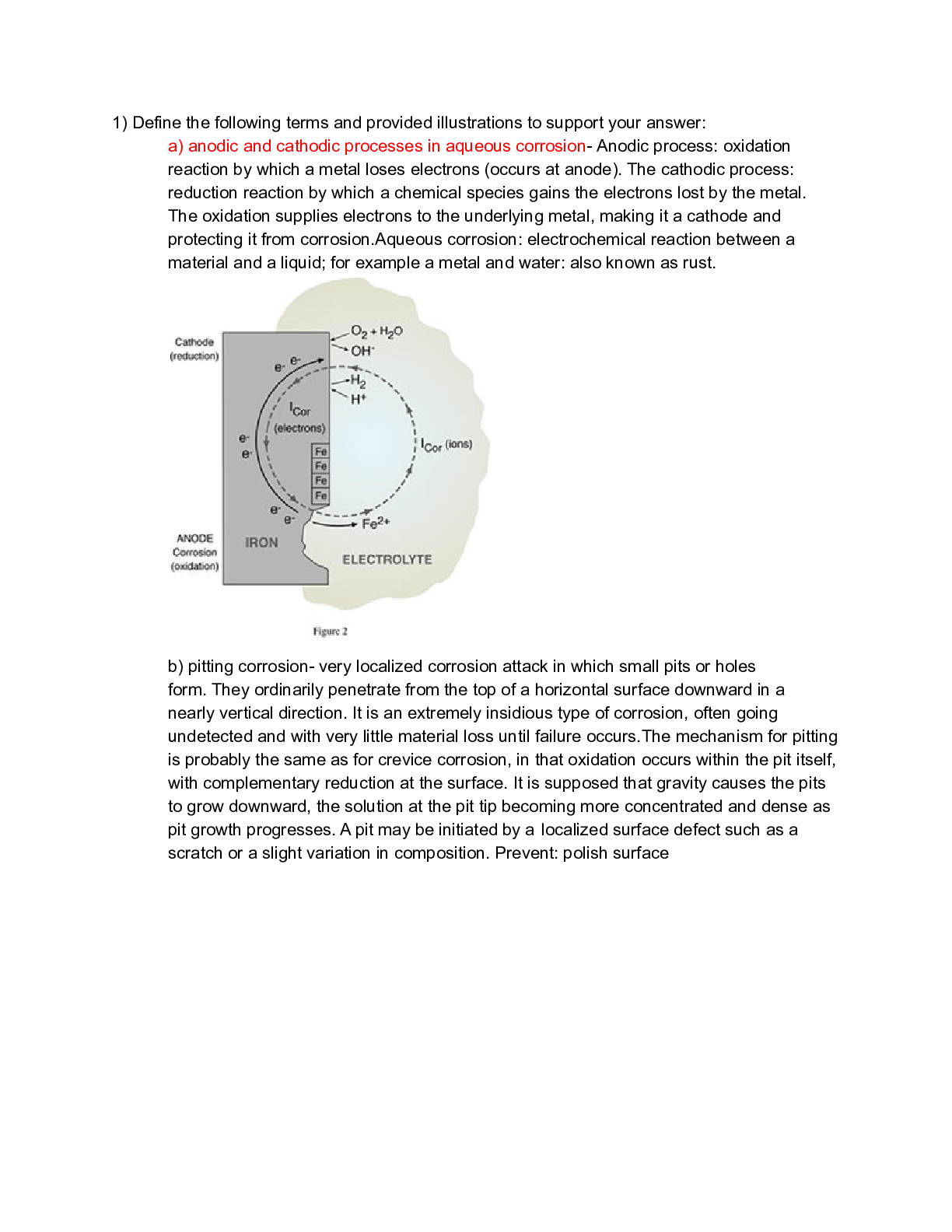
a) anodic and cathodic processes in aqueous corrosion
The anodic process involves the oxidation of a metal layer that is more susceptible to
corrosion in an aqueous environment than the metal that it is covering. The oxidation
supplies electrons to the underlying metal, making it a cathode and protecting it from
corrosion.
b) pitting corrosion
Pitting is a form of very localized corrosion attack in which small pits or holes form.
Oxidation occurs within the pit itself, with complementary reduction at the surface.
It is supposed that gravity causes the pits to grow downward, the solution at the pit tip
becoming more concentrated and dense as pit growth progresses.
c) galvanic corrosion
Galvanic corrosion occurs when two metals or alloys having different compositions
are electrically coupled while exposed to an electrolyte.
The less noble or more reactive metal in the particular environment will experience
corrosion (i.e., oxidation); the more inert metal, the cathode, will be protected from
corrosion (experience reduction).
anode cathode
Intergranular corrosion is corrosion that occurs preferentially along grain
boundaries for some alloys and in specific environments. The net result is that a
macroscopic specimen disintegrates along its grain boundaries.
This situation can happen in otherwise corrosion-resistant alloys, when the grain
boundaries are depleted of the corrosion-inhibiting elements. This is known as grain
boundary depletion.
A precipitate containing the corrosion-resistant element diffuses away from the
bulk and to the grain boundary and forms a precipitate along the grain
boundary. As a result, depleted zones form adjacent to the grain boundaries (this
process is called sensitization). These depleted zones are no longer composed of
the corrosion-resistant element, making these regions around the grain
boundary highly susceptible to corrosion.
d) intergranular corrosion
e) atmospheric oxidation of metals
Metals experience corrosion when exposed to ambient gases. Generally, metals would
undergo
oxidation reactions when exposed to oxygen and water vapor, while oxygen is reduced.
As a result, a precipitate forms at the interface of the metal and air.
E.g., Iron exposed to air
1) 2Fe + O2 + 2H2O → 2Fe(OH)2
2) 2Fe(OH)2 + ½ O2 + H2O → 2Fe(OH)3
and
4Fe + 3O2 → 2Fe2O3
2) a) What is the Galvanic series and explain how it is used
in engineering design of a metal can used for food
containment? (12pts)
b) What factors influence conductivity in metals and
alloys? (13pts)
2a) What is the Galvanic series and explain how it is used in engineering design of
a metal can used for food containment? (12pts)
Galvanic series- A ranking of metals and alloys as to their relative electrochemical
reactivity in seawater
For food containment purposes, a metal can will be exposed to salt solutions,
namely those with relatively high concentrations of sodium chloride. This
environment is similar to seawater, which frequently produce pitting and crevice
corrosion. To avoid corrosion within the metal can, one should look at the galvanic
series for the most
[Show More]