1) Define the following terms and provided illustrations to support your answer:
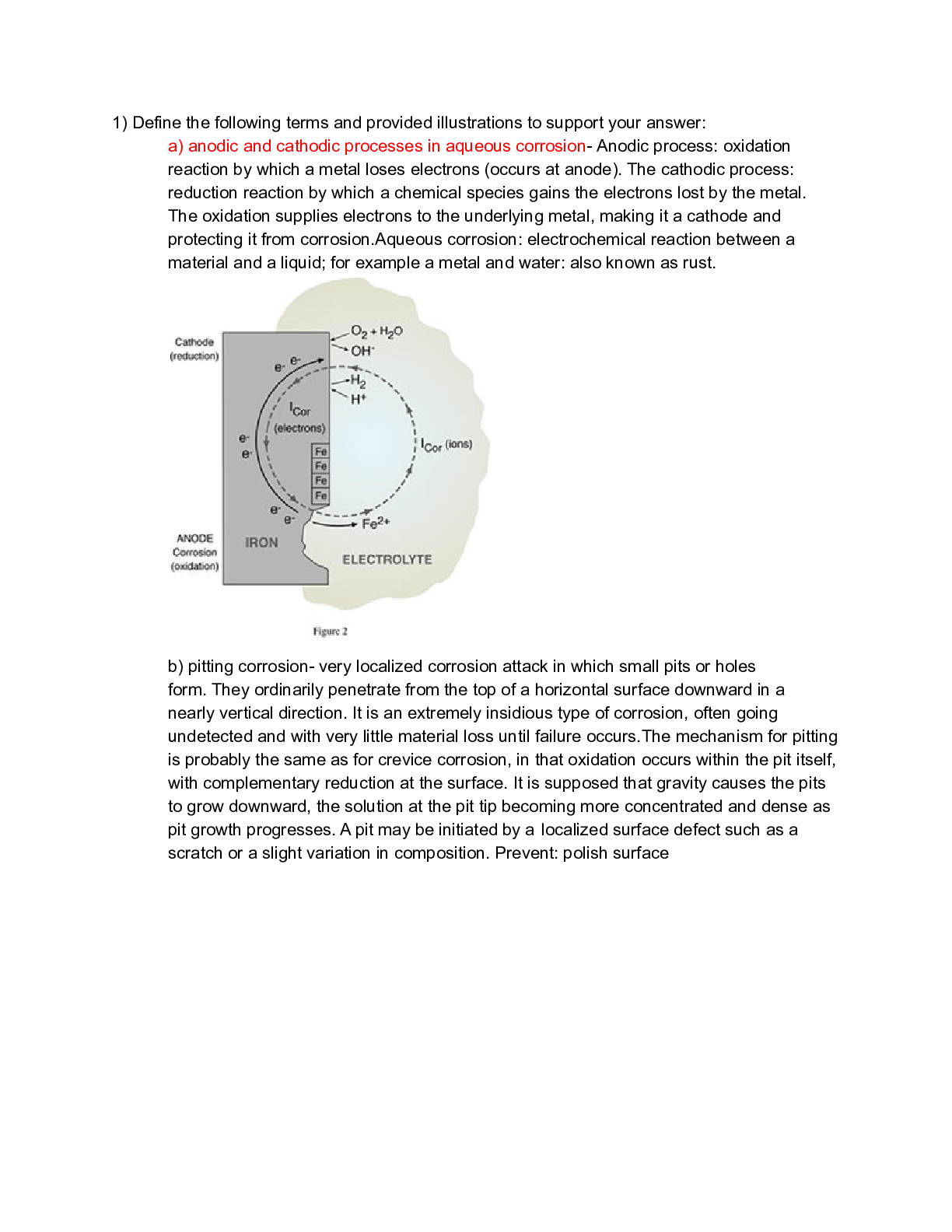
a) anodic and cathodic processes in aqueous corrosion- Anodic process: oxidation
reaction by which a metal loses electrons (occurs at ano
...
1) Define the following terms and provided illustrations to support your answer:
a) anodic and cathodic processes in aqueous corrosion- Anodic process: oxidation
reaction by which a metal loses electrons (occurs at anode). The cathodic process:
reduction reaction by which a chemical species gains the electrons lost by the metal.
The oxidation supplies electrons to the underlying metal, making it a cathode and
protecting it from corrosion.Aqueous corrosion: electrochemical reaction between a
material and a liquid; for example a metal and water: also known as rust.
b) pitting corrosion- very localized corrosion attack in which small pits or holes
form. They ordinarily penetrate from the top of a horizontal surface downward in a
nearly vertical direction. It is an extremely insidious type of corrosion, often going
undetected and with very little material loss until failure occurs.The mechanism for pitting
is probably the same as for crevice corrosion, in that oxidation occurs within the pit itself,
with complementary reduction at the surface. It is supposed that gravity causes the pits
to grow downward, the solution at the pit tip becoming more concentrated and dense as
pit growth progresses. A pit may be initiated by a localized surface defect such as a
scratch or a slight variation in composition. Prevent: polish surface
c) intergranular corrosion- occurs preferentially along grain boundaries
for some alloys and in specific environments. The net result is that a macroscopic
specimen disintegrates along its grain boundaries. This type of corrosion is especially
prevalent in some stainless steels. When heated to temperatures between 500C and
800C (950F and 1450F) for sufficiently long time periods, these alloys become
sensitized to intergranular attack. This heat treatment permits the formation of small
precipitate particles of chromium carbide (Cr23C6) by reaction between the chromium
and carbon in the stainless steel. Both the chromium and the carbon must diffuse to the
grain boundaries to form the precipitates, which leaves chromium-depleted zone
adjacent to the grain boundary. Consequently, this grain boundary region now highly
susceptible to corrosion. Prevent: heat treatment (redissolve), lower carbon, diff alloy.
d) atmospheric oxidation of metal- an oxide layer or scale forms on the surface of the
metal. Oxide layer increases in thickness electrons be conducted to the scale–gas interface, at
which point the reduction reaction occurs; in addition, M2+ ions must diffuse away from the
metal–scale interface, and/or O2- ions must diffuse toward this same interface
e) crevice corrosion- Electrochemical corrosion may also occur as a consequence of
concentration differences of ions or dissolved gases in the electrolyte solution and between two
regions of the same metal piece. For such a concentration cell, corrosion occurs in the locale
that has the lower concentration. A good example of this type of corrosion occurs in crevices
and recesses or under deposits of dirt or corrosion products where the solution becomes
stagnant and there is localized depletion of dissolved oxygen. The crevice must be wide enough
for the solution to penetrat
[Show More]