NUR 455 IHI PS 104 Questions and
Answers Rated A
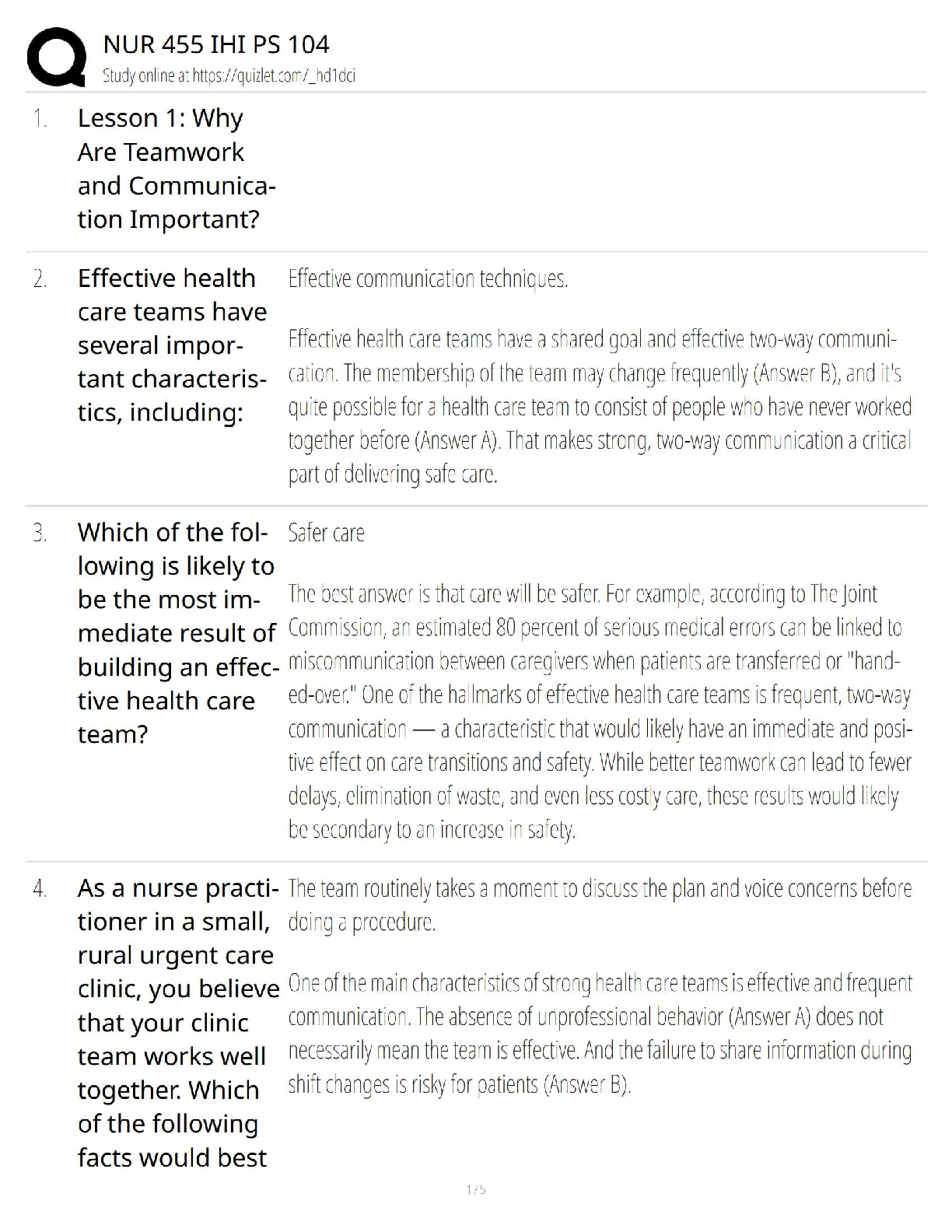
Lesson 1: Why Are Teamwork and Communication Important? ✔✔
Effective health care teams have several important characteristics, including: ✔✔Effective
communication tec
...
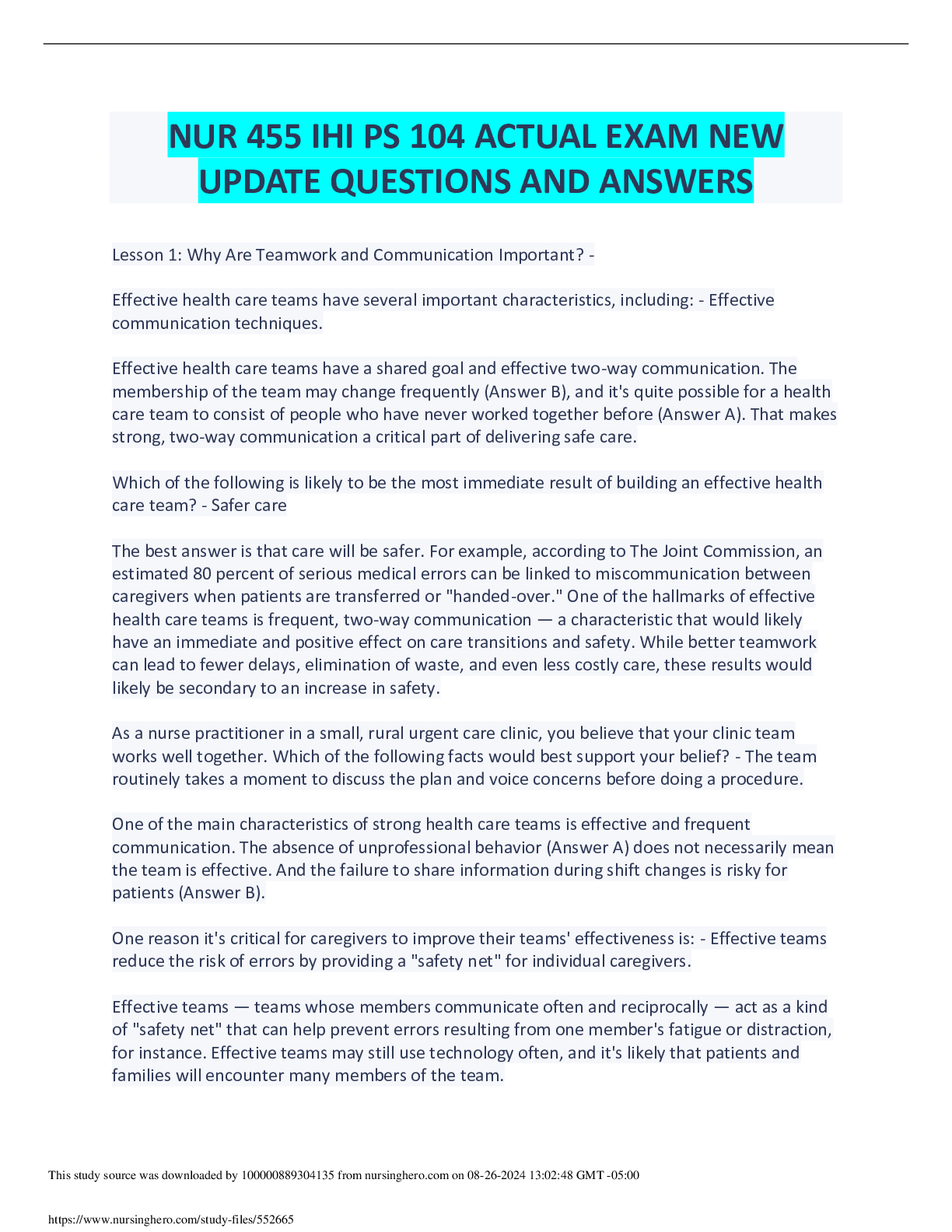
NUR 455 IHI PS 104 Questions and
Answers Rated A
Lesson 1: Why Are Teamwork and Communication Important? ✔✔
Effective health care teams have several important characteristics, including: ✔✔Effective
communication techniques.
Effective health care teams have a shared goal and effective two-way communication. The
membership of the team may change frequently (Answer B), and it's quite possible for a health
care team to consist of people who have never worked together before (Answer A). That makes
strong, two-way communication a critical part of delivering safe care.
Which of the following is likely to be the most immediate result of building an effective health
care team? ✔✔Safer care
The best answer is that care will be safer. For example, according to The Joint Commission, an
estimated 80 percent of serious medical errors can be linked to miscommunication between
caregivers when patients are transferred or "handed-over." One of the hallmarks of effective
health care teams is frequent, two-way communication — a characteristic that would likely have
an immediate and positive effect on care transitions and safety. While better teamwork can lead
to fewer delays, elimination of waste, and even less costly care, these results would likely be
secondary to an increase in safety.
As a nurse practitioner in a small, rural urgent care clinic, you believe that your clinic team
works well together. Which of the following facts would best support your belief? ✔✔The team
routinely takes a moment to discuss the plan and voice concerns before doing a procedure.
One of the main characteristics of strong health care teams is effective and frequent
communication. The absence of unprofessional behavior (Answer A) does not necessarily mean
the team is effective. And the failure to share information during shift changes is risky for
patients (Answer B).
One reason it's critical for caregivers to improve their teams' effectiveness is: ✔✔Effective teams
reduce the risk of errors by providing a "safety net" for individual caregivers.
Effective teams — teams whose members communicate often and reciprocally — act as a kind
of "safety net" that can help prevent errors resulting from one member's fatigue or distraction, for
instance. Effective teams may still use technology often, and it's likely that patients and families
will encounter many members of the team.
When considering your role within a health care team, it is important to keep in mind that:
✔✔No matter what profession you belong to, you will be a member of the team and must work
intentionally toward making that team effective.
If you're entering any field in which you'll be caring for patients, it's a certainty that you will be a
member of a team; in fact, you may be a member of multiple teams. As such, you'll have the
responsibility to communicate effectively, value the contributions of other members, and keep
building your team's ability to provide excellent care. Teamwork skills don't come naturally to
everyone (Answer C), but anyone can learn and practice them.
Lesson 2: How Can You Contribute to a Culture of Safety? ✔✔
Which of the following is a factor that might make it difficult for you to say something to this
pharmacist? ✔✔A and B
The best answer is A and B. While challenging authority figures requires courage in any field,
the hierarchical nature of health care can make speaking up particularly difficult. This is
especially true when senior practitioners get upset with junior staff who voice concerns about
safety. Other reasons it may be hard to say something in this case include your respect for the
pharmacist, concern that you are mistaken, and fear of being yelled at or mistreated. For learners,
there's the additional worry that your evaluations and grades may be affected. However, it is
always your place to speak up where safety is concerned, even if you're not certain you're right.
Why should you tell the pharmacist about your concern? ✔✔So that the patient does not
experience an adverse event
Speaking up about safety concerns should be a patient-centered act. Your goal in voicing your
concern is simply to ensure the patient receives safe and effective care — in this case, the correct
medication. Voicing your concern should not be about displaying your knowledge, currying
favor, or getting someone in trouble.
You decide to speak with the pharmacist while he is filling the order. What would be the most
appropriate thing to say? ✔✔"I am concerned there is a safety issue here."
When speaking up, it is important to use clear, direct language. Words like "safety" or
"concerned" can get people's attention. Hinting at a problem, such as in Answer A, is not
sufficient. Likewise, using threats, as in Answer D, is not professional behavior. Answer C is the
vaguest option, and it's least likely to result in a solution to the problem.
After you speak up, which of the following responses by the pharmacist would best indicate that
this pharmacy has a culture of safety? ✔✔"Thanks! I'll tell your supervisor that you helped me
today."
In a culture of safety, all individuals value safety. Those who help prevent errors should be
rewarded, not punished or told not to repeat their behavior. If this were an especially strong
culture of safety, the pharmacist would also suggest sharing his error with the rest of the staff and
changing the system to make medication mix-ups less likely. Answer B is threatening and
Answer C is likely to be confusing to the learner. Answer D shows that although this pharmacist
may value safety, the rest of the group does not.
What is a culture of safety? ✔✔A place where all staff can talk freely about safety problems
without fear
Humans, even humans using technology, are fallible. In health care, there will always be errors
and near-misses. In a culture of safety, however, people feel comfortable discussing errors and
are rewarded for their focus on patient safety. Although an anonymous reporting system may be
useful, the fact that it needs to be anonymous may indicate that people don't feel comfortable
discussing errors openly.
Lesson 3: Basic Tools and Techniques for Effective Communication ✔✔
What is "SBAR"? ✔✔A system for delivering information
SBAR, which stands for "Situation-Background-Assessment-Recommendation," is a system for
delivering information. It is an adaptation of a US Navy communication technique and can be an
effective means to communicate urgent patient care issues.
What has Linda just done? ✔✔Provided a read back
This is a read back, which is used to confirm receipt of information (SBAR is a system for
delivering information). The pharmacist went through the step of verbally verifying the order
from the nurse practitioner by repeating it back to him, which can catch mistakes. The additional
time that a read back requires is not a waste. In fact, it may make work more efficient by
decreasing the need for later calls for clarification.
At this point, what would an effective team leader do? ✔✔Conduct a debriefing
Debriefings occur after events to find out what happened and what could be done better next
time. The most effective debriefings happen soon after the event, while memories are fresh.
However, the first priority is the patient's health - so debriefings should only occur after the
patient is stabilized.
The unit leaders are trying to figure out what changes they should make to prevent this treatment
delay from happening again. Given what you know about the incident, what change would you
recommend? ✔✔Implement the use of critical language in the ICU.
Critical language (such as "I need some clarity") is an agreed-upon phrase or set of words that
indicates to all members of a patient care team that there is a problem. It helps individuals who
need to call attention to a problem but don't know what to say, especially if the patient is awake
and listening; and it also serves as a red flag to team members that they need to stop and pay
attention. Critical language might have helped the nursing assistant speak up more quickly when
he observed problems with the patient's breathing. Debriefings, which occur after the event,
would be a valuable source of learning, but they would not be sufficient to prevent an event like
this one in the future.
Effective team leaders: ✔✔Seek input from all members of the team.
Effective team leaders are not necessarily the ones with the most training, the most degrees, or
the highest salary. And they don't always have all the answers. They do, however, seek feedback
from all team members, recognizing that one person can't provide safe care alone.
[Show More]
.png)
.png)




.png)