IHI PS 104 Questions and Answers
Graded A
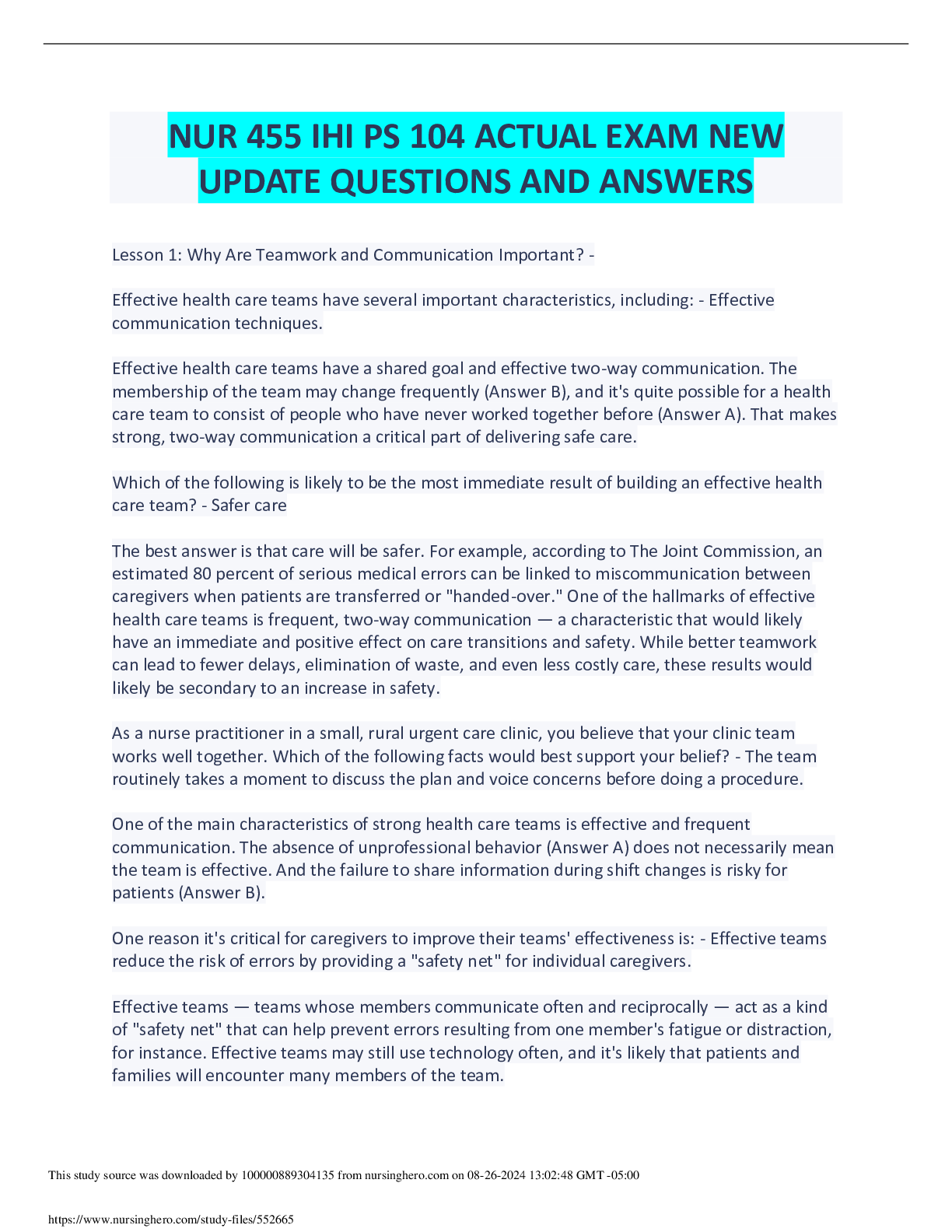
Effective health care teams have several important characteristics, including:
(A) The ability to rehearse procedures together, like a choir or a sports team.
(B) Stable memb
...
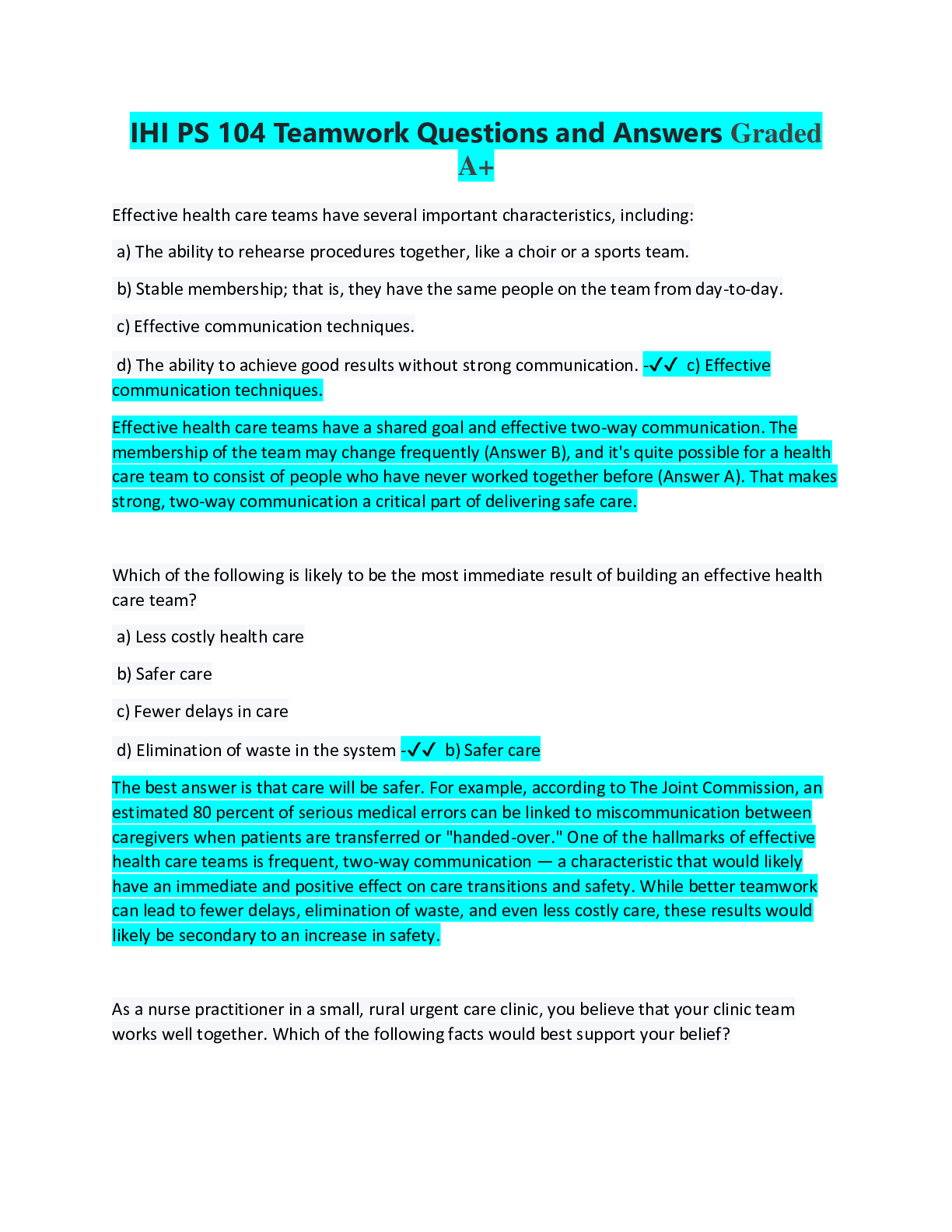
IHI PS 104 Questions and Answers
Graded A
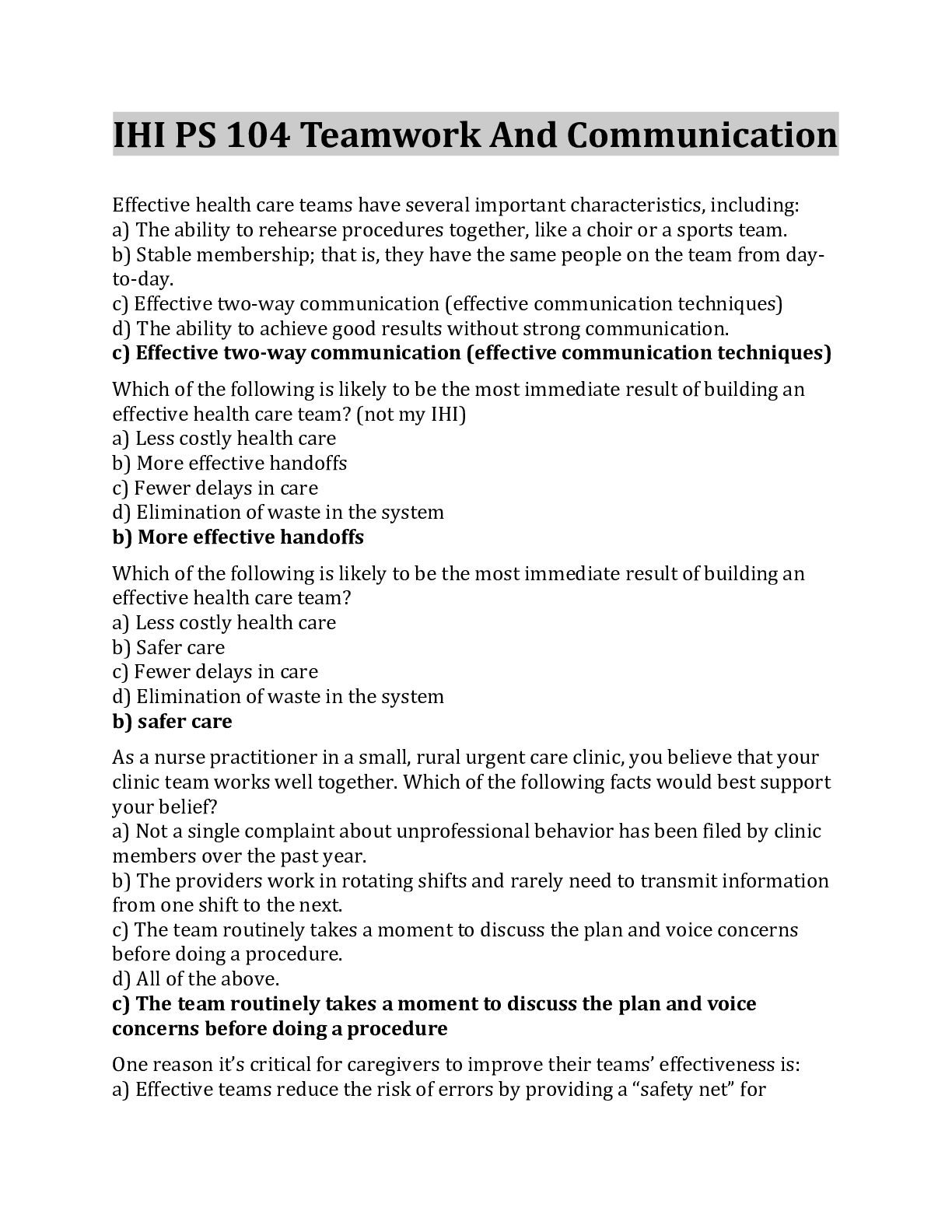
Effective health care teams have several important characteristics, including:
(A) The ability to rehearse procedures together, like a choir or a sports team.
(B) Stable membership; that is, they have the same people on the team from day-to-day.
(C)
Effective communication techniques.
(D) The ability to achieve good results without strong communication.
(C) Effective communication techniques.
Which of the following is likely to be the most immediate result of building an effective health
care team?
(A) Less costly health care
(B) Safer care
(C) Fewer delays in care
(D) Elimination of waste in the system
(B) Safer care
As a nurse practitioner in a small, rural urgent care clinic, you believe that your clinic team
works well together. Which of the following facts would best support your belief?
(A) Not a single complaint about unprofessional behavior has been filed by clinic members over
the past year.
(B) The providers work in rotating shifts and rarely need to transmit information from one shift
to the next.
(C) The team routinely takes a moment to discuss the plan and voice concerns before doing a
procedure.
(D) All of the above.
(C) The team routinely takes a moment to discuss the plan and voice concerns before doing a
procedure.
One reason it's critical for caregivers to improve their teams' effectiveness is:
(A) Effective teams reduce the risk of errors by providing a "safety net" for individual
caregivers.
(B) Effective teams limit the number of caregivers patients have to speak with, reducing
confusion among patients and families.
(C) Teams rely less on technology and more on human capabilities, thus leading to better care.
(D) All of the above
(A) Effective teams reduce the risk of errors by providing a "safety net" for individual
caregivers.
When considering your role within a health care team, it is important to keep in mind that:
(A) No matter what profession you belong to, you will be a member of the team and must work
intentionally toward making that team effective.
(B) You may be part of a team, but will likely be able to work autonomously without much input
or help from others.
(C) Teamwork skills will come naturally to you, because we all learn them in other settings.
(D) You will need to be a good team member until you become an expert in your field, at which
point you probably won't need teamwork skills.
(A) No matter what profession you belong to, you will be a member of the team and must work
intentionally toward making that team effective.
A patient's primary care provider (PCP) prescribes him a new diuretic because of a change in his
insurance. It is intended to replace his previous medication. However, when he gets home, he is
confused and takes both the previous and the new diuretic. He becomes dehydrated and ends up
in the hospital. Which of the following process improvements would have been the best option
for the PCP to prevent this adverse event?
Using teach back to confirm patient understanding
Approximately what percentage of serious adverse events in health care can be linked to
miscommunication between caregivers when patients are transferred or "handed-over"?
(A) 5 percent
(B) 20 percent
(C) 50 percent
(D) 80 percent
(D) 80 percent
Which of the following is NOT always a key part of the medication reconciliation process?
Following up with the patient to ensure he or she takes the medication as prescribed
Which is the following statements best describes the role of patients in ensuring safety across the
continuum of care?
Patients often need to be able to act out precise recommendations when they leave the health care
setting for home.
A primary care provider (PCP) refers her patient to a specialist for a sleep study. Which of the
following steps would represent the END of a closed-loop referral process? (Hint: Think of the
nine-step process this lesson recommends)
The PCP discusses the treatment plan with the patient, after communicating about it with the
specialist.
When speaking with a patient who has limited understanding of health care terminology, which
of the following words would you likely want to avoid?
All of the above
it is best to use simple language, and avoid complicated medical terminology or jargon. Each of
these words has a simpler alternative, that is more commonly known. Try saying: “harmful”
instead of “adverse”; “fats” instead of “lipids”; “belly” or “stomach” instead of “abdomen.”
Linda, a pharmacist at an outpatient pharmacy for a medium-sized medical group, receives a call
from John, a nurse practitioner in the cardiology clinic. John tells Linda he needs to call in a new
prescription for hydrochlorothiazide at 50 mg once a day for Ms. Krane. At the end of the
conversation Linda says to John, "Okay, so you want Ms. Joanne Krane to have a new
prescription for hydrochlorothiazide at 50 mg by mouth once a day. Thirty pills and six refills."
What has Linda just done?
(A) Increased the likelihood of error by repeating an order
(B) Provided a read back
(C) Used SBAR in communication
(D) B and C
(B) Provided a read back
00:02
01:22
ou are a member of an intensive care unit team in a regional hospital. This morning, a patient had
an unexpected severe allergic reaction (anaphylaxis) after being given a penicillin derivative.
There was a significant delay in getting the physician involved and beginning treatment for this
life-threatening condition. Fortunately, the patient is now stable and does not seem to be
experiencing any lasting effects.
At this point, what would an effective team leader do?
(A) Report this adverse event in the anonymous reporting system so that it can be investigated
(B) Ask administrators to launch an investigation immediately to find out who was responsible
for this adverse event
(C) Add this medication to the patient's allergy list
(D) Conduct a debriefing
(D) Conduct a debriefing
ou are a member of an intensive care unit team in a regional hospital. This morning, a patient had
an unexpected severe allergic reaction (anaphylaxis) after being given a penicillin derivative.
There was a significant delay in getting the physician involved and beginning treatment for this
life-threatening condition. Fortunately, the patient is now stable and does not seem to be be
experiencing any lasting effects.
The unit leaders are trying to figure out what changes they should make to prevent this treatment
delay from happening again. Given what you know about the incident, what change would you
recommend?
(A) Implement mandatory debriefings after the team works together on a patient.
(B) Fire the physician who failed to respond in a timely way.
(C) Stop using nursing assistants in the ICU.
(D) Implement the use of critical language in the ICU.
(D) Implement the use of critical language in the ICU.
Effective team leaders:
(A) Have multiple degrees.
(B) Are usually physicians.
(C) Seek input from all members of the team.
(D) Know the correct answer in any given situation.
(C) Seek input from all members of the team.
In health care, briefings:
(A) Are of limited effectiveness.
(B) Are a type of structured communication.
(C) Involve only doctors and nurses.
(D) Need to take place as soon after an event as possible, to maximize learning for the entire
group.
(B) Are a type of structured communication.
When you arrived at the unit today and listened to the change of shift report, you heard about a
patient named Jane W. According to the tape-recorded signout, Jane "is a 57-year-old woman
with abdominal pain and vomiting. She has pain medications ordered p.r.n. [as needed]." During
your shift, Jane does not request pain medications. Near the end of your shift, however, you get a
call from Jane's daughter. Distraught, she asks why nobody is treating her mother's pain. When
you explain that Jane has not requested any pain medications, her daughter exclaims, "But she's
had a stroke! She can't use the call light! What kind of place are you running over there?"
How might the transition between providers ("hand-over") have contributed to this situation?
(A) The handoff was too brief and failed to include important information.
(B) The handoff was hard to understand.
(C) You weren't paying close attention to the information you were being given.
(D) You had no opportunity for verbal repeat back.
(A) The handoff was too brief and failed to include important information.
Which of the following actions is essential for closed-loop communication?
(A) The sender gives a great deal of detailed information to the receiver, making sure not to
leave anything out.
(B) The receiver responds to all information, even if it is only with an "okay" or "uh-huh," to
acknowledge that he has heard the sender.
(C) The receiver repeats to the sender what he has heard.
(D) None of the above is essential.
(C) The receiver repeats to the sender what he has heard.
Effective structured communication:
(A) Must be initiated by the team leader.
(B) Includes SBAR, briefings, and debriefings.
(C) Is more important for nurses than for physicians.
(D) Includes email, text messaging, and debriefings.
(B) Includes SBAR, briefings, and debriefings.
[Show More]
.png)

.png)
.png)
.png)
.png)
.png)
.png)
.png)




.png)
.png)