N113 Postpartum care
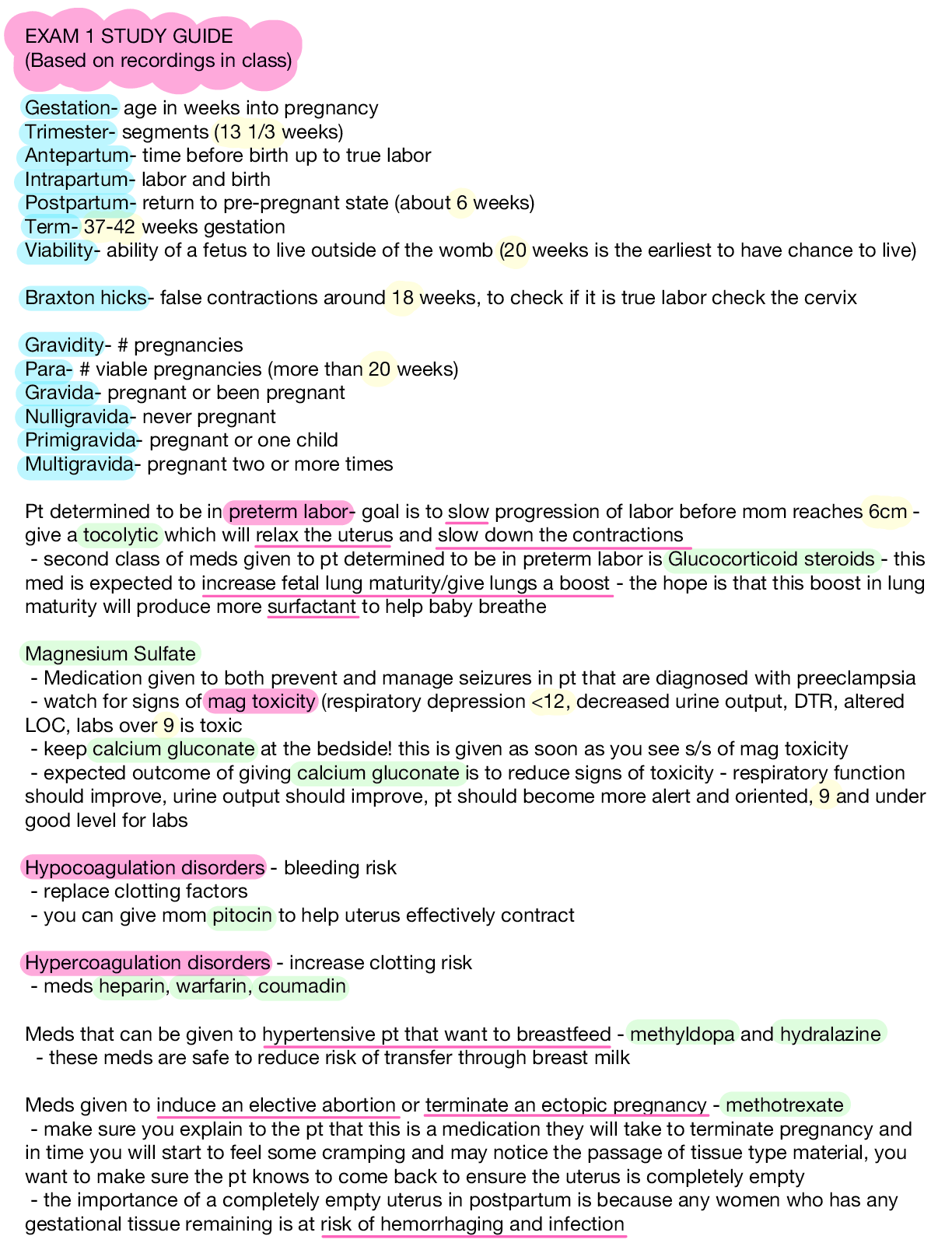
N113 - Postpartum Assessment & Care
Question Answer
What is postpartum?
From the delivery of the placenta
& membranes to the return of a
woman's reproductive system to
its non-pregnant state -
...
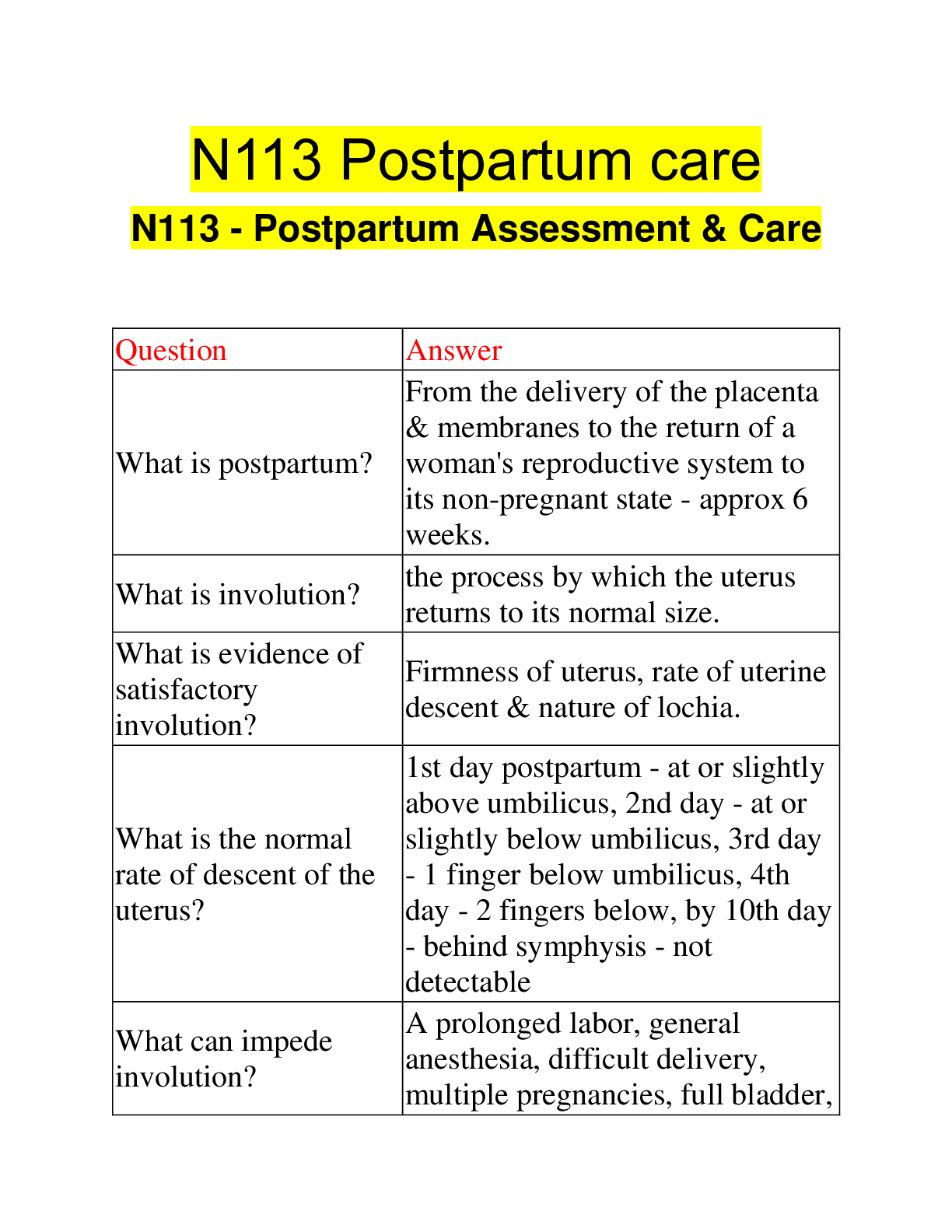
N113 Postpartum care
N113 - Postpartum Assessment & Care
Question Answer
What is postpartum?
From the delivery of the placenta
& membranes to the return of a
woman's reproductive system to
its non-pregnant state - approx 6
weeks.
What is involution? the process by which the uterus
returns to its normal size.
What is evidence of
satisfactory
involution?
Firmness of uterus, rate of uterine
descent & nature of lochia.
What is the normal
rate of descent of the
uterus?
1st day postpartum - at or slightly
above umbilicus, 2nd day - at or
slightly below umbilicus, 3rd day
- 1 finger below umbilicus, 4th
day - 2 fingers below, by 10th day
- behind symphysis - not
detectable
What can impede
involution?
A prolonged labor, general
anesthesia, difficult delivery,
multiple pregnancies, full bladder,
infection, retention of placental
fragments.
What is the #1
postpartum concern? Hemorrhage
What are S/S of
hemorrhage?
Increase pulse rate, decrease in
BP, excessive bright red bleeding,
boggy uterus that does not
respond to massage, unusual
pelvic discomfort or back pain,
cold, clammy skin
What are the panic
levels for H&H?
Hb <5.0g/dl & Hct of <20%,
hemoglobin will decrease 1 to 1.5
g/dl & hematocrit will decrease 2-
4% per 500 ml of blood loss
What are the early or
immediate causes of
hemorrhage?
blood loss greater than 500 ml in
first 24 hrs caused by uterine
atony, laceration of the genital
tract, retained placenta, adherent
placenta.
What are later causes
of hemorrhage?
Retained placenta and infection
are the most common causes.
What is lochia?
the decidua (lining) which is cast
off down to myometrium, a new
endometrium is formed
What is lochia rubra
and how long does it
last?
Bright red, tends to clot,
serosanguineous, becoming more
serous and less bloody - last 1-3
days.
What is lochia serosa
and how long does it
last?
Dark red (or pinkish) to brond,
sheds of decidua, looks less like
blood - lasts 3-10 days
What is lochi alba and
how long does it last?
Whitish/yellowish discharge -
lasts 10-14 days, may last 3-6
weeks and remain normal.
What is diastasis
abdominis?
separation of the rectus abdominis
muscles may occur leaving part of
abdominal wall with no support
except skin, subcutaneous fat,
fascia & peritoneum.
Why is bathing so
important?
There is an increased risk for
infection during postpartum.
What is an
episiotomy?
A surgical incision of the perineal
body - assess using REEDA -
redness, edema, echymosis,
discharge, approximation
What is a laceration? A tear in the perineal body which
occurs in varying degrees.
1st degree laceration tear through skin & structures that
are superficial to muscle
2nd degree laceration extends through perineal muscles
- much like an episiotomy
3rd degree laceration continues through anal sphincter
muscle
4th degree laceration involves anterior rectal wall
Sulcus tear tear into the tissue of the vagina
What are some
concerns involving the
bladder?
Pt should void within 6-8 hours
following delivery, check for
bladder distention if less than
adequate amount voided -
retention with overflow
What can cause bowel
dysfunction?
Delay in bowel function can be
due to loss of abdominal muscle
tone, fear of pain, sluggishness
due to progesterone effect on
smooth muscle function.
Are there any dietary
restrictions following
delivery?
Vaginal deliveries can have
normal diet, have increased thirst
due to fluid loss & medications.
C-sections start on clear liquids
until bowel sounds or flatus are
present.
How ofter should
vitals be checked after
delivery?
Q15 minutes for 1st hour, q30
minutes for 2nd hour, q4 hours for
24 hours then q8 hours.
What are considered
the standard vital
signs?
Temp, resp, pulse, BP, lochia,
fundus & appearance of sutures
What does BUBBLE
HE stand for?
Breasts, uterus, bladder, bowel
function, lochia, episiotomy (or
laceration) Homnam's sign,
emotional status.
How are the breasts
assessed?
Are they soft, firm or filling? Any
discharge - type & amount,
Nipples cracked/lesions? Unusual
contour?
How is the uterus
assessed?
Is it firm? Is it descending?
Location & position in abdomen
How is the bladder
assessed?
Assess for position and size.
Teach S/S of infection, teach
proper pericare
How is the bowel
assessed?
Check for flatus/bowel sounds,
rectal pressure. Teach need for
extra fluids, fiber
How is lochia
assessed?
Assess for amount: scant, light,
moderate, heavy, excessive, assess
for odor, clots
How is an episiotomy
or laceration assessed?
Assess for redness, edema,
echymosis, discharge &
approximation
What is assessed in
regards to emotional
status?
Is the mother dependent or
independent? Is she depressed, is
she bonding with the baby, does
she understand whats going on?
What does antepartum
mean?
The time between conception and
onset of labor, used
interchangeably with prenatal
What does intrapartum
mean?
The time between the beginning
of labor and the birth of the infant.
What does puerperium
or postpartum mean?
Time from birth of infant until
woman's body returns to
essentially prepregnant state.
What does para mean?
The number of pregnancies in
which the fetus has reached 20 or
more weeks gestation when they
are born regardless of live or still
born.
What does abortion
mean?
Birth that occurs prior to the 20
weeks, either selective or
spontaneous. Therapeutic - done
to save mother or non-viable
fetus.
What is preterm or
premature labor?
Labor that occurs after 20 weeks
but before completion of 37
weeks.
What is considered a
term pregnancy?
A pregnancy from the beginning
of 38 weeks of gestation to the
end of 42 weeks
What does TPAL
stand for?
TPAL replaces para & gives more
information. T = term infants, P =
preterm infants, A = abortions
(spontaneous or selective), L =
currently living children
What is considered a
still birth?
A baby born dead at 20 or more
weeks gestation.
What is a neonate? First 28 days after birth.
What is viability? Capacity to live outside the uterus
- about 22-25 weeks gestation.
What is placenta
accreta?
Slight penetration of placenta into
the myometrium
What is placenta
increta?
Deep penetration of the placenta
into the myometrium
What is placenta
percreta?
Perforation of the uterus by the
placenta.
What is hydroamios &
macrosomia and how
does it affect the
uterus?
Hydraminos is too much amnionic
fluid, macrosomia is a large baby.
Both stretch the uterus more than
normal and make it hard for the
uterus to contract after birth.
How are hematomas
related to delivery?
There is an injury to a blood
vessel, vulvar, vaginal,
subperitoneal causing a collection
of blood in the pelvic tissue, can
lead to postpartum hemorrhage.
What are S/S of a
hematoma?
Vulvar - most common & most
can be seen, Upper vaginal -
difficulty voiding due to pressure
on urethra or meatus, Upward -
severe lateral uterine pain, flank
pain, abdominal distention. May
have S/S of shock without blood
loss & a well contracted uterus.
What is the first sign
of infection? Presence of a fever of 100.4
What can happen to
the infant if infection
is present?
Leading cause of newborn sepsis
& meningitis, infant infected
through vaginal birth, can lead to
death or severe neurological
damage. Routine screening done
at 32-36 weeks. Ampicillin or
gentamycin can be given during
labor.
What is metritis? Infection of the muscle of the
uterus
What is endometritis? Infection at the placental site
What is parametritis? Infection of the pelvic connective
tissue.
What is salpingitis &
ooporitis? Infection of the tubes & ovaries.
What is
thrombophelpitis?
An infection of the lining of a
vessel in which a clot attaches to
the vessel wall.
What are the classic
signs of a polmonary
emboli?
Sudden onset of SOB, chest pain,
tachypnea, dyspnea,
apprehension, cough, hempotysis,
diaphoresis, fever, circumoral
cyanosis.
What causes an
amniotic fluid
embolism?
A small tear in the amnion or
chorion high in the uterus allows
fluid to enter maternal circulation.
What is disseminated
intravascular
coagulation?
The coagulation sequence is
activated by injury to the
epithelium, or by bacterial
particles or other foreign material.
The result is disseminated clotting
causing organ damage due to
small clot occluding capillaries
and consumptions of clotting
factors.
What are the
psychological
adjustment stages?
Taking in, taking hold and letting
go.
What are the
characteristics of the
taking in phase?
Consists of days 1-3, pts are
passive & dependent, preoccupied
with own needs, talkative,
identifying and interpreting infant,
gentle finger touch.
What are the
characteristics of the
taking hold phase?
Consists of days 3 to 2 weeks. Pts
resume control of life, concern
with control of body functions,
worry about quality and quantity
of breast milk and ability to feed
baby.
What are the
characteristics of the
letting go phase?
Accept and realize the physical
separation of infant and relinquish
role of childless individual.
Challenge - extreme exhaustion of
night time care and sleep
deprivation, anticipatory guidance
needed regarding the realities of
motherhood.
What are postpartum
or baby blues?
Can occur 1-2 weeks after birth,
often peaks around 5th day and
subsides by 10th day - believed to
be related to hormone levels.
Exhaustion is rated as one of the
top causes.
How does postpartum
depression differ from
baby blues?
Symptoms persist longer than 2
weeks and intensify.
What can cause an
elevated temp?
A temp elevated to 100.4* in the
1st 24 hours post delivery can be
due to exertion & dehydration.
What is mastitis?
An infection of the breast tissue.
More common in breast feeding
mothers.
[Show More]