N113 Neonatal
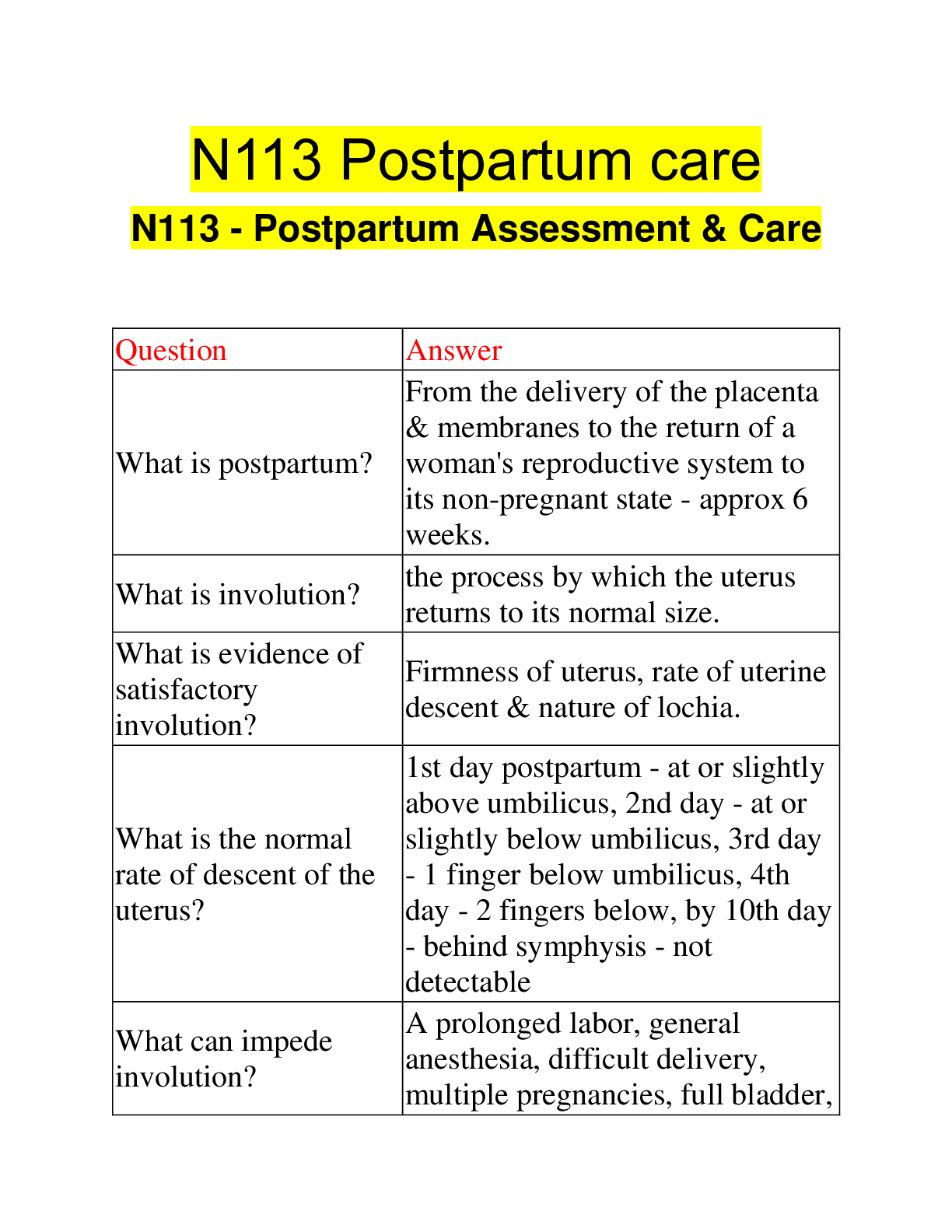
N113 - Neonatal transition
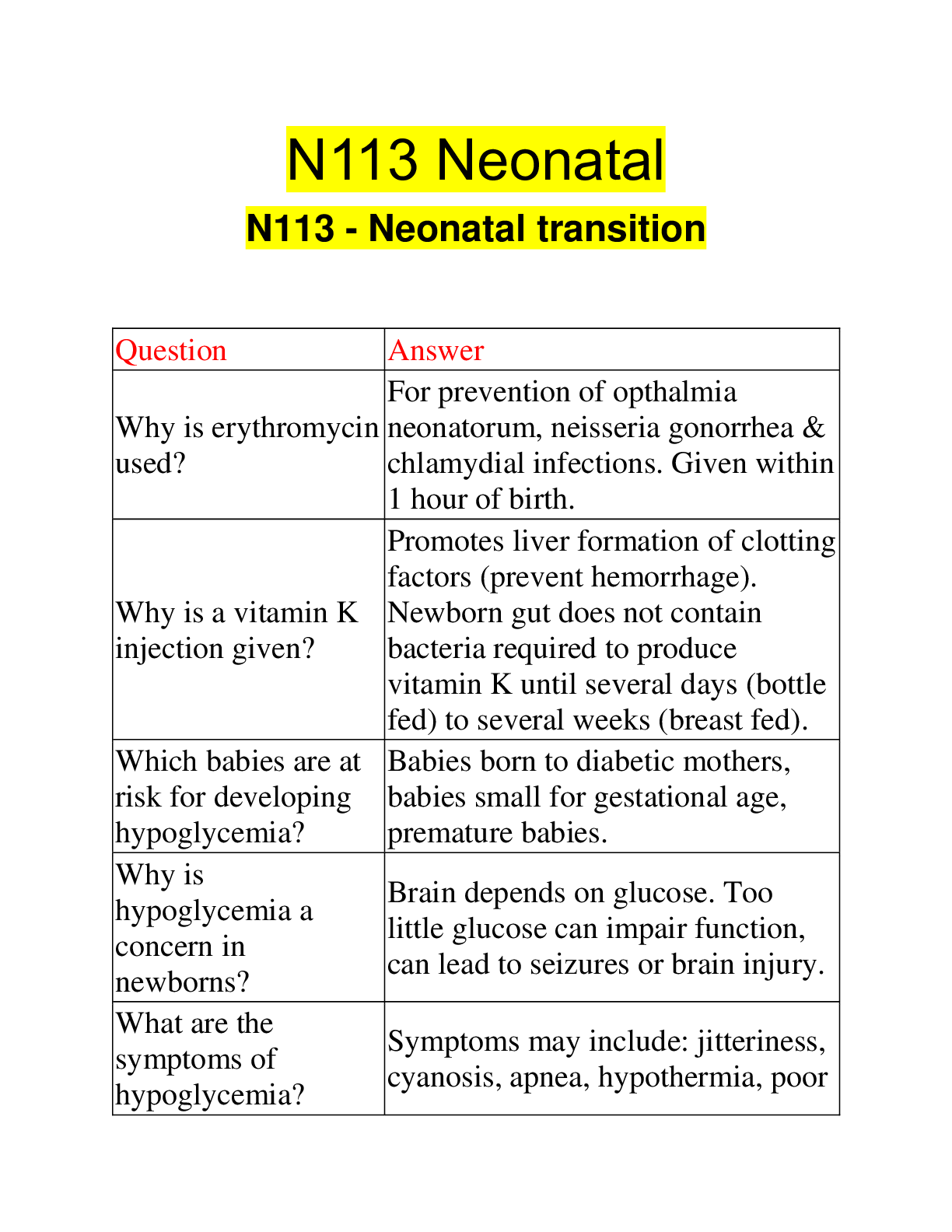
Question Answer
Why is erythromycin
used?
For prevention of opthalmia
neonatorum, neisseria gonorrhea &
chlamydial infections. Given within
1 hour of birth.
Why is a vita
...
N113 Neonatal
N113 - Neonatal transition
Question Answer
Why is erythromycin
used?
For prevention of opthalmia
neonatorum, neisseria gonorrhea &
chlamydial infections. Given within
1 hour of birth.
Why is a vitamin K
injection given?
Promotes liver formation of clotting
factors (prevent hemorrhage).
Newborn gut does not contain
bacteria required to produce
vitamin K until several days (bottle
fed) to several weeks (breast fed).
Which babies are at
risk for developing
hypoglycemia?
Babies born to diabetic mothers,
babies small for gestational age,
premature babies.
Why is
hypoglycemia a
concern in
newborns?
Brain depends on glucose. Too
little glucose can impair function,
can lead to seizures or brain injury.
What are the
symptoms of
hypoglycemia?
Symptoms may include: jitteriness,
cyanosis, apnea, hypothermia, poor
body tone, poor feeding, lethargy,
seizures.
How is a newborn
treated for
hypoglycemia?
May be as simple as giving
glucose/water mixture or formula.
Baby may require a glucose IV.
Glucose levels are closely
monitored after treatment for
recurrence.
What is considered a
low glucose level in
newborns?
In most cases 40 mg/dl, some will
go as low as 20 mg/dl.
What is APGAR
scoring?
It assess 5 characteristics of the
newborn: appearance-color, pulseheart rate, grimace-irritability,
activity-muscle tone, and
respirations-respiratory effort.
How often is
APGAR scoring
done?
At 1 and 5 minutes. If problems
continue, can be done again at 10
minutes.
How is the central
nervous system
assessed in a
newborn?
Moves extremities, symmetric
features & movements, reflexes
intact & appropriate, anterior
fontanel soft & flat, spinal column
completely closed
How is the
cardiovascular
Heart rate strong & regular - 120-
160, as low as 100 when sleeping,
as high as 180 when crying, no
system assessed in a
new born?
murmurs, pulses strong/equal
bilaterally, cord with 2 arteries & 1
vein, color overall pink.
How is the
respiratory system
assessed in a
newborn?
Lungs clear to auscultation, no
retractions or nasal flaring, rate 30-
60 breaths per/min, chest expansion
symmetric, no upper airway
congestion.
How is the
genital/urinary
system assessed in a
newborn?
Male - urethral opening at tip of
penis, testes descended bilaterally.
Female - vaginal opening apparent.
How is the GI
system assessed in a
newborn?
Abdomen is soft, no distention,
cord attached & clamped, anus
patent - 1st meconium stool
How is the ears, nose
& throat assessed in
a newborn?
Eyes clear, palates intact, nares
patent, symmetry, top of ears align
with outer canthus of eyes.
How is the
integument system
assessed in a
newborn?
Color - pink or acrocyanotic, no
lesions or abrasions, no peeling,
birthmarks, caput/molding, vacuum
'cap', forceps marks
When are the
alveolar ducts
developed?
Between 20-24 weeks, determines
viability and ability for newborn to
breathe.
At what age do the
type 1 & type II cells
differentiate?
Between 24-28 weeks, type I -
respiratory gas exchange, type II -
provide synthesis & storage of
surfactant.
What is surfactant?
A group of surface-active
phospholipids - lecithin &
spingomyelin, critical for alveolar
stability.
What mechanical
events take place in
the respiratory tract?
1/3 of fluid is squeezed out by
movement through the birth canal
by chest compression. Remaining
fluid must be suctioned out. All
fluid is suctioned with C-section
babies.
What chemical
events take place in
the respiratory tract?
First breath is an inspiratory gasp,
triggered by the cord being clamped
off. CO2 increases which stimulates
the aortic & carotid
chemoreceptors.
What is the ductus
venosus?
It is a shunt that bypasses the liver,
shunting blood directly to the
inferior vena cava.
What is the foramen
ovale?
It bypasses the lungs, it is an
opening between the right & left
atrium.
What is the ductus
arteriosis?
It bypasses the lungs also, it is an
opening between the pulmonary
artery & aorta.
When does the
ductus venosus
close?
It closes with clamping of cord,
permanently fibroses in 1 week.
When does the
foramen ovale close?
Closes when pressure in LA
becomes higher than RA.
Permanently closed by 3 months.
When does the
ductus arteriosis
close?
Constricts within minutes of birth,
complete closure in 10-15 hours.
Permanently closes by 3 weeks.
What hematologic
differences occur in
a newborn?
Infant has increased RBC's and
increased H&H which enables cells
to receive enough O2. Newborn
RBC's have shorter life span and
breakdown releases bilirubin
causing jaundice.
What factor can
impact fetal blood
volume?
Delayed cord clamping can cause
an increase in fetal blood volume.
What are the liver
functions after birth?
Maintenance of blood glucose
levels, production of clotting
factors, iron storage, metabolism of
drugs.
What is conjugated
bilirubin?
Conversion of yellow lipid-soluble
pigment into water-soluble
pigment.
What is
unconjugated
bilirubin?
A breakdown product derived from
hemoglobin that is released
primarily from destroyed RBC's -
NOT an excretable form and
potential toxin.
What are sources of
bilirubin?
Physiologic destruction of RBCs -
normal & pathologic destruction of
RBCs - abnormal
What is physiologic
jaundice?
Never present during first 24 hrs of
life, appears on 2nd or 3rd day.
Considered normal if level doesn't
get too high.
What is
breastfeeding
jaundice?
Develops due to insufficient intake
during first few days. Meconium
not eliminated, which is high in
bilirubin.
What is pathologic
jaundice?
Always abnormal. Occurs during
first 24 hours, clinical significance
depends on age. Major contributing
factor is incompatibilities between
mother & infant blood type.
How are jaundice
levels read?
Jaundice levels increase
corresponding to the newborns age.
A higher level in a 3 day old is
acceptable when the same level
would be unacceptable in a 2 day
old.
What digestive
enzyme is a newborn
lacking?
Pancreatic lipase, which is used to
digest fats. Lipase is found in breast
milk. The fats in breast milk are
easier to digest than those in
formula.
What can difficulty
coordinating
suck/swallow
signify?
May indicate cardiac abnormality
or tracheoesophageal fistula - may
drool.
What is conductive
heat loss?
Heat transferred from a heat source
(neonate) to an object that is colder
when the two are in contact.
What is convective
heat loss?
Loss of heat by air movement -
open door, air conditioning vent
What is evaporative
heat loss?
Heat loss related to moisture on
skin, wet linens or clothes.
What is radiant heat
loss?
Heat loss between a warm surface
(neonate) and cold room.
How will a newborn
combat cold stress?
Metabolic rate will increase.
Increased metabolism leads to
increased heat produced in body.
Oxidation of brown fat, reserves are
normally available for several
weeks.
What position will
conserve heat loss in
newborn?
Flexed position, arms and legs
drawn up under abdomen.
What happen during
cold stress?
Increased metabolic rate increases
demand for O2. O2 & energy are
diverted from normal function. If
demand for O2 can't be met,
respiratory distress syndrome can
occur.
When does a fetus
begin producing
urine?
At 12 weeks gestation, by 2nd half
of pregnancy - fetal urine is major
source of amniotic fluid.
When are the
kidneys completely
developed?
By 35 weeks gestation. Still more
difficult for newborn to concentrate
urine (high levels of H2O in urine),
may lead to dehydration, acidosis &
over hydration.
What happens during
the 1st period of
reactivity?
Occurs during 1st 30 minutes after
birth. Best time for bonding &
breast feeding. Infant is alert,
startles easy, cries, exploratory
behavior. Respirations are irregular,
possible grunting & nasal flaring.
How long does the
period of inactivity
last?
Can last anywhere from 60-100
minutes, decrease in motor activity.
Baby will likely sleep.
What happens during
the 2nd reactivity
phase?
Occurs during 4th to 8th hour after
birth. Lasts from 10 minutes to
several hours. Increase in muscle
tone, skin color & mucus
production. Meconium is frequently
passed at this time.
What is deep sleep?
Baby is very quiet with very little
movement, no facial or eye
movement. Breathing is smooth &
regular, very difficult to awaken.
What is light sleep?
Active sleep, eye fluttering & body
movements. Breathing is shallow &
irregular. Baby may make crying or
fussing sounds. Baby may console
self back to sleep. Babies spend
most of their sleep time in this
state. Can be aroused easily.
What is the quiet
alert state?
Time when baby is still and ready
for interaction. May smile and
follow objects with eyes. Best time
for parent interaction - talking,
singing, playing
What is habituation?
Ability to process and respond to
stimuli - neonatal defense
mechanism.
What is orientation? Ability to be alert, follow and fixate
on visual stimuli.
What is IgG?
Only immunoglobulin to cross
placenta, active against bacterial
toxins.
What is IgA?
Does not cross the placenta and not
adequate until 4 to 6 weeks of age.
Present in colostrum & breast milk.
Protects the respiratory & GI
systems. This is the reason infants
are susceptible to respiratory & GI
infections.
What is IgM?
Produced by gram negative enteric
organisms & some viruses. Does
not cross the placenta, produced by
fetus at 10-15 weeks gestation. If
elevated, may indicate intrauterine
exposure to bacteria.
What is active
acquired immunity?
Formation of antibodies in response
to an illness or immunization.
What is passive
acquired immunity?
Results when IgG antibodies are
passed from mother to fetus. Very
active against bacterial toxins,
passed in 3rd trimester.
What antibodies are
found in breast milk?
IgA, IgG & IgM are all found in
breast milk, the most important one
is IgA.
What is congenital
adrenal hyperplasia
(CAH)?
Defect in an important enzyme, can
cause dehydration, shock or even
death. Early treatment can prevent
medical problems.
What is congenital
hypothyroidism?
Babies lack a thyroid hormone. Can
cause poor growth or mental
retardation, can be treated
medically.
What is
galactosemia?
Babies cannot digest galactose.
Galactose is a simple sugar found
in breast milk & many formulas.
Can cause eye damage, liver or
brain damage. Baby must be given
milk-free formula.
What is maple syrup
urine disease?
Babies cannot digest part of a food
protein. Can cause severe mental
retardation or even death. Babies
require a special formula & diet.
What is
phenylketonuria?
Babies cannot digest a different part
of food protein. Can cause nerve &
brain cell damage and lead to
mental retardation. Babies get
special formula and diet.
[Show More]