N113 Newborn
N113 - Newborn care & assessment
Question Answer
What are normal head
circumferences?
13-14 inches, 1 inch larger than
chest circumference.
What are normal chest
circumferences? 12-13 inches
What is
...
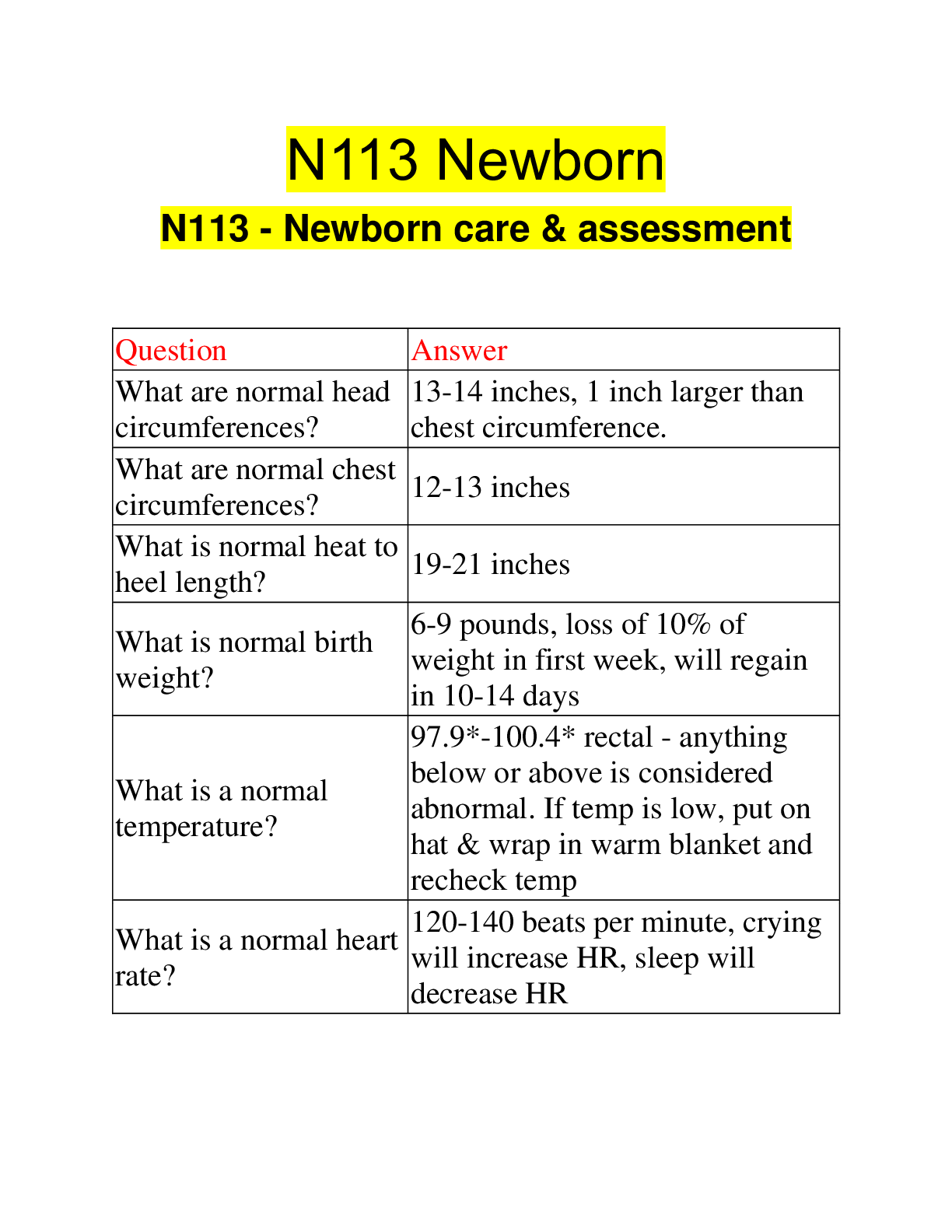
N113 Newborn
N113 - Newborn care & assessment
Question Answer
What are normal head
circumferences?
13-14 inches, 1 inch larger than
chest circumference.
What are normal chest
circumferences? 12-13 inches
What is normal heat to
heel length? 19-21 inches
What is normal birth
weight?
6-9 pounds, loss of 10% of
weight in first week, will regain
in 10-14 days
What is a normal
temperature?
97.9*-100.4* rectal - anything
below or above is considered
abnormal. If temp is low, put on
hat & wrap in warm blanket and
recheck temp
What is a normal heart
rate?
120-140 beats per minute, crying
will increase HR, sleep will
decrease HR
What are normal
respiration?
30-60 breaths per minute, crying
will increase RR, sleep will
decrease RR
What posture should a
newborn have?
Flexion of head and extremities,
which rest on chest & abdomen.
How is a frank breech
different?
Extended legs, abducted and fully
rotated thighs, flattened occiput,
extended neck
How should the skin
look in a newborn?
Bright red, puffy & smooth at
birth. Second to third day, pink,
flaky & dry. Vernix caseosa will
be present, more in preterm, less
in past due infant.
What is acrocyanosis? Cyanosis of the hands and feet.
What is milia?
Distended sebaceous glands that
appear as tiny white papules on
cheeks, chin & nose.
How should the
anterior fontanel
appear?
Should be diamond shaped,
sunken fontanel is a sign of
dehydration, closes at approx 18
mos
How should the
posterior fontanel
appear?
Should be triangular, closes
earlier than anterior fontanel
What is caput
succedaneum?
Swelling that crosses the midline
of the cranium
What is
cephalhematoma?
Hemorrhage of blood between the
periosteum & skull bone - doesn't
cross midline
What is the pilonidal
cyst or sinus?
Small dimple near tailbone. Make
sure its not an actual opening.
What can quivering or
momentary tremors
indicate?
Can be sign of low blood sugar or
something more serious.
What are the important
reflexes?
Sucking, gag, rooting, grasp,
babinski, Moro, Startle,
Asymmetric tonic neck, Dance or
step.
What is the sucking
reflex?
Sucking movements in response
to stimulation, persists throughout
infancy even without stimulation
such as during sleep.
What is the rooting
reflex?
Stroking the cheek causes infant
to turn head toward that side and
begins to suck. Should disappear
around 3-4 months, but can
remain until 12 months.
What is the grasp
reflex?
Touching palms of hand or soles
of feet causes digits to flex,
palmar grasp lessens after 3
months - replaced by voluntary
movement. Plantar grasp lessens
by 8 months of age.
What is the babinski
reflex?
When stroking the sole of the foot
causes toes to hyper extend -
disappears after age of 1
What is the moro
reflex?
Sudden jarring or change in
equilibrium causes sudden
extension & abduction of
extremities and fanning of
fingers, disappears after age of 3-
4 months
What is the startle
reflex?
A sudden loud noise causes
abduction of the arms with
flexion of the elbows, hands
remain clenched, disappears by 4
months
What is the
aysmmetric tonic
neck?
When infant's head is turned to
one side, arm and leg extend on
that side & opposite arm & leg
flex. Disappears by age 3-4
months replaced by symmetric
positioning.
What are the neonatal
signs of low blood
sugar?
Jitteriness, tremors, twitching,
weak or high pitched cry,
lethargy, limp
What is routine
circumcision care?
Post-circumcision, check for
bleeding q15 min for 1st hour,
then q 1 hour x 4 hours
What is the
recommended way to
breast feed?
Chest to chest, chin to breast - use
pillows for support.
How do you know the
baby is getting enough
to eat?
6 to 10 wet diapers & 1 bm per
day
How is LATCH used
in charting
breastfeeding?
L - latch, A - audible swallowing,
T - type of nipple, C - comfort
(breast/nipple), H - hold
(positioning)
What teaching should
be given for nonbreastfeeding mothers?
Do not stimulate or manipulate
breasts, avoid warm water on
breasts, do not let shower water
hit breasts, wear well-fitting
supportive bra, no supply,
demand will dry up.
What should the
mother do when the
milk comes in?
Use breast binder, ice packs,
Tylenol
What are some
warning signs for a
newborn?
No urine in first 24 hours, no bm
in first 48 hours, temp, rapid
breathing over 60 per/min,
retractions, wheezing, odor,
drainage or bleeding from
ublilical stump, yellow coloring
[Show More]